


Examining the conditions that produce decisions.
A decision can make sense in isolation and still contribute to a recurring organizational problem.
A leadership team agrees on a priority but struggles to act. A capable employee repeats a behavior that additional training has failed to change. A commercial organization generates activity without meaningful progress. A new process produces initial improvement, only for familiar problems to return.
Each situation invites an explanation. Sometimes that explanation is correct. Sometimes it is simply the most familiar one.
We look for the person who made the decision, the action that failed, or the procedure that was not followed. We reinforce accountability, introduce new expectations, or provide additional training.
But what happens when the conditions surrounding the decision remain unchanged?
Decision Architecture™ examines the conditions that produce decisions.
Developed by Lynda Nguyen, Decision Architecture™ is an integrative framework for understanding how human judgment, organizational structures, competing needs, and feedback interact to shape decisions and their consequences.
Its purpose is to strengthen decision quality, accountability, adaptability, and organizational learning.
The Conditions Behind the Decision
Every organization has a decision architecture, whether deliberately designed or not.
Information travels through established channels. Certain interpretations gain authority. Incentives influence what people prioritize. Responsibilities shape what individuals believe they can change. Organizational norms determine which questions are welcomed, which concerns are raised, and which assumptions remain unexamined.
Some of these conditions are intentionally established. Others emerge through habit, history, and adaptation.
Together, they influence what people notice, how they interpret events, which alternatives they consider, and how they respond when outcomes differ from expectations.
Consider a recurring delay in cross-functional decision-making.
The immediate explanation might be insufficient accountability. Yet the delay could also involve conflicting priorities, ambiguous authority, incomplete information, or concerns about consequences that have never been openly examined.
Each explanation suggests a different response.
The challenge is to distinguish the visible problem from the conditions sustaining it.
Decision Architecture™ provides a framework for that examination.
Seven Diagnostic Lenses
Decision Architecture™ examines seven interacting dimensions of decision-making.
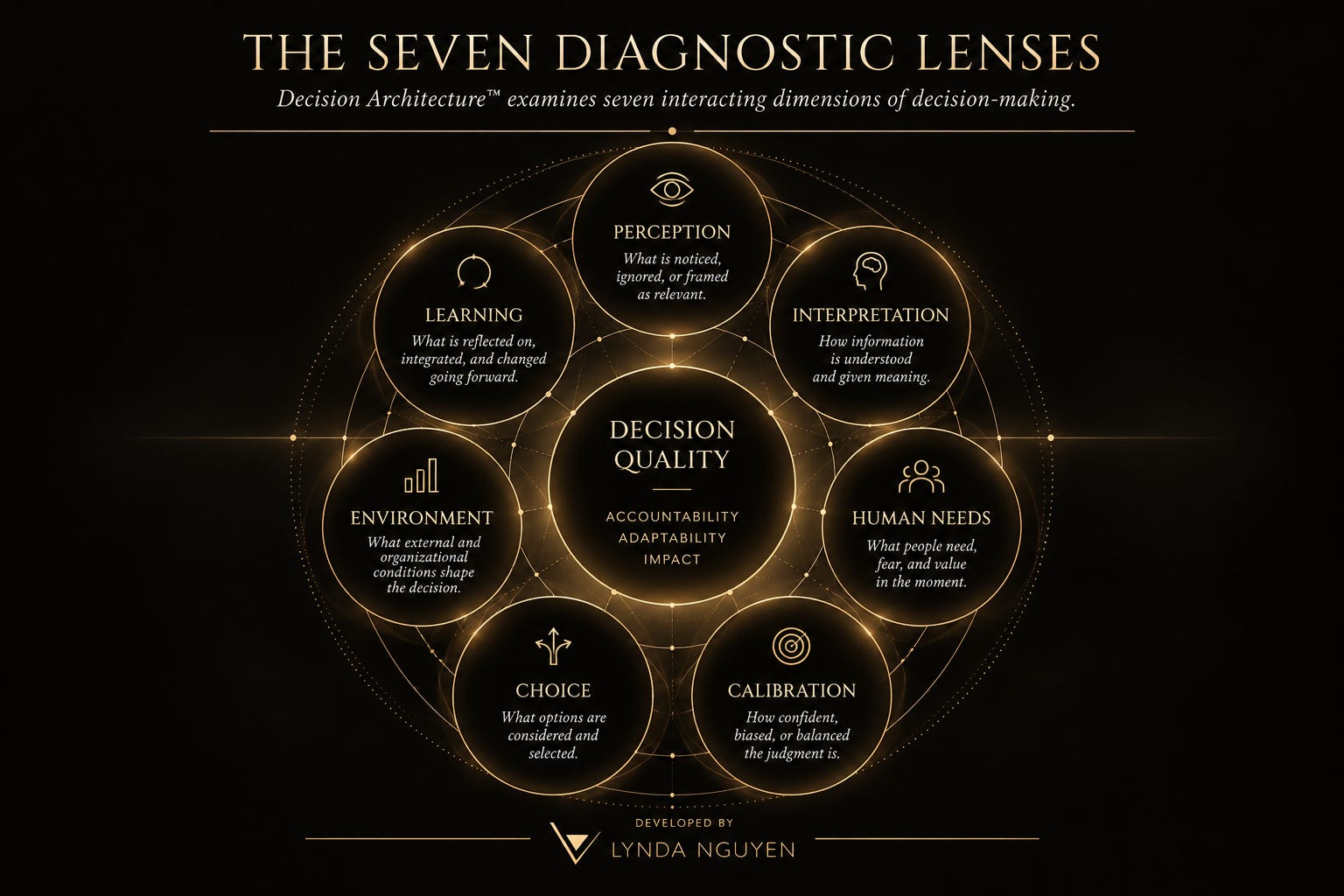
01 — Perception
What becomes visible, receives attention, or remains overlooked?
Decisions are influenced by the information people encounter, the signals they notice, and the information their environment makes available.
02 — Interpretation
How is available information understood?
Experience, assumptions, expectations, and competing explanations influence the meaning people assign to events. The same evidence can produce different conclusions.
03 — Human Needs
What human concerns, responsibilities, and interests influence behavior?
People make decisions while navigating professional obligations, relationships, uncertainty, competing priorities, and legitimate human needs.
04 — Calibration
How well does confidence correspond to evidence?
Sound judgment requires an ongoing relationship between what is believed, what is known, and what remains uncertain.
05 — Choice
What alternatives and trade-offs are available?
Decisions are shaped by perceived options, constraints, authority, consequences, and the willingness to make commitments under uncertainty.
06 — Environment
What surrounding conditions enable, constrain, or reinforce behavior?
Organizational structures, incentives, norms, resources, and decision rights influence what people can realistically do.
07 — Learning
How does experience change subsequent decisions?
Feedback, reflection, and adaptation influence whether organizations improve their judgment or continue reproducing familiar outcomes.
Why the interaction matters
These dimensions do not operate independently or in a fixed sequence.
An organizational environment influences what information becomes visible. That information shapes interpretation. Interpretation affects confidence and the alternatives people consider. The resulting decisions generate outcomes that may reinforce existing assumptions or create opportunities for learning.
Recurring organizational problems can emerge from several interacting conditions rather than a single identifiable cause.
The seven lenses offer different perspectives on the same decision-producing system.
From Examination to Action
Decision Architecture™ includes a five-stage executive protocol for moving from inquiry to action.
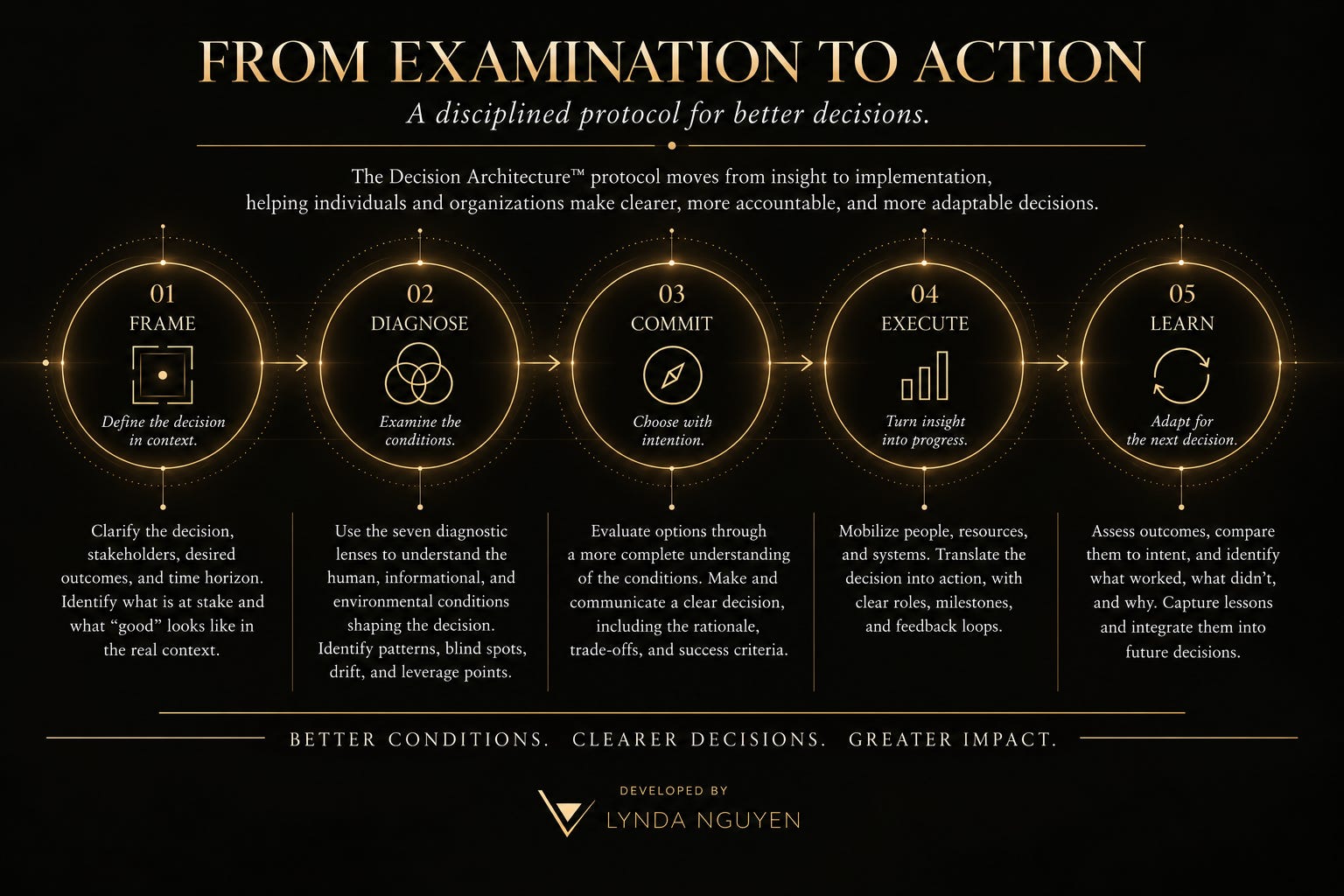
Frame → Diagnose → Commit → Execute → Learn
Frame — Establish the decision, its context, purpose, constraints, and relevant stakeholders.
Diagnose — Examine the conditions and plausible explanations influencing the situation.
Commit — Make a deliberate choice, acknowledging trade-offs, uncertainty, and responsibility.
Execute — Translate the commitment into coordinated action.
Learn — Examine outcomes and incorporate what the evidence reveals into subsequent decisions.
The protocol offers a practical structure for applying executive judgment. The broader framework examines the conditions within which that judgment occurs.
The Decision Conditions Map™
Recurring organizational challenges often generate competing explanations.
The Decision Conditions Map™ is a proprietary diagnostic instrument developed within Decision Architecture™ to support structured examination of observed decisions and the conditions that may be producing them.
Its purpose is to support clearer diagnosis, more deliberate intervention, and learning from results.
The instrument’s detailed assessment methods, calibration procedures, and practitioner resources are maintained within Lynda Nguyen’s advisory practice.
Organizational Applications
Executive Leadership and Governance
Examining strategic alignment, decision authority, accountability, and the conditions influencing consequential leadership choices.
Organizational Effectiveness
Understanding recurring friction, execution delays, coordination challenges, and patterns that persist despite repeated interventions.
Training Quality and Capability Development
Examining how individual capability, organizational expectations, performance evidence, and learning systems interact.
Commercial and Revenue Performance
Exploring how buyers, sellers, managers, and organizations interpret information, navigate uncertainty, and make consequential commercial decisions.
Cross-Functional Collaboration
Understanding how different priorities, responsibilities, information flows, and organizational incentives influence collective action.
Across these applications, the central inquiry remains:
What conditions are producing the decisions we observe, and what might need to change?
Intellectual Foundations
Decision Architecture™ is informed by established scholarship and practice in systems thinking, decision science, behavioral psychology, organizational learning, and leadership.
These fields have long examined the influence of limited information, human behavior, institutional conditions, and feedback on judgment and action.
Decision Architecture™ integrates these perspectives into an applied framework centered on the conditions that produce decisions and the opportunities to improve them.
The framework is a developing professional methodology. Its diagnostic instruments and applications continue to be refined through research, professional practice, and critical examination.
It is not presented as a scientifically validated predictive model or a newly discovered universal theory of decision-making.
About the Creator

Lynda Nguyen
Executive Coach | Strategic Advisor | Creator of Decision Architecture™
Lynda Nguyen works at the intersection of leadership, human behavior, organizational effectiveness, and strategic decision-making.
Her experience spans executive coaching, leadership development, strategic facilitation, and communication. She has also coached more than 60 TED and TEDx speakers, helping individuals communicate complex ideas with clarity and impact.
Decision Architecture™ grew from a question that has shaped her professional inquiry: why do capable individuals and organizations sometimes continue making decisions that produce outcomes they are actively trying to change?
Her work brings attention to the relationship between human judgment and the organizational conditions that influence accountability, execution, and learning.
Explore Decision Architecture™ in Your Organization
When the same challenges return despite capable people, clear intentions, and repeated interventions, the next step may be to examine the conditions shaping those outcomes.
Decision Architecture™ informs Lynda Nguyen’s executive coaching, strategic advisory, and organizational consulting engagements.
Whether your organization is navigating consequential leadership decisions, persistent execution challenges, cross-functional friction, or complex change, an initial conversation can help establish what deserves closer examination.
For executive advisory and organizational inquiries:
Decision Architecture™ and Decision Conditions Map™ are framework and instrument names developed and used by Lynda Nguyen.
© 2026 Lynda Nguyen. All rights reserved.