
Trying Harder Isn’t Working (And What Actually Does)
Most of us assume growth looks like this: more effort, longer hours, a harder push. Work harder. Give more. Try again.
That’s the default 2× mindset — and it’s exhausting.
But the deeper truth?
Most people don’t burn out because they’re incapable. They burn out because they’ve built a life that only works if they keep over-functioning.
Trying harder doesn’t solve that.
It reinforces it.
The Shift: From Effort to Design
Here’s the counterintuitive part:
Trying harder often makes things harder.
Real growth — in work, in love, in leadership — doesn’t come from doing more. It comes from rethinking the structure itself.
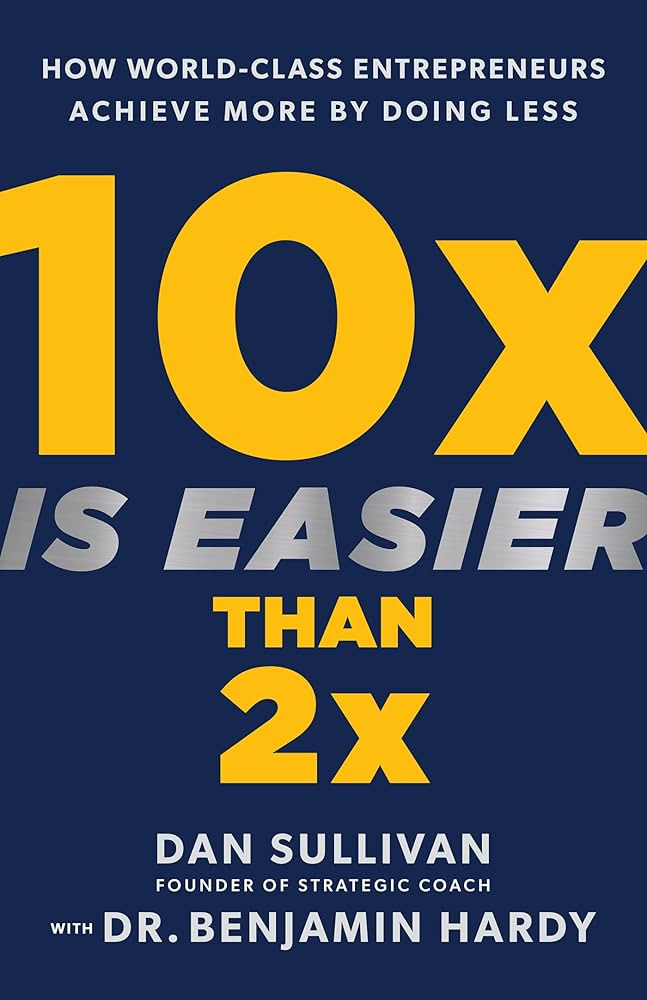
Radical improvement isn’t about adding effort — it’s about designing systems so results happen naturally. That’s where this idea from 10x Is Easier Than 2x by Dan Sullivan and Dr. Benjamin Hardy really lands:
Real growth isn’t about adding effort. It’s about redesigning the system.
It’s the difference between carrying stones across a river…
and building a bridge.
The Identity Behind 2×
2× thinking isn’t just a strategy problem.
It’s an identity pattern.
It often comes from the part of us that believes:
•I have to prove myself
•I need to hold everything together
•If I don’t do it, it won’t get done right
So we compensate: More effort. More control. More responsibility.
But that identity creates a ceiling — because it requires you to constantly overextend to maintain results.
Your Nervous System Knows the Difference
When you’re operating in 2× mode, your nervous system is often in a subtle state of stress:
•managing
•reacting
•anticipating
•pushing
It might look high-functioning on the outside…
but internally, it’s unsustainable.
10× design shifts you into something else entirely:
•clarity
•focus
•trust
•spaciousness
You’re no longer forcing outcomes.
You’re creating conditions where outcomes naturally happen.
10× Thinking at Work
I used to approach work the way most people do — doing everything myself, staying on top of every detail, filling my calendar with meetings and follow-ups.
It worked… until it didn’t.
What shifted wasn’t my effort — it was the design:
•Automating repetitive tasks
•Redesigning workflows so ownership was clear
•Protecting time for deep, high-impact work
I didn’t just get more done.
The work itself moved differently.
•The team stepped up.
•Decisions happened faster.
•Energy wasn’t drained — it was directed.
It felt less like pushing…
and more like turning a system that actually worked.
Micro-shift:
Identify one task this week you can automate, delegate, or redesign — and notice how quickly pressure turns into flow.
10× Thinking in Love
We assume love should be effortless.
But the truth is — connection needs structure.
Most relationships don’t fail from lack of love.
They erode from lack of design.
Not because people don’t care…
but because life gets full, and connection gets left to chance.
10× love isn’t about grand gestures.
It’s about intentional structure — the non-negotiables — that actually supports closeness and connection:
•Weekly rituals — walks, quick check-ins or calls, little notes, small moments that matter
•Consistent, intentional date nights — prioritize them so they don’t get lost in life’s noise
•Mini resets — pause and reconnect before small frustrations build into distance
•Time away together — think 2×2×2: a date night every 2 weeks, a staycation every 2 months, and a longer trip every 1–2 years
These rhythms aren’t rigid rules — they’re reassurance. They tell each other: I choose you. I prioritize us. I see you, even when life is busy or stressful.
And just as important:
•Listening without immediately solving
•Building enough safety that disagreements don’t feel like the end of the relationship.
It’s scaffolding for connection.
Once it’s there, love doesn’t have to fight to survive — it flows.
Micro-shift:
Choose one small, consistent act this week that reinforces connection — something simple, repeatable, and real.
The Deeper Truth
I didn’t realize how much I was over-functioning until I stopped —
and nothing broke.
In fact… things worked better.
Because the goal was never to do more.
It was to stop carrying systems that were never designed to support me in the first place.
The Takeaway
•2× effort exhausts you.
•10× design expands you.
Not because it’s easier —
but because it’s aligned.
So the real question isn’t:
Where should I try harder?
It’s:
Where am I overworking a system that was never designed to support me — in work, in love, or in how I show up?