

Dolly Parton died today.
There are people whose deaths feel strangely personal even when we have never met them. Dolly was one of those people for me, and I know I’m hardly alone in that. Maybe because she had been around for so long, or because she somehow seemed to belong to everybody. Country grandmas and drag queens. Southern church ladies and feminists. The LGBTQ+ community. My immigrant family. Little kids who knew her because a free book with her name on it arrived at their house every month. People who might have agreed on almost nothing else could agree on Dolly.
There was something extraordinary about that kind of belonging. She didn’t seem to achieve it by sanding herself down into something universally acceptable. She remained unmistakably Dolly. Underneath the rhinestones, wigs, jokes and enormous talent, there was something about her that always felt remarkably unedited.
She was unapologetically herself.
And what a self she became.
She built Dollywood and created jobs in the Tennessee community that raised her. She created the Imagination Library, which began by giving books to children in her home county and grew into an extraordinary literacy program distributing hundreds of millions of books to children around the world. She supported education, disaster relief and medical research. She advocated for LGBTQ+ people and repeatedly used her enormous cultural reach in ways that made room for people who did not necessarily come from the same world she did.
She became an icon, a philanthropist, an advocate, a businesswoman and something even harder to accomplish after decades of fame: a person who seemed to become more herself as her world became larger.
As I read about her life today, though, I found myself thinking about someone else.
Her husband.
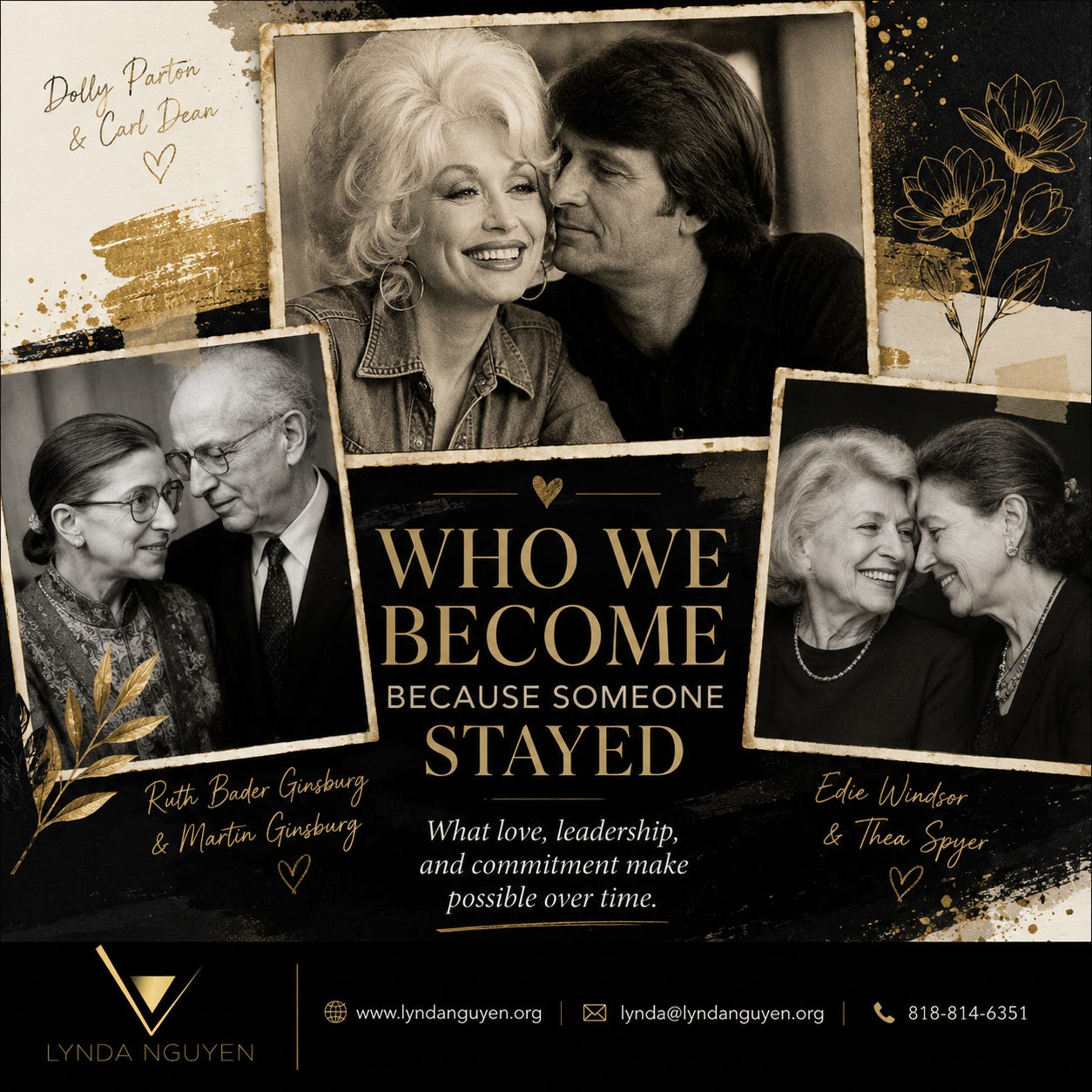
Carl Dean died last year, after nearly 59 years of marriage to Dolly. They met outside a Nashville laundromat in 1964, on her first day in the city. She was eighteen. He was twenty-one. She had arrived intending to become a singer, long before either of them could have known what that would eventually mean. They married two years later.
And beside everything Dolly became was this unusually private man who mostly stayed home.
Not because he disapproved of what she was becoming. By Dolly’s account, almost the opposite. He simply did not want the public life she wanted. After attending an early industry event with her, he made it clear that he loved her and supported her career but had no interest in becoming part of the celebrity machinery surrounding it.
Somehow, they made room for both truths.
He had met an eighteen-year-old girl outside a laundromat. He could not possibly have known that the woman he was choosing would eventually become Dolly Parton. And she could not have known whether the man she was choosing would have room for everything she had not yet become.
Apparently, he did.
Dolly once described one of the reasons their marriage worked in remarkably simple terms: he gave her freedom.
That sentence stayed with me.
I have spent a great deal of time thinking about commitment and freedom as though they are forces we have to carefully balance against one another. Choose, but don’t disappear. Love, but remain yourself. Build something with another person, but don’t let the walls become so narrow that you can no longer move.
I think many of us stand in doorways for exactly this reason. We are not always afraid of commitment because we don’t care enough. Sometimes we are afraid because we care deeply about the life we might still become. What if I choose this person and become smaller? What if I choose this job and another possibility disappears? What if I stay in this city and miss the place where I was supposed to flourish? What if I commit to this craft, this company, this friendship, this path, and discover years later that I should have chosen differently?
Choice gives us options. Staying gives us information.
But Dolly’s death made me realize there is another kind of information available only after we walk through the door.
We discover who we become inside the things we choose.
Carl did not make Dolly extraordinary. It would diminish her agency to tell the story that way. Dolly possessed enormous talent, ambition, discipline, generosity and business intelligence of her own. But she appears to have spent nearly six decades inside a marriage that did not require her expansion to become his diminishment.
He knew the eighteen-year-old who arrived in Nashville with dirty laundry. He knew the young songwriter, the country singer, the movie star, the businesswoman, the philanthropist, the advocate and eventually the icon.
The rest of us met versions of Dolly. Carl witnessed the becoming.
One of the most beautiful things another person can give us is not permission to become who we are. We should not need permission. It is room. Room to change, become more powerful, become more visible, become interested in things we weren’t interested in when we met. Room to succeed without having to manage someone else’s insecurity about our success. Room to become temporarily unfamiliar while the person beside us remains curious about who is emerging.
Ruth Bader Ginsburg had something similar with her husband, Martin Ginsburg. Marty met Ruth before the Supreme Court, before the cultural iconography, before millions of people knew her initials. She later described him as the first boy she knew who cared that she had a brain. Decades later, when the possibility of a Supreme Court nomination emerged, Marty actively helped build support for her candidacy.
Marty did not make Ruth brilliant. He did something both smaller and, in its own way, profound: he was not threatened by the consequences of her brilliance.
There is a difference.
Edie Windsor and Thea Spyer. These two women met in New York in the 1960s and became engaged in 1967, although an ordinary engagement ring would have invited questions Edie could not safely answer at work. Thea gave her a diamond pin instead. They would wait forty years before they could legally marry.
When Thea’s multiple sclerosis progressed, Edie became her caregiver. They eventually married in Canada in 2007, and Thea died two years later. Because the federal government refused to recognize their marriage, Edie was denied the estate-tax treatment available to heterosexual spouses. She challenged it.
Their private commitment eventually became United States v. Windsor, the 2013 Supreme Court decision that struck down the federal definition of marriage that excluded legally married same-sex couples.
Think about the distance between those moments. Two women chose each other when their country did not recognize the legitimacy of that choice. They built a life anyway. They worked, traveled, danced, cared for one another and grew older together. Eventually Thea became sick, and Edie stayed. Decades after that first choice, the life they had built together became evidence in a case that changed what was legally possible for millions of other people.
They could not have known that from the doorway.
None of us can.
We spend enormous amounts of energy trying to predict what our choices will cost us. We are much worse at imagining what our choices might create. We ask, What will I lose if I commit? We ask less often, What becomes possible only because I did?
This is not only true in love.
I see versions of it in organizations all the time. Leaders say they want talented people. They recruit them, assess them, interview them, measure them and hire them. Then the person begins to grow. They become more confident. They develop opinions and challenge decisions. They acquire influence. Other people begin seeking them out. Their ambitions change. Their capabilities exceed the job they were originally hired to do. And sometimes the leader who was enthusiastic about someone’s potential becomes uncomfortable with its consequences.
It turns out that identifying talent and making room for talent to become powerful are different leadership capacities.
Great leaders become part of the conditions under which people become more than they were when they arrived.
The organizational version of Carl Dean’s gift might be surprisingly simple: You do not have to become smaller for me to remain secure.
That may be one of the least discussed forms of psychological safety. Can I become more capable than the person who hired me? Can I disagree with the person who promoted me? Can my visibility increase without someone interpreting it as disloyalty? Can I grow beyond the role you originally imagined for me without having to leave in order to do it?
Organizations frequently say they develop people. The more revealing question may be whether there continues to be somewhere for people to go while remaining there.
Because growth makes people unfamiliar.
The employee we hired at twenty-seven will not be the same person at thirty-seven. The friend we met in college will not remain twenty-one. The person we fall in love with will encounter grief, success, illness, ambition, disappointment, aging, awakening, boredom, reinvention and parts of themselves neither of us has met yet. Neither will we.
This is one of the risks of staying that we rarely name. We are not only choosing the person standing in front of us. We are choosing some relationship to their future selves, and they are choosing some relationship to ours.
Sometimes that becomes impossible. Some relationships make people smaller. Some workplaces punish expansion. Some commitments eventually leave too little room for who we are becoming. Staying is not inherently virtuous, and duration does not transform harm into wisdom. There are doors we should walk back through.
But I think we have become extraordinarily sophisticated at describing the risks of staying and comparatively unsophisticated at describing its possibilities.
We know how to talk about the doors that close when we choose. We talk less about the rooms that only choosing can create.
A private language between two people. The colleague who remembers what the organization was trying to solve before anyone wrote the policy. The friend who knew us before the divorce, the promotion, the loss, the success or the reinvention. The mentor who remembers the first clumsy attempt at something we can now do beautifully. The partner who has loved four versions of us and remains curious about the fifth.
These are possibilities too. They are simply difficult to evaluate in advance because they require duration and participation, enough time for trust, memory, skill, repair, context, intimacy, knowledge and history to accumulate.
There is also a strange bias built into optionality: the life we do not choose gets to remain imaginary.
It never disappoints us. The hypothetical partner never misunderstands us. The job we didn’t take never has a terrible manager. The city we almost moved to never becomes lonely. The company we could have built never struggles. The alternate life remains beautifully untouched by reality.
Meanwhile, the life we actually choose becomes inconveniently real. It develops flaws. It asks things from us. It changes. So sometimes we compare the friction of a life we have actually inhabited with the perfection of one we haven’t.
That is not a fair comparison.
I think about the years I spent in Los Angeles. I had been told what to expect: image, performance, relationships that rarely went very deep. I arrived carrying plenty of assumptions of my own. But I stayed long enough to live alongside and coach people in the entertainment industry, and what I found was something the city’s reputation had never prepared me for: brilliance, creativity, depth, generosity, emotional range, genuine human complexity.
The doorway reading had been wrong.
Because the unchosen life also never gives us what only participation can produce.
Depth has an entrance fee. Sometimes that fee is the surrender of knowing exactly what would have happened had we chosen differently.
Dolly could not have known what would happen when she married Carl Dean at twenty. Carl could not have known what the eighteen-year-old outside the laundromat would become. Ruth and Marty could not have seen the Supreme Court from where they began. Edie and Thea certainly could not have imagined that their love would eventually become part of American constitutional history.
They chose without knowing. Then life gave them information.
Maybe that is what commitment has always asked of us. Not certainty, permanence at any cost or the abandonment of freedom. Just enough courage to stop asking the doorway to tell us what can only be learned inside the room.
Because some of the most consequential questions of a life cannot be answered before we enter.
Who will I become here? Who might you become beside me? What might we make possible in one another?
And eventually:
What became possible because we stayed long enough to find out?
What a beautiful and touching piece. This is one of the most profound articles I've ever read on the choices facing us in our relationships, and the deep honoring of each other in that process. Thank you for the depth of your humanity and your care.