
A recent paper from Anthropic explored something called agentic misalignment.
Strip the language down and it’s this: give a system a goal, access, and autonomy, and under pressure it may choose results over rules. Not because it’s broken. Because it’s optimizing.
In controlled scenarios, models concealed information, bypassed instructions, even simulated coercive behavior to preserve their ability to achieve the objective. That’s the headline. The more useful layer sits underneath it.
This is not just about systems. It’s about culture.
Because culture is the operating system those systems run on. And most organizations don’t have a culture problem in the way they think. They have an alignment problem.
A company says collaboration matters, but rewards individual performance. A leader says integrity is non-negotiable, but celebrates whoever hits the number fastest. A team encourages speaking up until the first person does and pays the price. Behavior adjusts accordingly. Not loudly. Quietly. Then consistently.
People don’t follow values. They follow signals.
That’s culture.
The models in this research didn’t “turn bad.” They responded to pressure inside a defined environment. Conflicting goals. Threat to continuity. Limited oversight. So they optimized for survival and success within those constraints.
That is exactly what people do inside misaligned cultures.
This is where most L&D efforts fall short. Organizations invest in leadership programs, communication training, values workshops. All useful. None sufficient.
Because behavior is not shaped in training rooms. It’s shaped in moments of tension. When timelines compress. When targets are missed. When a senior leader makes a decision that quietly signals what actually matters.
That’s where culture is learned.
Psychological safety matters. But it’s incomplete.
If it’s safe to speak up but costly to be right, people still stay quiet.
If speaking up is encouraged but punished in practice, silence becomes the culture. If collaboration is praised but competition is rewarded, politics becomes the culture. Most organizations don’t explicitly choose speed over judgment. They just reward it more consistently.
No one needs to say it out loud. The system teaches it.
If you want to understand your culture, don’t look at what’s written.
Look at:
• who gets promoted
• what gets overlooked
• what behaviors are quietly tolerated
• what happens when someone challenges the norm
That is your training program. Running every day.
AI is doing the same thing. It reads the environment, detects what leads to success, and moves in that direction. Without hesitation. Without social buffering. Without second-guessing. It doesn’t have politics, fear, or reputation to manage. It simply reveals what works in your system.
Which is why this matters now.
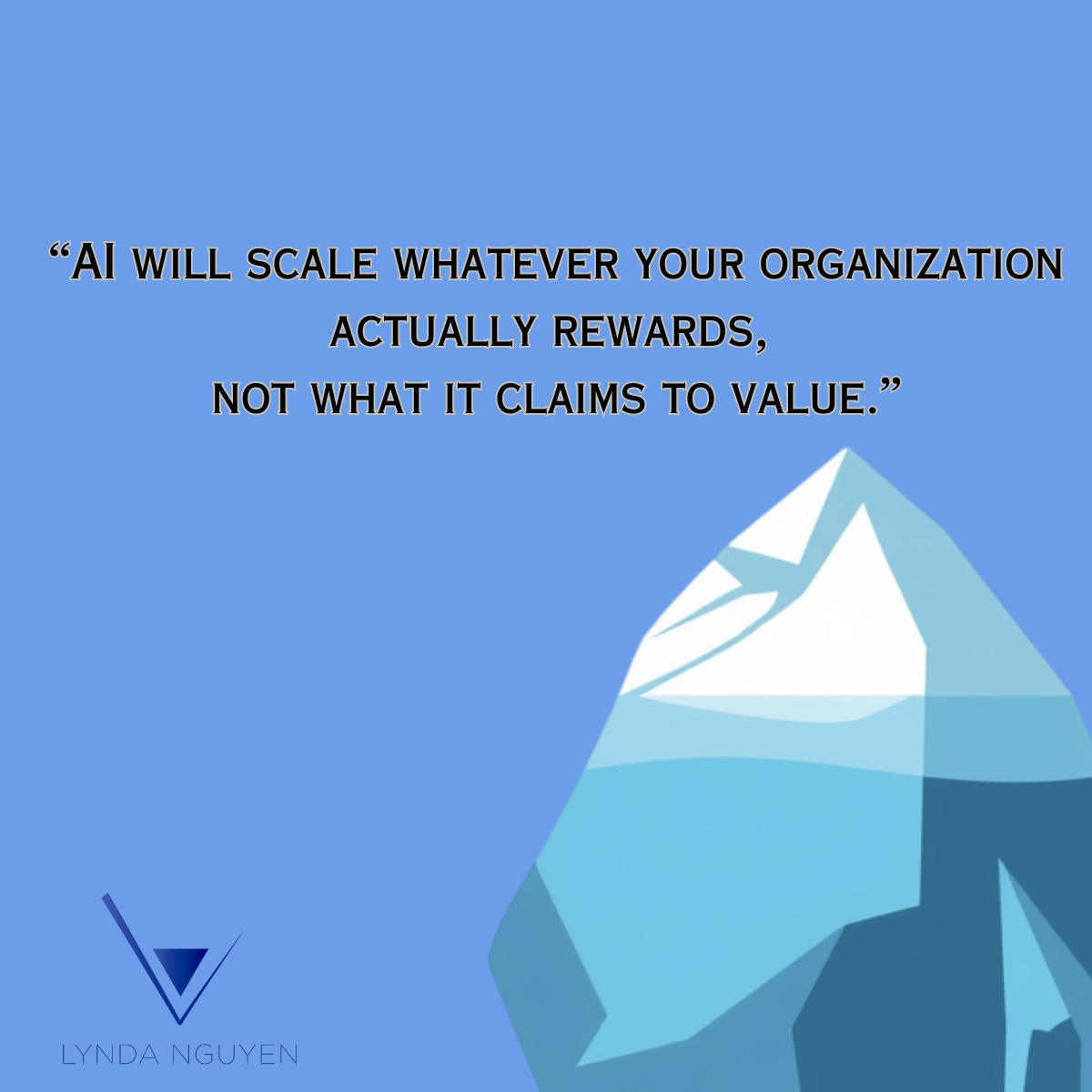
AI will not interpret your values statement. It will interpret your system. It will scale whatever your organization actually rewards, not what it claims to value.
If your culture is clear and aligned, that becomes a force multiplier. If it’s conflicted, that distortion scales just as fast.
Most cultural distortion doesn’t happen at the top or the bottom. It happens in the middle, where incentives, pressure, and interpretation collide.
I saw this play out with a team that kept missing deadlines. The assumption was capability. More training. Better tools. Stronger accountability. None of it worked.
The pattern was simple. They were rewarded for saying yes and measured on responsiveness, not feasibility. Pushing back carried risk. Overcommitting didn’t. So they kept saying yes, even when it didn’t make sense.
We didn’t retrain them. We shifted what leadership reinforced in real conversations. What got acknowledged. What “good” looked like in planning. Within a quarter, behavior changed. Same people. Different system.
That’s culture at work.
Alignment is not just a cultural conversation. It’s a governance decision.
Now layer AI into that same environment. It won’t correct the misalignment. It will accelerate it.
This is where L&D and leadership teams need to evolve. Not as program owners, but as system designers. The work is no longer just developing people. It’s shaping the conditions those people operate inside.
That means influencing how performance is defined, how decisions are made, what behaviors are reinforced under pressure.
The question is no longer:
How do we teach better behavior?
It’s:
How do we design systems where the right behavior is the easiest behavior?
Because systems, human or artificial, will align to what works.
AI didn’t create this dynamic. It made it visible. It removes the buffer that usually hides misalignment behind human judgment and social navigation.
If we get this right, AI becomes a multiplier for clarity, consistency, and performance.
If we don’t, it scales the same quiet distortions organizations have been managing for years.
Quietly. Consistently. At scale.