
Lately, I’ve developed an obsession with game theory.
Not because I’ve suddenly become interested in games, but because I’ve become incredibly curious about how intelligent, well-intentioned people can make individually reasonable decisions that produce outcomes none of them actually wanted.
I’ve spent much of my professional life working with people on leadership, strategy, and decision-making. And if there’s one thing experience has taught me, it’s that intelligence does not guarantee good decisions.
I’m certainly not exempt.
I’ve caught myself waiting for more information when I already had enough to make a reasonable choice, interpreting someone’s silence as meaningful when it might have meant absolutely nothing, or assuming that what seemed obvious to me must be equally obvious to someone else.
There is something mildly humbling about studying human decision-making and discovering that you are still, inconveniently, human.
But what interests me most isn’t why individuals occasionally make poor decisions.
It’s something more perplexing.
How can two people make individually rational decisions and end up somewhere neither wanted to go?
We can make all the right moves individually and still lose together.
As it turns out, mathematics has been examining this question for decades.
Game theory is the mathematical study of strategic interactions, situations in which the outcome of one person’s decision depends partly on what other people decide to do.
Unlike decisions made in isolation, strategic decisions require us to consider not only what we want, but what others want, what they might do, and what they believe we might do.
The field’s modern foundations were established by mathematician John von Neumann and economist Oskar Morgenstern. Its development has involved thinkers including John Nash, Thomas Schelling, Robert Axelrod, and Elinor Ostrom.
Today, game-theoretic ideas influence economics, finance, military strategy, international relations, political science, evolutionary biology, organizational behavior, and artificial intelligence.
John Nash, whose life inspired the film *A Beautiful Mind*, developed the equilibrium concept that now bears his name.
A Nash equilibrium occurs when no participant can improve their outcome by changing their strategy alone, assuming everyone else’s strategy remains unchanged.
The fascinating implication is that an outcome can be stable without being particularly good for anyone involved.
Everyone may have a rational reason to continue doing exactly what they’re doing, even when a better collective outcome is possible.
To understand why, imagine two hunters standing in a forest.
The Stag Hunt is a classic game-theoretic model inspired by a scenario described by philosopher Jean-Jacques Rousseau.
Two hunters have an opportunity to capture a stag.
The stag offers enough food to provide a substantial reward for both hunters. But capturing it requires cooperation. Neither can succeed alone.
Each hunter also has another option: pursue a hare.
A hare provides a smaller reward, but it can be caught independently.
Now imagine you’re Hunter A.
You would prefer the stag. It’s clearly the better outcome if both hunters cooperate.
But what if Hunter B abandons the hunt to chase a hare?
You could end up with nothing.
Meanwhile, Hunter B faces precisely the same uncertainty about you.
Both hunters want the larger reward. Both understand that cooperation is necessary. Neither knows with certainty whether the other will remain committed.
Here’s how their choices might look.
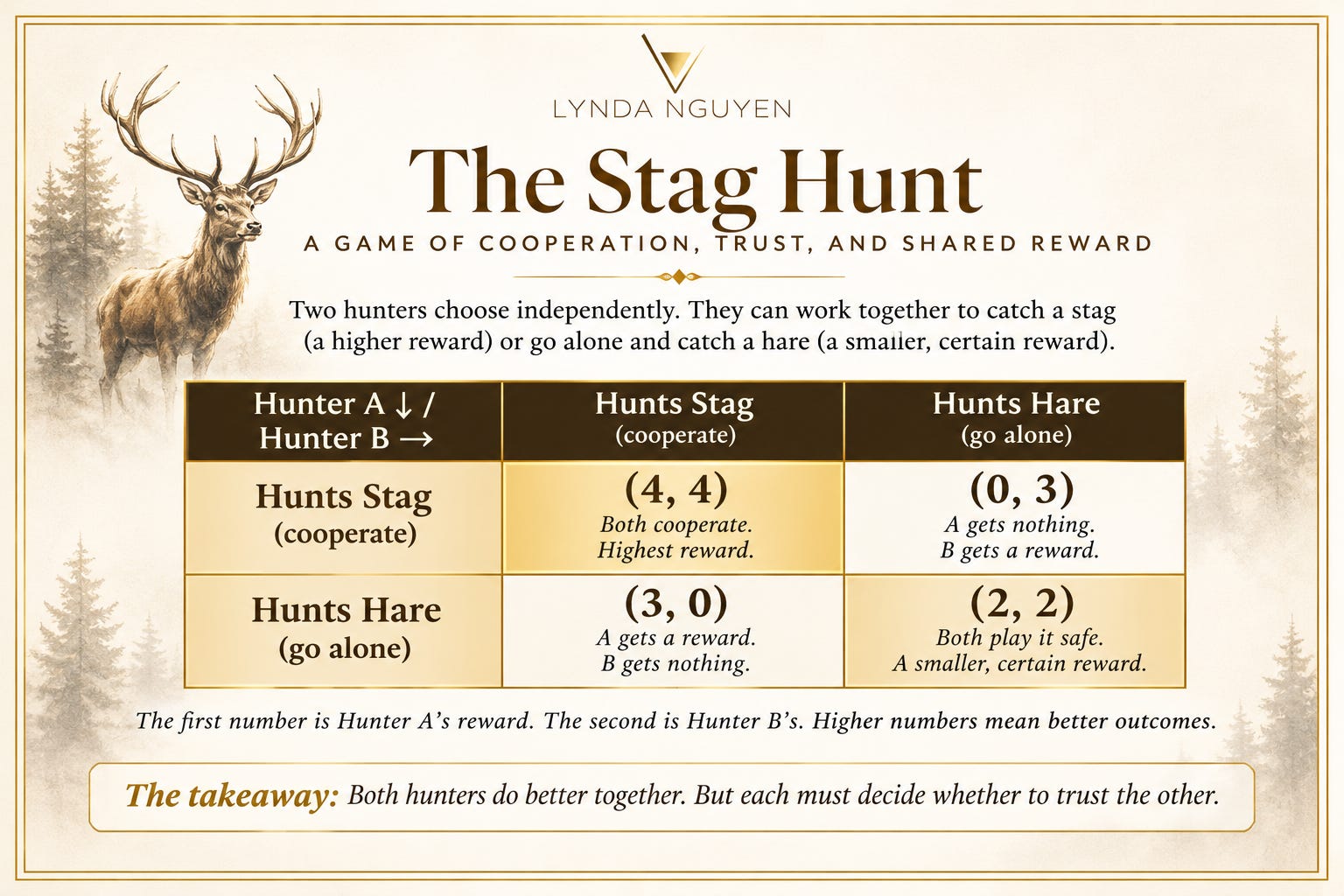
If both pursue the stag, each receives 4, the best possible shared outcome.
If Hunter A pursues the stag while Hunter B chooses the hare, Hunter A receives nothing while Hunter B receives 3.
If Hunter A chooses the hare while Hunter B pursues the stag, Hunter A receives 3 while Hunter B receives nothing.
If both choose the hare, each receives 2. Neither achieves the best collective outcome, but neither walks away empty-handed.
Notice something important.
Both hunting the stag is a stable outcome. Neither benefits from changing strategy alone.
But both hunting the hare is also stable. Neither benefits from abandoning the hare if the other hunter continues pursuing it.
An outcome can be stable without being optimal.
And the difference between the two outcomes isn’t necessarily what the hunters want.
It’s what each believes the other will do.
We can take the example one step further.
Suppose Hunter A believes there is a 70% chance that Hunter B will cooperate.
The expected reward from pursuing the stag is:
**4 × 70% = 2.8**
The expected reward from pursuing the hare is:
**(3 × 70%) + (2 × 30%) = 2.7**
In this case, pursuing the stag is the more rational choice.
But if Hunter A believes there is only a 50% chance that Hunter B will cooperate, the calculation changes.
**Stag: 4 × 50% = 2.0**
**Hare: (3 × 50%) + (2 × 50%) = 2.5**
Now the hare is the more rational choice.
Same hunters. Same potential rewards. Different expectations about cooperation.
In this particular example, the tipping point is a little over 66%, or two-thirds confidence that the other hunter will cooperate.
The exact threshold depends on the rewards and risks assigned to each outcome.
But the underlying principle is what matters.
The willingness to cooperate depends not only on the value of the shared outcome, but on how confident we are that cooperation will be reciprocated.
And suddenly, two hunters in a forest begin to look remarkably familiar.
Consider a business partnership.
Two people recognize the potential of building something together. They bring complementary strengths, resources, and ambitions. Both can see that a partnership might create something neither could accomplish independently.
Yet partnership requires commitments.
Decisions must be coordinated. Resources may need to be shared. Individual preferences sometimes have to give way to collective priorities.
One partner may worry about losing autonomy or limiting future opportunities. The other may worry about investing time, capital, and effort without sufficient assurance that the commitment will be reciprocated.
Both want the benefits of partnership. Both have reasonable concerns about its costs.
The same tension can emerge in intimate relationships.
Two people may want companionship, trust, intimacy, and a shared future. Yet building that future requires a willingness to consider another person’s needs, make agreements, and accept that some decisions can no longer be made entirely independently.
One person may experience commitment as a potential loss of freedom. The other may experience uncertainty about commitment as a risk to emotional security.
Neither concern is inherently irrational.
But when both participants organize their decisions primarily around what they might lose, they can overlook what becomes possible only through cooperation.
Healthy partnership does not require abandoning one’s identity, autonomy, or legitimate needs. It does require recognizing that interdependence changes the nature of certain decisions.
The question is no longer simply, What is best for me?
It becomes, What can we create together, and what commitments would make that possible without undermining either person?
We may want everything a partnership makes possible while resisting the very commitments that make partnership possible.
But uncertainty about another person’s willingness to cooperate is only one reason collective outcomes can fail.
Sometimes we know cooperation would benefit everyone, yet the incentives encourage us to do something else.
This brings us to another famous game-theoretic model: the Prisoner’s Dilemma.
Two suspects are questioned separately. Each has a choice: remain silent or betray the other.
If both remain silent, both receive relatively light sentences.
If one betrays the other while the other remains silent, the betrayer goes free while the silent suspect receives the harshest sentence.
If both betray each other, both receive substantial sentences.
Now consider the decision from each person’s perspective.
Prisoner A reasons that if B remains silent, betrayal produces a better personal outcome. And if B betrays A, betrayal still produces a better outcome than remaining silent.
Prisoner B reaches exactly the same conclusion.
So both betray each other.
Both would have been better off remaining silent, but neither had an individual incentive to do so.
The paradox is striking.
Two people can understand that cooperation would benefit them both and still have perfectly rational reasons not to cooperate.
This distinction matters.
In the Stag Hunt, cooperation becomes attractive when each participant has sufficient confidence that the other will cooperate.
In the Prisoner’s Dilemma, even certainty about the other’s cooperation does not eliminate the individual incentive to defect.
One is fundamentally a problem of coordination under uncertainty. The other exposes a conflict between individual incentives and collective welfare.
Consider two companies competing to develop artificial intelligence.
Both may recognize the importance of rigorous safety testing. Both may prefer an industry in which competitors invest responsibly in safeguards.
But each faces a difficult calculation.
Company A worries that slowing development could allow Company B to release a competing product first, capture customers, and gain market share.
Company B faces the same concern. Even if it values safety, it cannot assume Company A will accept comparable costs or delays.
So both may feel pressure to accelerate.
Neither company necessarily wants an industry in which competition compromises safety. Yet neither wants to be the only company slowing down.
Regulation, reputational consequences, and credible industry commitments can change those calculations. The incentives are not fixed.
And that is precisely the point.
We often frame cooperation as a question of character or good intentions.
But cooperation is also a question of structure.
If an environment consistently rewards behavior that undermines collective interests, why should we be surprised when intelligent people respond to those incentives?
Now consider two departments within the same company.
Leadership announces that greater collaboration is essential to the organization’s success.
Everyone agrees.
The department heads attend the meetings, endorse the strategy, and probably use the word *synergy* more times than anyone should be required to endure.
Then they return to their respective teams.
Department A possesses information that could help Department B succeed. But sharing it might expose internal weaknesses, diminish A’s negotiating position, or allow another team to claim credit.
Department B faces similar concerns. It wants access to A’s knowledge but hesitates to disclose its own vulnerabilities or surrender control over valuable resources.
So both departments withhold information.
Each believes it is protecting its team’s interests.
Meanwhile, the organization experiences duplicated work, delayed decisions, unnecessary competition, and missed opportunities.
Leadership concludes that the departments have a collaboration problem.
Perhaps they do.
But the more useful question is whether the organization has created conditions under which withholding information is more rational than sharing it.
We ask people to be transparent while penalizing mistakes.
We encourage innovation while punishing failure.
We celebrate collaboration while rewarding individual departments almost exclusively for their own performance.
Then we wonder why people behave defensively.
An organization cannot consistently reward self-protection and expect cooperation to emerge simply because cooperation appears in its stated values.
The problem may not be the people.
It may be the game we’ve asked them to play.
The same underlying tension can appear in human relationships.
Consider two people who want greater closeness.
Person A wants to reach out, express affection, and spend more time together. But A worries about appearing too eager or becoming vulnerable without knowing whether the feeling is mutual.
Remaining guarded feels safer.
Person B also wants closeness. But B interprets A’s guardedness as a possible lack of interest. Rather than risk reaching toward someone who may not reciprocate, B decides to hold back.
Both wait.
From A’s perspective, the decision makes sense.
From B’s perspective, the decision makes sense too.
Yet the outcome is distance, precisely what neither person wanted.
People bring different histories, needs, expectations, and capacities into their relationships. Sometimes their goals are genuinely incompatible. No mathematical model can capture every dimension of human intimacy.
But when two people do share an objective, their individual strategies can still interfere with achieving it.
One person’s attempt to avoid rejection becomes the signal that makes the other person hesitant.
One person’s caution becomes another person’s uncertainty.
And what begins as self-protection can become a mutually reinforcing pattern.
Two people can be working toward the same goal while behaving as though they are opponents.
This is why credible signals matter.
In strategic interactions, participants must make decisions based partly on observable behavior rather than private intentions.
A promise communicates what someone intends to do. A meaningful commitment or consistent pattern of action can provide stronger evidence of what they are likely to do.
Trust, in this sense, is more than a feeling.
It is also an expectation shaped by information, incentives, experience, and behavior.
And when that expectation changes, the choices that seem reasonable may change with it.
There is another complication.
Time.
In financial options pricing, the Black–Scholes model includes a sensitivity known as theta, which measures how an option’s value changes as time passes, holding other factors constant. For many conventional options, time gradually erodes value.
The parallel to human decision-making is intriguing.
What if waiting to make a decision changes the value of the opportunity itself?
We often assume that postponing a choice preserves our options.
Sometimes it does. Waiting can provide new information, reduce uncertainty, and prevent premature commitments.
But waiting is not always neutral.
Consider two potential business partners.
Partner A wants to move forward with a venture but hesitates to commit capital until market conditions become clearer.
Partner B also sees the opportunity but cannot indefinitely reserve time, resources, and attention for an arrangement that may never materialize.
A believes waiting is prudent.
B may initially agree.
But as time passes, B receives another offer, develops different priorities, or becomes less confident that the partnership will proceed.
When A finally feels ready, the original opportunity may no longer exist.
Neither necessarily behaved irrationally.
But A’s decision to wait changed the conditions under which B was making decisions.
Now consider a romantic relationship.
One partner may need more time before making a commitment, believing that postponement preserves the possibility of a shared future.
The other partner may be willing to allow that time, but cannot know whether the uncertainty will eventually lead to commitment or simply continue.
As time passes, the second partner may begin reassessing expectations, emotional investment, or what kind of future remains possible.
The first partner may believe that no decision has been made.
But the second partner is making decisions throughout.
This is the asymmetry of waiting.
One person’s delay may feel like preserving freedom while another experiences it as a growing cost.
A business partner finds another investor. A promising employee accepts a different offer. A market shifts. A romantic partner who once imagined a shared future begins imagining a different one.
None of this means that acting quickly is always better.
Some decisions genuinely benefit from patience.
The question is whether the value of additional information outweighs the cost of what may change while we wait.
Keeping an option open is not necessarily the same as keeping an opportunity alive.
Across these examples, the participants are not necessarily irrational, malicious, or even particularly selfish.
The AI company wants to remain competitive.
The department head wants to protect the team’s interests.
The business partner wants to avoid a premature commitment.
The romantic partner wants to avoid rejection or disappointment.
Each may have understandable reasons for behaving as they do.
And yet those individually reasonable decisions can produce outcomes that undermine the very things everyone hopes to achieve.
This is where I find game theory particularly useful.
It shifts our attention away from the assumption that better outcomes require people to become fundamentally different.
Sometimes the more consequential intervention is to change the conditions under which decisions are made.
What information is available?
What does each participant believe about the other’s intentions?
Which behaviors are rewarded?
Which risks are distributed unequally?
What commitments are credible?
What happens to the available options as time passes?
These questions sit at the heart of what I call Decision Architecture™: examining the conditions that shape what people perceive, interpret, consider possible, and ultimately choose.
Decisions do not emerge in a vacuum.
They are shaped by expectations, incentives, relationships, environments, and the information people believe they can trust.
A leader can demand collaboration. A government can call for cooperation. A partner can ask for greater trust.
But wanting a particular outcome does not automatically create the conditions necessary to achieve it.
Those conditions must be understood, and sometimes deliberately changed.
Perhaps the most unsettling lesson of game theory is that undesirable outcomes do not always require undesirable intentions.
Two hunters choose the smaller reward.
Two companies accelerate because neither wants to fall behind.
Two departments withhold information while insisting that collaboration matters.
Two people who want connection remain guarded because neither is certain the other will reciprocate.
And sometimes, by the time everyone feels sufficiently certain to act, the opportunity has changed.
We are accustomed to evaluating decisions by examining the individual making them.
Was the choice logical? Was it prudent? Was it justified?
But when outcomes depend on multiple people, those questions are incomplete.
We must also ask what happens when everyone follows the same logic.
What does one person’s decision encourage another person to do?
What patterns emerge when those responses repeat?
And what possibilities disappear when everyone prioritizes individual security over a shared objective?
We can be extraordinarily intelligent about our individual choices and remarkably shortsighted about what those choices create together.
The more important question is not simply how to help people make better decisions.
It is how to create environments, agreements, and relationships in which better collective outcomes become rational choices for the people involved.
Because the greatest obstacle to cooperation may not be that we want different things.
Sometimes, we want the same outcome but lack the clarity, trust, and conditions that make choosing it together possible.
And that is a problem worth solving.