
Years before I understood what regeneration meant, I spent a week living in a tent overlooking the ocean in Hāna, Hawaiʻi.
I had been invited to stay on a beautiful property, learning alongside a family and their team what it meant to live more directly from the land. The experience brought me into a different relationship with the natural world. Food, water, soil, labor, and community were no longer abstractions separated by the conveniences of modern life.
There was something quietly profound about being there.
I had no particular language for it then. I simply knew that the relationship between living and taking, between receiving and giving back, felt different.
Approximately five years later, while consulting with an investor, I found myself sitting with the founder and team of Kiss the Ground in Santa Monica, learning about regenerative agriculture.
During our conversation, I discovered an extraordinary connection. The beautiful property in Hāna where I had spent a week learning to live from the land belonged to Terces Engelhart, whose stepson, Ryland Engelhart, was a co-founder of Kiss the Ground. The family was also behind Café Gratitude and Gracias Madre. I had experienced regeneration through the hospitality of one generation before encountering its philosophy through the work of another.
Life had brought me full circle.
I had encountered a way of living before I encountered the philosophy that would help me understand it.
Years later, I would spend a year in an international cohort of business leaders with Laura Storm, exploring how regenerative principles could be integrated into business and leadership.
And through my studies of Shakti and Tantra in India, and my engagement with the Śrī Vidyā tradition, I would encounter another understanding of creation, dissolution, and renewal.
These experiences emerged from different worlds, yet they gradually led me toward the same question.
What must we allow to die so that something more whole can be born?
Regenerative agriculture begins with the recognition that the land is not merely an instrument of production.
A field can yield an impressive harvest while the soil beneath it becomes increasingly depleted. Certain intensive practices may produce short-term abundance while contributing to erosion, declining biodiversity, and dependence on external inputs.
Regenerative approaches seek to restore and enhance the living processes that make future harvests possible.
Healthy soil is not inert matter. It is an extraordinary network of organisms, organic material, water, minerals, roots, fungi, and countless interactions that sustain life.
Practices such as cover cropping, diversified planting, managed grazing, reduced soil disturbance, and agroforestry can support these processes.
The underlying principle is that production and renewal must belong to the same conversation.
This is where regeneration differs in emphasis from sustainability.
Sustainability asks how we can meet our needs without compromising the future. Regeneration asks how our participation in a living system might also renew its capacity to flourish.
One seeks continuity. The other emphasizes the possibility of continual becoming.
A forest does not remain alive by remaining unchanged. Leaves fall. Organisms die. Organic matter decomposes. Nutrients return to the soil. New growth emerges from the material of what came before.
Death and creation are not always opposing events.
Sometimes they belong to the same process.
And this understanding has implications far beyond agriculture.
During my year studying regenerative leadership with Laura Storm, I began examining the assumptions underlying many of our organizational models.
We often treat businesses as machines. We design processes, establish targets, measure output, identify inefficiencies, and attempt to optimize performance.
There is considerable value in these disciplines.
But organizations are also living networks of relationships.
Trust accumulates or erodes. Information circulates or becomes distorted. People develop or disengage. Creativity expands or contracts depending on the conditions in which individuals are expected to perform.
An organization may deliver impressive financial results while gradually exhausting the very people and relationships responsible for those results.
We know how to measure the harvest.
We are less consistent about examining the soil.
Regenerative leadership asks us to look beyond whether a system is producing and consider whether it is developing the capacity to continue creating value.
Are people becoming more capable, or merely more exhausted?
Does authority cultivate responsibility in others, or concentrate dependence on a few individuals?
Does the culture encourage honest information to reach decision-makers, or reward people for telling leaders what they want to hear?
These questions connect directly to my work in Decision Architecture™.
The conditions that produce a decision deserve as much scrutiny as the decision itself.
A leader may make an apparently rational choice while operating within a culture that systematically suppresses inconvenient information. An executive may demand innovation while creating an environment in which experimentation carries unacceptable personal risk.
The resulting decisions cannot be understood independently of the conditions that produced them.
The same is true of human beings.
And this is where regeneration became something more personal for me.
I grew up in an Asian culture where women were expected to know when to remain quiet.
There were lessons we absorbed without anyone necessarily explaining them. How to accommodate. How to anticipate the needs of others. How to preserve harmony. How to be agreeable without appearing weak, capable without appearing threatening, and intelligent without making anyone feel challenged.
A good woman understood her place. She did not always need to be told where it was.
By my late twenties and thirties, I had moved decisively in the opposite direction.
I became assertive, commanding, and increasingly comfortable exercising authority. I learned to speak directly, establish boundaries, make difficult decisions, and take up space without waiting for permission.
Much of this was necessary.
I had discovered capacities that my earlier conditioning had discouraged me from expressing.
But I had also begun associating strength with command, self-protection, and the ability to direct outcomes.
I had learned to stand my ground.
I was less practiced at remaining open while doing so.
Now, in my late forties, I have come to understand something neither version of myself fully grasped.
I do not have to choose between being loving and being powerful.
I can be receptive without being submissive. Assertive without being domineering. Compassionate without abandoning discernment. I can establish a boundary without turning it into a wall, and remain emotionally available without assuming responsibility for another person’s choices.
The qualities I once understood as opposing forces have gradually become capacities I can hold together.
It has taken me nearly five decades to recognize that the opposite of submission is not domination.
It is sovereignty.
And perhaps this is where our understanding of the divine feminine deserves reconsideration.
In popular culture, femininity is frequently associated with softness, nurturing, emotional availability, beauty, and receptivity. These qualities can be extraordinary, but they represent only a fraction of what the feminine signifies within deeper spiritual traditions.
Shakti is not simply softness.
She is power.
Within the Tantric traditions I have studied, Shakti represents the creative dynamism through which existence manifests, transforms, and renews itself.
She is not merely the nurturing aspect of creation. She is also the force through which forms change, dissolve, and become something else.
The feminine does not exist only to preserve what is already here.
She also participates in what must be released.
Within Śrī Vidyā and related Tantric understandings, Shiva and Shakti are inseparable principles of consciousness and creative power.
Stillness and movement. Awareness and manifestation. The capacity to perceive and the power to bring something into being.
Neither is complete as an isolated principle.
This is an important distinction because masculine and feminine energies are not synonymous with men and women.
They are not assigned by biology, gender identity, or sexual orientation.
A woman may embody extraordinary direction, structure, and protective strength. A man may embody deep receptivity, intuition, and nurturing presence. Two women, two men, or partners of any gender may express different energetic polarities within their relationship.
These qualities can also shift within the same person across circumstances and stages of life.
The question is not which gender possesses which energy.
It is whether we have developed the capacity to express both without distorting either.
Structure without receptivity becomes rigidity.
Receptivity without discernment becomes self-abandonment.
Protection without compassion becomes control.
Care without boundaries becomes depletion.
What we call strength often depends on which of these qualities our culture has taught us to admire.
For generations, many women were denied meaningful access to education, property, economic independence, and institutional authority. Their capacity to shape their own lives was constrained by laws, customs, and expectations that treated their participation as secondary.
The consequences extend well beyond individual households.
A 2018 World Bank study estimated that barriers preventing girls from completing twelve years of education could cost countries between $15 trillion and $30 trillion in lost lifetime productivity and earnings.
Research on women’s education also documents associations with improved health, greater economic opportunity, increased decision-making agency, and benefits extending across generations.
When women gain education, resources, and meaningful autonomy, the possibilities available to them expand. Their participation can also strengthen families, communities, and economies.
But a woman’s right to education and sovereignty does not depend on the economic value she creates for others.
Her life has value in itself.
What interests me is what happens when that agency is no longer systematically constrained, and what becomes possible when institutions make room for a fuller range of human capacities.
What happens when women gain access to institutions whose understanding of power was established largely without them?
And what happens when success within those institutions requires adopting the same behaviors that once made them exclusionary?
Representation, economic independence, and equal access to opportunity are essential. But inclusion within an existing system is not necessarily the same as transforming that system.
If women enter leadership only to reproduce the same patterns of extraction, domination, and depletion, we may have changed who holds authority without changing our understanding of what authority is for.
Human beings of every gender are capable of both regeneration and extraction.
The question is which qualities we choose to cultivate.
We need leaders who can exercise authority without domination, maintain standards without humiliation, and pursue ambitious goals without exhausting the human and ecological systems on which their success depends.
This becomes especially important in an age of artificial intelligence, accelerating technological change, and extraordinary capacities for optimization.
We are becoming remarkably sophisticated at predicting behavior, automating decisions, increasing efficiency, and scaling production.
But optimization is not wisdom.
A business can optimize its operations while degrading its culture. A platform can maximize engagement while diminishing the quality of human attention. An economy can grow while leaving communities and ecosystems increasingly depleted.
The question is not simply what more we can produce.
It is what kind of world our production is creating.
And perhaps the same question belongs in our intimate relationships.
A relationship can survive for years without flourishing.
Two people may remain together through habit, obligation, fear, financial dependence, or the sincere belief that endurance itself is proof of love.
Yet a relationship can remain intact while the people within it become increasingly disconnected from themselves and one another.
One person accommodates. The other controls.
One pursues. The other withdraws.
One attempts to preserve closeness by surrendering boundaries. The other attempts to preserve autonomy by creating distance.
Both may love each other.
Both may also be participating in a dynamic that steadily depletes the connection.
Regenerative love asks a different question from the one we ordinarily associate with commitment.
Not simply, how do we remain together?
But how do we continue becoming, individually and together?
Sometimes the relationship itself does not need to die.
The way two people have been relating needs to die.
The pursuit. The withdrawal. The fear of vulnerability. The need to win. The silence that masquerades as peace. The pride that prevents an apology. The belief that love requires one person to carry responsibility for the emotional development of both.
What once provided protection can eventually become the very thing preventing intimacy.
There is a fascinating expression of this process within twin-flame spirituality.
Within spiritual communities, twin flames are understood as two expressions of a shared spiritual essence, drawn together through a rare connection that awakens profound recognition, self-discovery, and spiritual growth.
Unlike karmic relationships, which bring recurring unhealthy patterns and lessons to the surface so they can be recognized and released, twin-flame connections invite a deeper transformation. Their purpose is not simply to resolve the past, but to awaken each person to a greater capacity for love, vulnerability, and conscious union.
Their journey is often described through the polarity of the divine masculine and divine feminine, expressed in the familiar dynamic of the runner and the chaser.
These roles are not gender-specific. A man may pursue while a woman withdraws. Two women, two men, or partners of any gender may experience the same dynamic. The roles may even shift over time.
The runner seeks freedom through distance.
The chaser seeks union through proximity.
But beneath the apparent opposition, both are confronting a similar question.
Can I remain fully myself while allowing myself to be deeply connected to another?
The runner must confront the possibility that what feels like independence may actually be fear and ego disguised as freedom.
The chaser must discover that love cannot be secured through self-abandonment.
Each encounters the limitations of the strategy that once offered protection.
And then comes the separation phase.
Within the twin-flame journey, separation is a sacred period of regeneration. What appears to be the dissolution of a connection becomes the beginning of its transformation.
The runner encounters what distance cannot resolve. The chaser discovers what pursuit cannot secure. Without the familiar dynamic to sustain them, both are drawn inward, toward the parts of themselves that must be awakened, healed, and integrated.
Separation becomes the fertile ground of rebirth.
Just as fallen leaves decompose and return their nutrients to the forest floor, old identities, protective patterns, and expectations begin to dissolve. What could not flourish within the former relationship begins to take root.
The fear of vulnerability. The need to control. The belief that distance guarantees safety or that pursuit guarantees love.
What once served as protection becomes the very material from which regeneration begins.
The masculine energy discovers that presence does not require the loss of freedom.
The feminine energy discovers that receptivity does not require the loss of sovereignty.
Both begin to embody the qualities they once sought exclusively in the other.
And this returns us to Shiva and Shakti.
Their union is not the victory of one force over another. It is the recognition that consciousness and creative power, stillness and movement, form and possibility, participate in the same unfolding reality.
Union is not achieved by eliminating difference.
It becomes possible when difference no longer requires opposition.
The twin-flame journey moves through separation toward a different expression of union, one in which two sovereign beings can meet without recreating the patterns that once separated them.
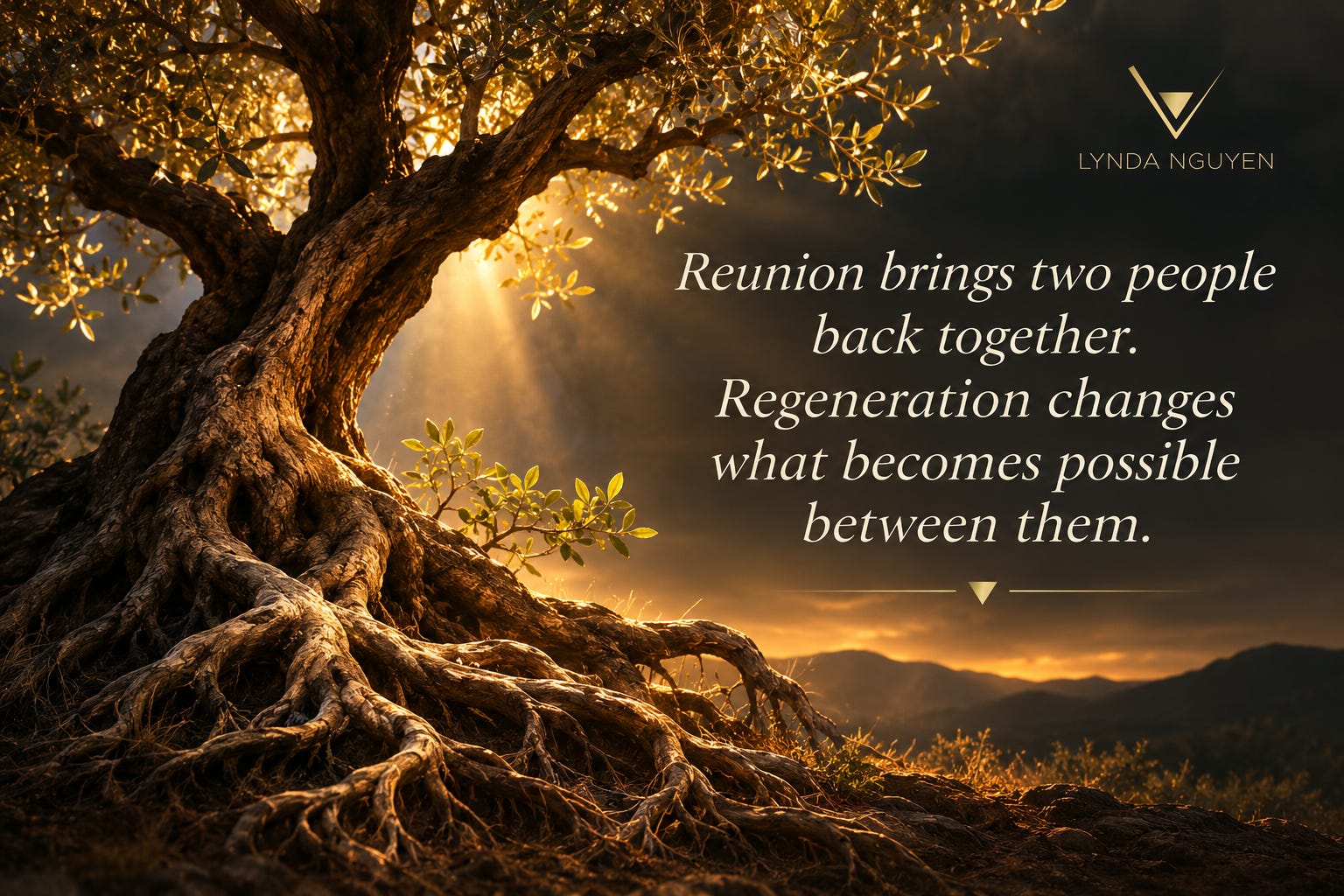
Reunion brings two people back together.
Regeneration changes what becomes possible between them.
The relationship is not merely restored to its previous condition. It becomes capable of sustaining a different quality of intimacy, autonomy, responsibility, and creation.
And union is not the end of regeneration.
It is the beginning of another cycle of becoming together.
Living systems do not reach a final state of perfect balance.
They continue adapting, releasing, renewing, and becoming.
The same is true of individuals, partnerships, and organizations.
I think about the young girl I once was, learning to remain quiet.
I think about the woman I became, learning to command.
I am grateful for both of them.
The first understood something about sensitivity, observation, and the importance of relationships, even if she had not yet learned to protect her own voice.
The second understood something about agency, boundaries, and decisive action, even if she sometimes confused strength with control.
Neither was wrong to develop the capacities she needed.
Neither was complete.
And perhaps the most meaningful transformation has been discovering that I do not need to reject either of them.
I can lead without dominating.
Love without disappearing.
Remain open without surrendering discernment.
I can be both tender and formidable, receptive and decisive, independent and deeply connected.
What is possible within one human being is also possible within our partnerships, organizations, and communities.
We have built extraordinary structures of production. We are still learning how to regenerate the conditions that make production meaningful.
We have expanded our understanding of individual freedom. We are still learning how to live responsibly within our interdependence.
We have learned how to accumulate power. We are still discovering how to exercise it without diminishing what we claim to value.
The next stage of our evolution may require more than better strategies, more sophisticated technologies, or different people occupying familiar positions of authority.
It may require a more mature relationship with power itself.
One capable of holding structure and creativity, accountability and compassion, autonomy and belonging, ambition and renewal.
One that recognizes that what has served us in one season may need to be released in another.
The land teaches us that life does not remain fertile by preserving everything that has ever grown within it.
And human beings are no different.
We are continually becoming, releasing old identities, questioning inherited assumptions, and discovering new ways of relating to ourselves and one another.
The goal is not permanent balance, as though wholeness were a destination we could reach and never revisit.
It is the capacity to participate consciously in the ongoing process of creation, dissolution, and renewal.
The highest expression of power is not what we can command, conquer, or preserve.
It is what we can cultivate.
What we can nourish without possessing.
What we can protect without controlling.
What we can love without diminishing.
And what we can allow to be born again.
Not through the triumph of the masculine or the feminine, but through their union.