
I recently learned that Tippi Hedren — the actress most people know from Alfred Hitchcock's The Birds — played an unlikely role in the rise of the Vietnamese-American nail industry.
In 1975, Hedren was working with Vietnamese refugees in California when a group of women became fascinated by her manicured nails. She noticed their interest and brought her manicurist to teach them. Twenty Vietnamese women were eventually trained in the profession. What followed was much larger than anyone standing in that refugee camp could have predicted.
Vietnamese refugees entered the nail industry in significant numbers. Families trained relatives. Networks formed. Salons multiplied. Prices came down, making manicures accessible to far more Americans. An occupation became an economic foothold for a community rebuilding after war and displacement.
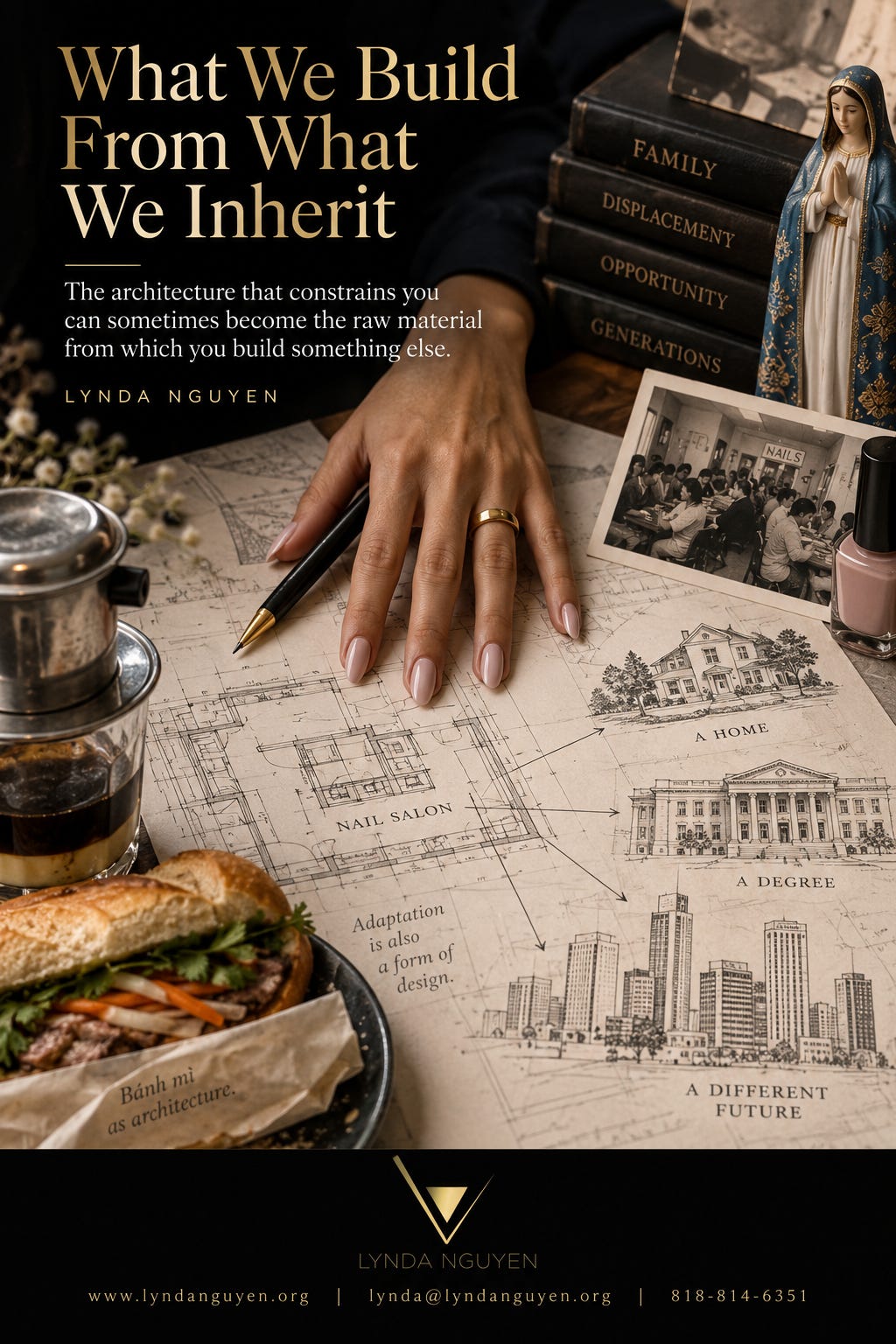
And, being Vietnamese, we did what we have apparently been doing for centuries: we took what was available and made it ours.
The French brought the baguette. We made bánh mì. They introduced coffee cultivation. We added condensed milk, poured it over ice, developed our own coffee culture, and eventually became the world's largest producer of robusta coffee. European missionaries brought Catholicism. We gave Mary an áo dài. Vietnamese refugees settled along the Gulf Coast, encountered crawfish culture, and eventually somebody decided the whole operation could use considerably more garlic butter.
Apparently, one of our cultural competencies is looking at whatever history drops on the table and saying, Fine. We'll work with this.
There is humor in that history, but there is also violence. Vietnam did not encounter France through a friendly cultural exchange. Colonialism was an architecture of domination. War was not an opportunity. Displacement was not an entrepreneurial strategy. Refugees did not leave Vietnam because America offered better career prospects.
We should be careful not to romanticize conditions simply because people eventually created something useful or beautiful from them. Making something from constraint does not justify the constraint.
But it does tell us something about human agency.
The architecture that constrains you can sometimes become the raw material from which you build something else.
I was born in Vietnam and came to America by boat when I was one. Growing up, I didn't experience any of these things as examples of adaptation. Bánh mì was lunch. Vietnamese coffee was Vietnamese coffee. Catholicism was Catholicism. Nail salons were everywhere. This was simply Vietnamese life.
I also grew up understanding that education mattered enormously. Go to college. Get the degree. Build a profession. Vietnamese parents could be wonderfully unsubtle about the acceptable options: doctor, engineer, lawyer, pharmacist, accountant. There were variations, but nobody was gathering the children around to announce that the family dream was for us to become nail technicians.
That contradiction didn't strike me as a contradiction then. Vietnamese people could be enormously successful in the nail industry while simultaneously wanting their children to have different choices. As children, we mostly experienced the second part: the expectations, the enormous emphasis on education, the insistence that we build stable professional lives.
I understand the first part differently now.
The salon paid the mortgage. It employed the aunt or cousin who had just arrived. It offered a path into work when English was limited and conventional professional doors were difficult to open. It created businesses, supported extended families, bought houses and paid tuition. Somewhere a Vietnamese mother could spend six days a week doing nails while insisting that the daughter whose tuition those hands were paying needed to study harder.
It would be easy to read that insistence now as a judgment about the work. I see something different: the work was doing exactly what they needed it to do.
They weren't building an industry simply so the next generation could inherit the same occupation. They were building economic capacity. The point of their adaptation was that their children might have choices they hadn't had.
There is something funny about it. Vietnamese immigrants helped build a $14 billion American industry while working very hard to make sure their children wouldn't need it.
We were told to get degrees partly so we wouldn't have to do the work that was paying for our degrees.
That changes how I understand those old instructions. Study. Go to college. Get the degree. What sounded like parental expectation had an economic architecture underneath it. Someone else's adaptation was paying for our options.
The nail salon wasn't simply an occupation. It was architecture for somebody else's choices.
And once you see that pattern, it becomes difficult not to see it elsewhere.
A company has a terrible approval process. One capable employee figures out how to navigate it. She creates a spreadsheet, develops relationships across departments, learns which stakeholder needs advance warning and discovers which three people can accomplish in twenty minutes what the formal process takes three weeks to do. Eventually she becomes known as someone who gets things done.
Her competence is real. So is the possibility that her competence is concealing a badly designed system.
Organizations often reward people for becoming excellent at compensating for their architecture. We call them resourceful. We promote them. We send other people to them when something gets stuck. Meanwhile, the workaround becomes so effective that the organization loses some of the pressure to repair what made the workaround necessary.
A workaround should eventually become information.
If five employees have independently invented ways around the same process, study what they built. Their behavior may be telling you more about the system than the policy manual does. Pay attention to what people have built in order to survive your architecture. They may already be showing you how to redesign it.
We do something similar in our relationships.
Some of us grew up in families where affection wasn't spoken very often. Love had verbs. Have you eaten? Take this with you. Call when you get there. I made extra. You learn to recognize care without hearing it named. You become attentive to gestures other people might miss.
That adaptation can become a genuine capacity. It does not have to become a lifelong requirement.
I can understand unspoken love and still want someone I love to say the sweet thing. I can appreciate the language I inherited without requiring every relationship I enter to speak only that language.
Other people learn to anticipate everyone's needs, manage tension, make the plans, absorb uncertainty, repair conflict and keep everything moving. Those abilities can make a difficult family functional or an unstable relationship appear surprisingly stable. Eventually, however, competence creates its own question:
Can my competence hide the relationship's incompetence?
Being good at compensating for an architecture does not prove the architecture works.
This is part of what Decision Architecture™ asks us to examine. We spend much of our lives inside systems we did not design. We inherit families, cultures, institutions, economies, histories and relationship models already in motion. We learn how to function inside them long before we have enough power or perspective to question their design.
Adaptation is often necessary. It can keep a family alive, a company functioning or a relationship intact. But what begins as a way of surviving an architecture can eventually become information for building a different one. One generation works with what is available. Their adaptation creates stability; stability creates choices; and the next generation gets to build from a different starting point.
The goal is not to become endlessly better at surviving every system we inherit. It is to notice what survival taught us and decide what deserves to be carried forward, what should be altered, and what the people coming after us should never have to become good at surviving at all.
Sometimes adaptation becomes infrastructure. Vietnamese refugees who entered the nail industry through networks that began in resettlement communities eventually built businesses of their own. Vietnamese Americans now own more than half of the nail salons in the United States.
The results of that adaptation can show up a generation later. Today, 59 percent of U.S.-born Vietnamese Americans over 25 hold a bachelor’s degree or higher, compared with 36 percent of Americans overall—and roughly twice the rate among Vietnamese immigrants.
A baguette becomes bánh mì. A manicure becomes an industry. A salon becomes tuition. A workaround becomes a better process. A childhood adaptation becomes a different way of loving.
We may not choose the architecture we inherit. We have more say in what we build from it.