
In 1983, a United States Army Lieutenant Colonel wrote a 29-page classified analysis of human consciousness for the CIA.
His name was Wayne McDonnell. His document was titled “Analysis and Assessment of Gateway Process.” It was part of a broader Cold War investigation into whether consciousness could be used as an intelligence tool — whether the human mind, under certain conditions, could access information beyond the reach of ordinary perception.
The document was classified for twenty years. Declassified in 2003. Largely unread until 2021, when a Reddit post sent it viral and crashed the CIA’s FOIA server under the traffic load.
Most people focused on the remote viewing. The out-of-body travel. The more sensational conclusions.
But beneath all of that was a quieter finding.
Self-knowledge appeared foundational to perception itself.
McDonnell drew heavily on neuroscientist Karl Pribram and physicist David Bohm, whose work suggests reality functions less like a collection of separate solid objects and more like an interconnected field of energy and information. Consciousness, in this framework, is not entirely confined to the brain. Under certain conditions, the boundary between individual awareness and the larger field becomes permeable.
The document is speculative synthesis, not settled neuroscience. McDonnell was analyzing theories and experiential practices, not delivering proof.
But the questions it raises are real. And for anyone who has spent time studying consciousness, nervous system regulation, or the way perception shapes decision-making, parts of it feel less like discovery and more like recognition.
Reading it, I recognized something familiar.
I spent time in India studying yoga and life-energy systems under Sikh and Hindu lineages. I sat with teachers who had spent decades in these practices. I studied directly with Stanislav Grof in Taos New Mexico, whose work on non-ordinary states of consciousness explores similar territory from a clinical direction.
But the moment I understand best happened not in a temple.
It happened in the streets of Old Delhi.
Organized chaos. Goats and cows exchanging hands in narrow lanes. Dogs lying belly-up in the heat. A world so different from Los Angeles that my nervous system didn’t know what category to put it in.
At first I was nervous. The sensory overload was real. My analytical mind was doing what analytical minds do, cataloguing threats, calculating distances, looking for the familiar.
And then something shifted. Not gradually. Immediately.
I thought, strangely and clearly: if something happened and I had to stay here, I could make friends. I could find love. I could build community. I would be okay.
I didn’t reason my way to that. It arrived. Whole. Without explanation.
Moments later an old woman ran after me through the crowd. She pressed a small Ganesh keychain into my hand. She had seen me trying to haggle in my broken Hindi, she said, and found me endearing. Two young boys on a moped appeared shortly after and rode us back through the streets to where we were staying.
I have thought about that sequence many times.
The certainty arrived before the confirmation. The knowing preceded the evidence.
Years later I founded a nonprofit delivering emotional intelligence and medically accurate relationship education in the years after #MeToo.
I didn’t have a marketing budget. I didn’t have a network specifically built for this work. What I had was a program framed with enough precision and integrity that it answered something the moment was already asking for.
The connections came before I went looking for them. A principal here. A teacher there. Artists who heard about the work and offered to support it before I had thought to ask. Volunteers who showed up already aligned, already certain this was where they were supposed to be.
The work was not easy. But the field around it moved with unusual ease. Resources appeared at the threshold of need. The right people arrived at the right moments with a regularity that stopped feeling like coincidence somewhere in the second year.
What I came to understand is that coherence attracts. When the work is genuinely aligned with what is needed, it stops having to chase. That is not mysticism. It is what happens when the signal is clear enough to be heard.
This is where the Gateway document stops being about consciousness research and starts being about leadership.
Most leaders are operating from a layer of conditioned response so familiar it feels like reality. They are not seeing the room. They are seeing their history of rooms. They are not hearing what is being said. They are hearing what they have learned to expect.
Every decision made from that layer carries the distortion with it.
The ones who consistently make the best decisions under pressure are not the ones with the most information or the highest IQ. They are the ones who know themselves well enough to distinguish between what they are perceiving and what their nervous system is projecting onto a situation.
That distinction sounds simple. It is extraordinarily rare.
Self-knowledge, in this sense, is not therapy. It is not journaling. It is not 360 feedback.
It is the specific, often uncomfortable practice of seeing yourself clearly enough that you stop mistaking your conditioned reactions for accurate perception. That you stop performing certainty when what’s actually happening is that you’re afraid. That you stop managing a room when what the room actually needs is for someone to be genuinely present in it.
The Gateway document calls the state of clear perception the Absolute. The Indian traditions I studied have their own names for it. Neuroscience might describe it as heightened metacognition with less defensive filtering.
I call it what happens when a person finally stops performing and starts actually paying attention.
The CIA spent years trying to understand how human consciousness could access something beyond its ordinary limits.
What fascinated me most was that the document ultimately pointed not toward a technology, but toward a practice. Available to anyone. Requiring no clearance and no equipment beyond the willingness to sit with yourself honestly until the noise settles and something truer surfaces.
I have spent fifteen years in rooms with leaders helping them find that place. Not because I read about it. Because I found it in the streets of Old Delhi when the analytical mind finally went quiet and something clearer moved in.
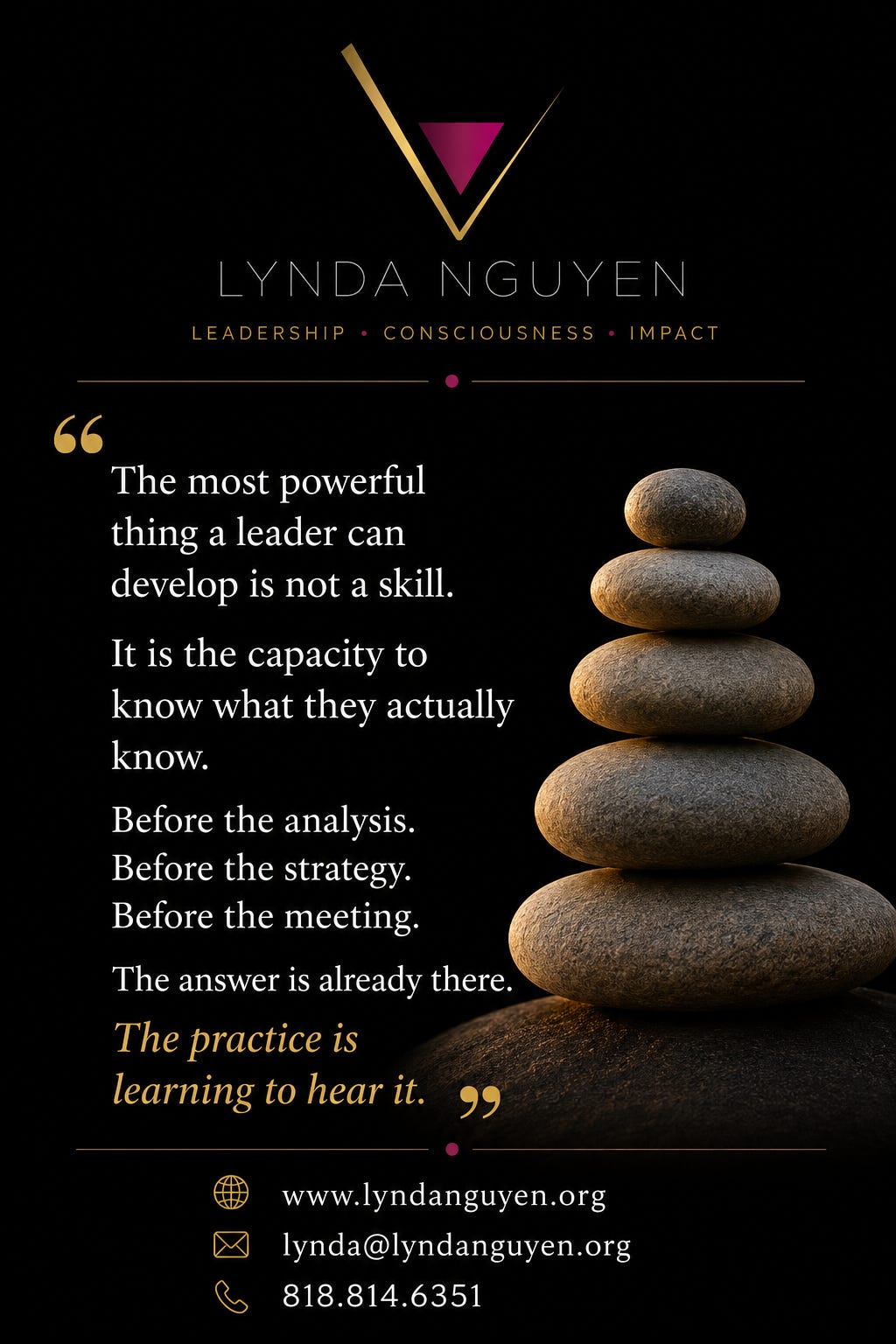
The most powerful thing a leader can develop is not a skill.
It is the capacity to know what they actually know.
Before the analysis. Before the strategy. Before the meeting.
The answer is already there.
The practice is learning to hear it.