
For most of my adult life, I've considered myself the wild card in my family. I've never married, I don't have children, and I've built an unconventional life that has taken me across continents, through different careers and spiritual traditions, and into experiences that would have been difficult to imagine when I was growing up. I've followed my curiosity to India to study consciousness, explored different ways of understanding love and identity, and given myself permission to keep changing my mind about what a meaningful life looks like.
Sometimes I wonder whether my mother wishes I'd chosen something more conventional. A predictable profession, a traditional marriage, children, perhaps a life that would be easier to explain to relatives.
There are moments when my choices seem to shock her, particularly when I speak openly about things that women of her generation were expected to keep private. I can almost see her trying to reconcile the world she grew up in with the daughter standing in front of her.
And then she'll be watching television, see an actress or journalist doing something bold and extraordinary, and point at the screen. "She's like you. You can do that. Didn't you do that once?"
Apparently, while I’m occasionally questioning whether I should have pursued a more conventional career and become a dentist, my mother is wondering why I’m not doing bigger, bolder things on television.
The irony.
I’m wondering whether I should have played it safer. She’s wondering why I’m not taking even bigger risks.
I've also overheard her bragging about me when she doesn't know I'm listening. The very things that sometimes seem to initially unsettle her are often the things she later proudly tells other people about. For years, I thought those reactions contradicted each other. Now I wonder whether they reveal something about what happens when one generation witnesses the freedoms of another.
My mother turns another year older next month, and I've been thinking about the remarkable distance between the life she inherited and the one she helped make possible for me.
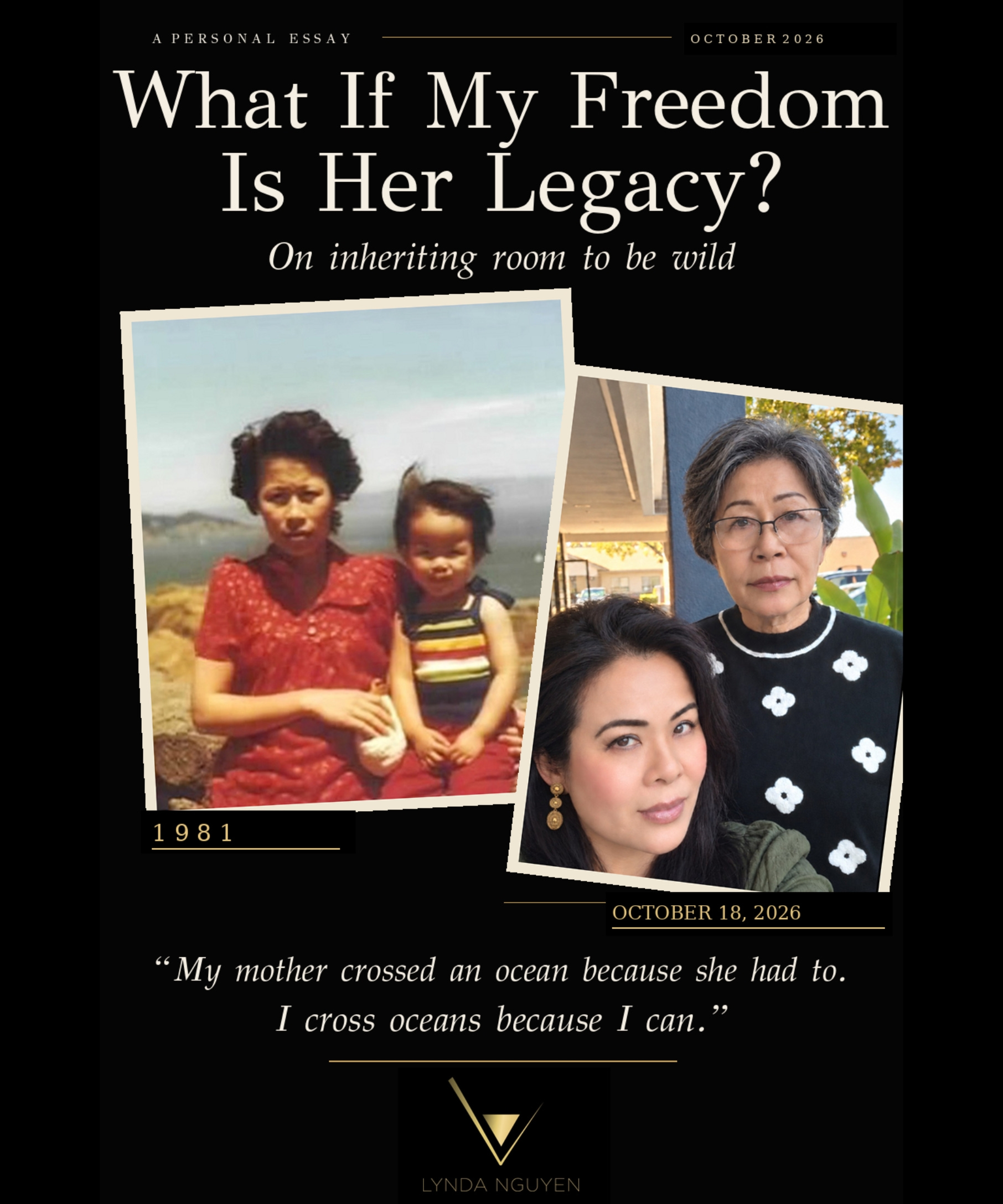
She married at sixteen, having never dated anyone. The man she married was ten years older, a South Vietnamese soldier who had been her tutor. My grandmother encouraged the marriage, and by seventeen, Mama had become a mother. She had my sister first, then me at twenty-one. A year later, at twenty-two, she found herself aboard a boat with her husband and two young daughters, escaping Vietnam after the war.
My father had served in the South Vietnamese military, allied with the Americans, and feared being sent to a re-education camp. He had attempted to escape twice before and been caught both times. Initially, he considered leaving alone because bringing two small children made an already dangerous journey even riskier, but eventually we escaped together. We were lost at sea for fifteen days. I was still nursing.
I have no memories of that journey, but I think about it often, especially when I'm traveling. I imagine my mother holding her children on that boat, uncertain whether we'd reach land, while I now board planes with the luxury of wondering what I'll discover when I arrive.
My mother crossed an ocean because she had to.
I cross oceans because I can.
We were eventually rescued and brought to Singapore. My grandmother, who was already living in Utah, sponsored us to the United States. We stayed with her briefly before my father decided that California, with its growing Vietnamese communities and greater opportunities, offered a better place to begin again.
My parents raised two daughters between cultures, encouraging us to learn English and embrace American opportunities while making sure we remembered our Vietnamese roots. Naturally, my sister and I had our own ideas about how much of each culture we wanted to embrace. We were little rebels, growing up in a world that offered possibilities our parents hadn't known.
What strikes me now is how young my mother was through all of it. By thirty, she'd already spent fourteen years as a wife, thirteen as a mother, survived a war, crossed an ocean as a refugee, and begun rebuilding her life in a foreign country. At thirty, I was still exploring who I wanted to become. She'd already been required to become so many things.
For a long time, I thought about the women in my family primarily through the sacrifices they made. But as I approach my mother's next birthday, I'm realizing how much courage, independence, and outright wildness existed in their lives long before I came along.
My grandmother, for example, was hardly a conventional woman.
While she was still living in Vietnam, she traveled to Paris and London. She had a curiosity about the world and a willingness to venture beyond the familiar that I recognize in myself. She also made choices about love that carried consequences far beyond the relationships themselves.
She left my grandfather, a decision for which she was condemned throughout her life. Yet she dared to love openly, defying her family's expectations and enduring their disapproval. She went on to build a lasting partnership with someone who stood beside her for decades, until death parted them. Even then, the judgment surrounding her first marriage never quite faded.
After immigrating to America, she built businesses and created opportunities for herself in a new country. When her partner died, she chose to remain single. She had built businesses, crossed continents, challenged conventions, and ultimately chosen independence.
The more I think about her, the funnier it seems that I've spent so much of my life believing I'm the rebellious one in the family. Apparently, I inherited a considerable amount of my wildness.
Before she passed, whenever my grandmother saw me, she would quietly tell me, "You're my bravest granddaughter."
I always treasured those words, but I understand them differently now. She knew what it meant to choose a life that other people might not approve of, and she understood the price women could pay for loving outside the expectations of their families and communities. I believe some of my choices might have shocked her initially, just as they sometimes shock my mother, but I also believe that however I decide to live or whomever I decide to love, she would be cheering me on.
Perhaps she recognized in me something she had spent her own life practicing: the courage to make an honest choice and then live with it.
My mother's relationship with love took another path. She married at sixteen, before she'd had much opportunity to discover what love or adulthood might look like on her own terms. Her marriage to my father was complicated, and there were difficult years when my grandmother offered her a place to live if she wanted to leave. Mama stayed, for reasons that belong to her and that I won't pretend to fully understand.
What I do know is that their relationship has changed enormously over time. After more than fifty years of marriage, my parents are now best friends. They've learned how to communicate with each other, how to soften, how to accommodate differences, and how to enjoy the companionship they've built. I catch them cuddling, and sometimes I marvel at the idea that two people who began their relationship so young could spend decades discovering how to love each other differently.
My grandmother left a marriage and found lasting love elsewhere. My mother remained in hers and eventually developed a friendship with the man she married at sixteen. I have never married at all. Three women, three very different relationships with love, each shaped by the choices available to her and the courage to remain true to herself.
I've been thinking about how courage changes from one generation to the next.
My grandmother defied expectations about marriage, crossed borders, built businesses, and chose independence when she wanted it. My mother raised children through war and displacement, navigated immigration, and continued growing within a lifelong relationship. Mine has taken a different form: pursuing an unconventional career, exploring the world, speaking openly about my beliefs, and allowing myself to love without following a predetermined script.
Our risks aren't equivalent, but perhaps courage was never supposed to look identical across generations.
One generation takes extraordinary risks to create a future. The next inherits enough freedom to take different risks within it.
And sometimes those risks can appear almost contradictory.
My parents worked to establish security, while I've occasionally chosen to step away from security in pursuit of something uncertain. My mother began raising a family before she had much time to explore herself, while I've spent years exploring who I am without becoming a wife or mother.
For a long time, those differences produced a quiet guilt in me. I wondered whether my freedom was somehow indulgent compared with what my mother and grandmother had endured, whether I was doing enough with the opportunities they helped create, or whether choosing a less conventional life meant failing to appreciate the stability they worked so hard to establish.
But something has shifted.
These days, whenever I land on another shore, I call Mama.
She doesn't particularly care for travel herself. I'm the one who wants to see the world, experience different cultures, meet people, and discover what exists beyond the life I already know. She doesn't need to accompany me or share that particular appetite for adventure.
But I love calling her when I arrive.
What once felt like guilt now feels like a gift.
I get to tell the woman who once carried me across an ocean that I've reached another part of the world safely, this time because I chose to go there. I get to share the places I've seen and the experiences I've had, knowing that the freedom to make those journeys is inseparable from the courage that brought our family here.
And I suspect that something in her heals when she sees me living and loving freely.
Perhaps that's why her reactions to my authenticity can be so wonderfully contradictory. Sometimes she's shocked by the things I say or the choices I make. Other times she's bragging about those same things when I'm not around. She might need a moment to absorb the latest chapter of my life, but then she'll see someone on television and insist I should be doing something even bigger.
I spent years wondering whether my freedom made her uncomfortable, when perhaps part of her has been celebrating it all along.
Over a decade ago, during my first sacred ayahuasca ceremony, I entered with a question about whether I was on the right path. During that experience, I saw images of women and goddesses and received a message that has stayed with me: You're not doing this just for yourself. You're doing it for the women in your family.
I also encountered the spiritual teaching that healing ourselves can heal seven generations backward and seven generations forward.
I began to understand this as a recognition that we carry more than our own experiences. We inherit family stories, unspoken fears, expectations, and ways of understanding love and belonging. Even emerging research in epigenetics raises questions about how the effects of adversity may extend across generations. But healing the past does not mean changing what happened. It means transforming what those experiences continue to mean in our lives. To heal is to become fully oneself, to honor the women who came before us without remaining blocked and confined by the expectations they endured, and perhaps to make a freer life imaginable for those who follow.
“You are your ancestors' wildest dreams.”
I think about that phrase differently now.
My grandmother was already traveling to Paris and London before I was born, choosing love despite condemnation and building businesses after immigrating to America. My mother crossed an ocean at twenty-two, raised two daughters between cultures, and spent decades learning what love and commitment could become.
And here I am, their daughter and granddaughter, traveling the world by choice, pursuing questions that fascinate me, speaking my truth, and exploring forms of love and freedom that women before me could not always exercise without consequence.
For years, I thought I was the exception to my family's story. Now I wonder whether I'm one of its natural continuations.
Perhaps I wasn't the first wild woman in my family. Perhaps I'm simply the one who inherited more room to be wild.
What moves me most is that Mama is still here to witness it.
She doesn't have to love traveling to enjoy hearing about my adventures, and she doesn't have to understand every expression of my authenticity to celebrate my courage. Sometimes I think she sees possibilities through me that make her own world a little larger, just as her life has given me an understanding of love, resilience, and commitment that I could never have learned through my adventures alone.
As Mama approaches her next birthday, I think about the young mother on that boat, the immigrant raising two daughters between cultures, the woman who learned to love her husband differently over the course of more than five decades, and the mother who now points at the television and tells me I can do whatever extraordinary thing she's watching.
I also think about my grandmother, who quietly called me her bravest granddaughter, and how certain I feel that she would be cheering me on through every surprising choice, every unconventional relationship, and every new chapter of my life.
They lived in times when choosing whom to love or how to live could carry consequences I don't face in quite the same way. Yet they kept making choices, finding possibilities, and showing me what courage could look like.
I no longer feel guilty when I arrive somewhere new. I feel grateful, excited, and connected to the women whose stories brought me here. I call Mama because I want to share that moment with her, and because every arrival reminds me how much can change within a few generations.
Once, she held me while we crossed an ocean, uncertain whether we'd reach the other side. Now I get to call her from shores she may never want to visit herself and tell her where I've landed.
And perhaps, in some small way, each call allows us both to experience how far we've come.
On Mama's birthday, I don't simply want to thank her for the life she gave me. I want to celebrate the woman she continues to become, and the remarkable fact that we still get to witness each other's evolution.
I hope she keeps imagining more for herself, just as she keeps imagining more for me.
And the next time I land somewhere new, I'll call her, as I always do. Not because I need permission to go, but because sharing my freedom with her has become one of my favorite ways to love her.
Happy birthday, Mama.
Your wildest dreams are still unfolding.