
People assume the hardest part of this work is the work.
The difficult conversations. The executive who won't hear feedback. The team that's been in conflict so long they've forgotten what it felt like before. The leader sitting across from you who is brilliant and defended and quietly drowning and doesn't know it yet.
That part is hard. But it's also clear. There's a container. A role. A reason you're in the room.
What nobody asks about is what happens after.
When the session ends and the client logs off and you close your notebook and walk back into your own life.
I've been asked, more than once, whether I can actually turn it off.
Whether the skills stay at work. Whether I come home and stop listening the way I listen professionally. Whether I get to just be a person.
The honest answer is no. And I've stopped thinking of that as a problem.
What I know how to do — really hear someone, track what's underneath what they're saying, stay present when things get uncomfortable, not take the bait when someone is defending instead of communicating — that doesn't live in my work brain. It lives in me. There's no commute it doesn't survive.
So I bring it home. All of it.
What that actually looks like is quieter than people imagine.
It doesn't look like facilitating my own relationships. It doesn't look like running a debrief after a hard conversation or naming someone's attachment pattern out loud.
It looks like staying in the room when the room gets tense. Not because I'm performing patience but because I've learned, at a cellular level, that the thing someone says when they're defensive is almost never the thing they mean. And that if you can wait — really wait, without preparing your response or managing your reaction — something truer usually surfaces.
It looks like knowing when I'm the one who's defended. That's the harder skill. Seeing yourself clearly in real time is different from seeing a client clearly. The stakes are different. The ego is more involved. But the practice is the same: what am I actually feeling, and is what I'm about to say going to serve this moment or just protect me from it.
It looks like not needing every conversation to resolve. Coaching teaches you that insight rarely arrives on schedule. You plant something and you wait. That's true at home too. Some things need to be said and then left alone to do their work.
I think the assumption is that people who do this work are either saints or frauds.
Either they've transcended the ordinary difficulties of being in relationship with other humans, or they're performing wisdom they don't actually live.
The truth is more ordinary than either.
I get it wrong. I get tired. I have days where I've given so much to the work that I come home empty and the best I can offer is presence without much behind it. I know what I should do and sometimes I do the other thing anyway.
But the training doesn't leave. It's not a hat I wear professionally and hang by the door.
It's closer to a language. One I've spoken long enough that I don't translate anymore. I just think in it.
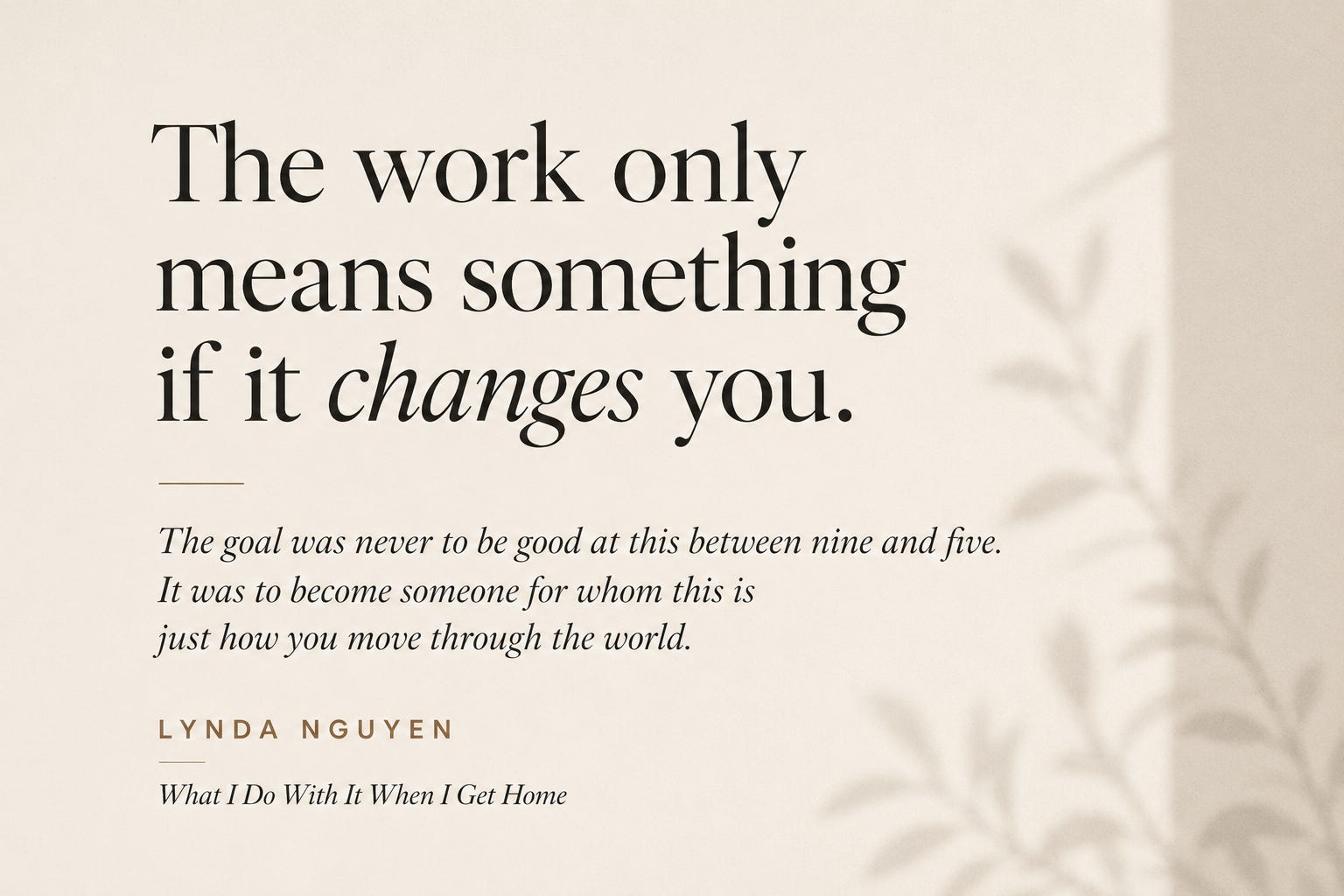
What I've come to believe is that this work only means something if it changes you.
Not your resume. Not your methodology. You.
If you can hold a client in a moment of real vulnerability and then go home and be defended and reactive and unwilling to be seen — something didn't transfer. The work stayed at work. And that's a kind of compartmentalization that I think quietly costs people more than they realize.
The goal was never to be good at this between nine and five.
It was to become someone for whom this is just how you move through the world.
I remember a moment with my partner when things got uncomfortable and I had no words. Me, without words. I didn't reach for a reframe or a question or anything I would have used professionally. I just stayed. Present, quiet, without needing to fix it. And I spoke the next day, when there was actually something true to say.
That might be the most useful thing this work has ever given me. Not the language. The willingness to wait until the language is real.
I'm not there perfectly. Nobody is.
But I'm closer than I used to be. And the distance between who I am in a session and who I am when I close the laptop has gotten smaller every year.
That's the thing I actually measure. Not the client outcomes or the frameworks or the credentials.
Whether the work is making me more human.
So far, I think it is.