
Everyone wants emotional intelligence.
Organizations hire for it. Leadership books celebrate it. Therapists cultivate it. Parents hope to raise emotionally intelligent children. We've become remarkably fluent in the language of feelings.
And yet, I think we've quietly started confusing several very different capacities.
We use words like emotional, sensitive, attuned, and emotionally intelligent almost interchangeably. I don't think they describe the same thing. I think they describe different capacities that build on one another, and when we confuse them, we misunderstand not only ourselves, but the architecture of healthy relationships.
We often assume that someone who feels deeply must also be deeply sensitive. Someone who cries easily must be emotionally attuned. Someone who remains composed must not feel very much at all.
I'm no longer convinced any of those conclusions necessarily follow.
Not everyone who feels deeply notices deeply.
I've met people who experience emotion with extraordinary intensity. Every disappointment becomes devastation. Every disagreement feels like rejection. Every uncomfortable feeling immediately enters the room with them. Their emotions are genuine, but the intensity of what they feel doesn't always seem to translate into a deeper awareness of the people around them.
I've also met people who rarely cry in front of others. They appear calm, almost understated. Yet they notice everything. The colleague who has quietly withdrawn halfway through a meeting. The hesitation before someone says, "I'm fine." The subtle shift in a partner's voice that reveals exhaustion rather than frustration. They don't seem to feel less. They seem to perceive more.
I recognize myself somewhere in that second description. The noticing came early. The words for it came much later. I feel everything deeply.
Research points in a similar direction. Psychologist Elaine Aron, whose work on Sensory Processing Sensitivity found that highly sensitive people aren't simply more emotional. They tend to process information more deeply, notice subtle environmental and interpersonal cues, and reflect before responding. Emotional responsiveness is part of sensitivity. It is not the whole of it.
Which makes me wonder whether we've mistaken emotional intensity for emotional sensitivity.
Feeling intensely and perceiving accurately are different capacities.
One describes the force of our internal experience. The other describes the quality of our perception. One can exist without much of the other.
I've noticed something in certain conversations. Someone describes their sensitivity at length. They explain how deeply they feel things, how much they notice, how aware they are of every emotional current in the room. And then the hour ends and they've never once asked how you're doing. The sensitivity was real. The awareness turned entirely inward. The person across from them never quite made it into the room. Not the partner. Not the friend. Not the one sitting right there.
Emotional intensity without outward attention isn't sensitivity. It's self-absorption wearing the language of self-awareness.
And even perception isn't the end of the story.
I've met people who read every room with astonishing precision. They know what someone wants, what someone fears, what words will persuade, what silence will create uncertainty. They're remarkably perceptive.
But perception alone isn't emotional intelligence.
It isn't even attunement.
The ability to understand another person can become compassion.
It can also become manipulation.
Perception, by itself, is morally neutral.
Attunement begins somewhere else.
It begins when what we notice changes how we choose to respond. Not because it serves us, but because it serves the relationship.
You recognize that someone is overwhelmed, so you slow down.
You notice your own defensiveness before it becomes someone else's burden.
You sense that your partner isn't asking for solutions. They're asking for connection, and whether you're still with them.
Sensitivity notices.
Attunement allows what we notice to change how we behave.
Research on emotional intelligence has consistently arrived at a similar conclusion. The distinguishing characteristic isn't that emotionally intelligent people feel less. They often feel just as deeply. The difference is that they're better able to recognize their emotions, regulate them, understand the emotions of others, and choose responses that strengthen rather than erode relationships.
Which makes me think emotional intelligence isn't another capacity alongside the others.
It's what emerges when emotion, sensitivity, attunement, and regulation begin working together.
I've started wondering if we've made the same mistake here that we've made with self-awareness.
We assume that because someone feels deeply, they'll naturally relate deeply.
But emotion isn't relationship.
Just as self-awareness isn't transformation, emotion isn't emotional intelligence.
One is an internal experience.
The other is a relational capacity.
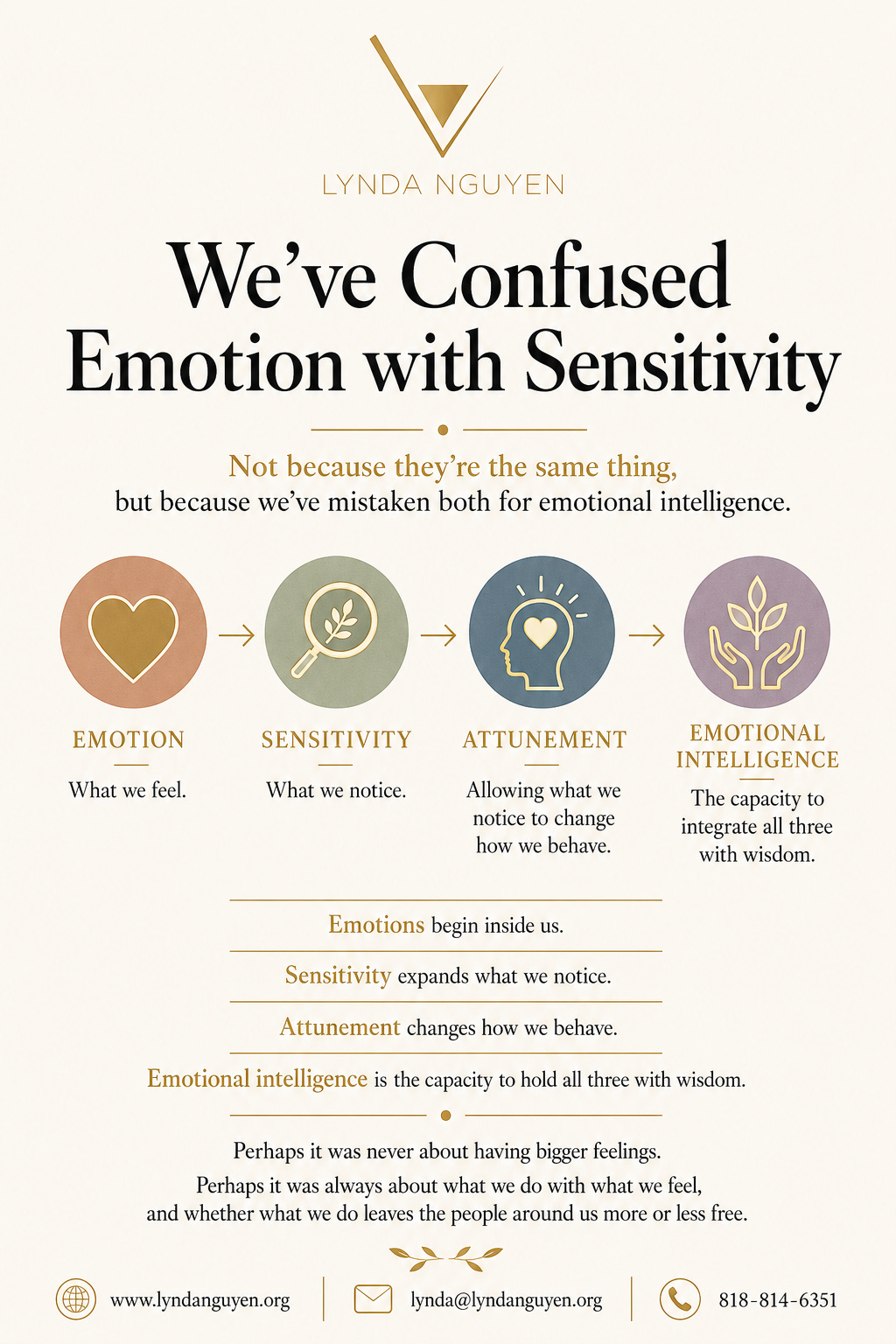
Emotion is what we feel.
Sensitivity is what we notice.
Attunement is allowing what we notice to change how we behave.
Emotional intelligence is the capacity to integrate all three.
Perhaps this is another architecture problem.
Every relationship is quietly shaped by what each person brings into the room: not only their intentions, but their nervous system, their attention, their ability to regulate themselves, and their willingness to let what they notice change how they behave.
Some people fill a room with their feelings.
Others create enough safety that everyone else's feelings finally have somewhere to land.
Those are very different kinds of presence.
The question isn't:
How deeply do I feel?
The better question is:
What do my feelings allow me to notice about my partner right now, in this moment, in this room? And does what I notice make the person in front of me feel more seen, more held, more themselves?
Emotions begin inside us.
Sensitivity expands what we notice.
Attunement changes how we behave.
Emotional intelligence is the capacity to hold all three with wisdom.
Perhaps it was never about having bigger feelings.
What do my feelings allow me to notice, and does what I do with that noticing help my partner, or the people I love, feel more seen?