
Whenever something mysterious enters the public conversation, something predictable happens.
We begin telling stories.
Today June 29, 2026, the Large Hadron Collider at CERN entered a planned shutdown for upgrades. Within hours, the internet filled with explanations. Some wondered whether timelines would shift. Others speculated about portals, hidden technologies, or changes in the Earth's energy. The theories themselves were fascinating, but not for the reasons most people assumed.
I wasn't interested in whether they were true.
I was interested in why we needed them.
There is something deeply human about our relationship with uncertainty. We don't leave empty space alone for very long. When information is incomplete, the mind begins constructing a bridge between what it knows and what it cannot yet explain. That bridge is built from stories.
Sometimes those stories become myths.
Sometimes they become scientific hypotheses.
Sometimes they become conspiracy theories.
Sometimes they become religions.
Different stories. The same instinct.
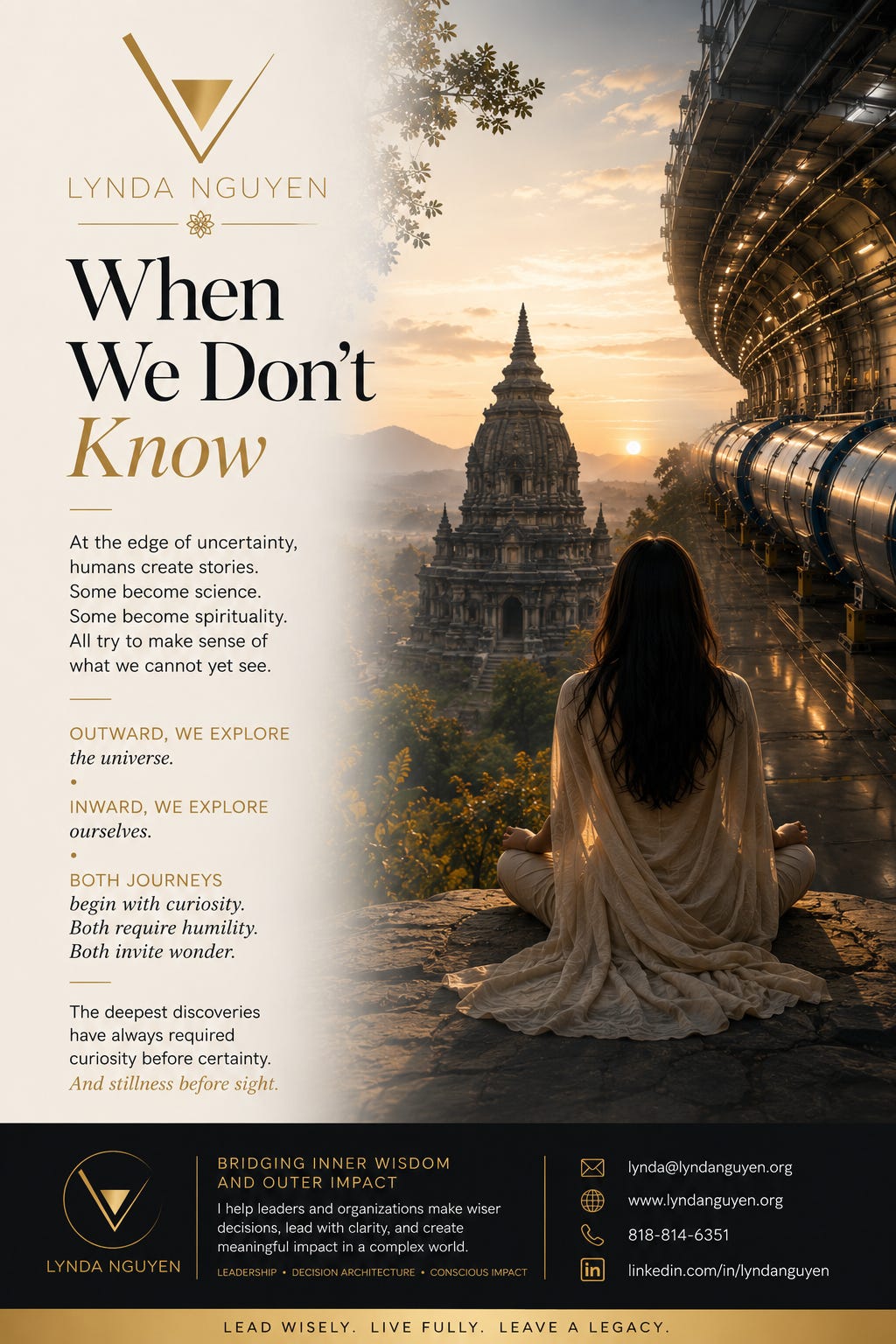
Long before particle accelerators existed, people stood beneath the night sky wondering what held the stars in place. They built observatories. They built temples. They developed mathematics. They wrote sacred texts.
None of those efforts began with certainty.
They began with wonder.
That is why I've never been particularly interested in the argument that science and spirituality are opponents. They ask different questions, use different methods, and arrive at different kinds of knowledge. But both emerge from the same refusal to stop asking what lies beneath appearances.
One turns telescopes and particle detectors toward the universe.
The other turns attention toward consciousness.
Both are attempts to understand reality.
What fascinates me isn't which path someone chooses.
It's what happens before the choice is made.
Because there is a moment that appears everywhere — in laboratories, boardrooms, relationships, governments, and families — when the evidence runs out before our need for certainty does.
That is where Decision Architecture begins.
Leaders experience it every day.
A strategy changes and people invent reasons before they receive an explanation.
A company restructures and stories spread faster than facts.
Someone doesn't return a text, and an entire narrative appears in the mind before a conversation ever takes place.
I once sat with a leadership team the week after their CEO canceled an all-hands meeting with no explanation. The meeting had been on the calendar for a month. Everyone had questions queued up. And then, two hours before it was set to begin, an assistant sent a one-line message: postponed, new date TBD.
By the next morning I had heard four different theories from four different people on that team. A merger. Layoffs. A health scare. A board conflict. Each story was specific. Each was delivered with conviction. None of them turned out to be true. The CEO had simply been pulled into an unrelated personnel matter that had nothing to do with the company's direction.
But for nearly a week, an entire leadership team operated as though one of those four invented stories was real. Decisions slowed. Trust frayed slightly at the edges. People began protecting themselves against outcomes that were never actually coming.
The cancellation wasn't the problem.
The empty space it left behind was.
The human nervous system is remarkably uncomfortable with ambiguity.
So we fill it.
Not because we're irrational.
Because we're meaning-making creatures.
Perhaps that's why CERN captures our imagination so easily. It isn't merely a laboratory beneath the Swiss countryside. It has become a canvas onto which millions of people project hope, fear, spirituality, skepticism, and curiosity.
In that sense, CERN isn't the story.
We are.
My own path has taken me through contemplative practice, sacred pujas and chant, leadership development, and organizational consulting. I've spent years watching how people interpret uncertainty — inside themselves and inside organizations. The patterns are remarkably consistent.
The stories change.
The architecture underneath them rarely does.
Maybe the real question isn't whether CERN is changing reality.
Maybe it's whether we notice how quickly our minds begin constructing reality whenever certainty disappears.
Because once you see that process, you begin to recognize it everywhere.
In leadership.
In conflict.
In culture.
In relationships.
In the stories we tell about ourselves.
And perhaps the most profound discovery isn't hidden beneath seventeen miles of underground tunnel.
Perhaps it's hidden inside the astonishing human capacity to create meaning from mystery.