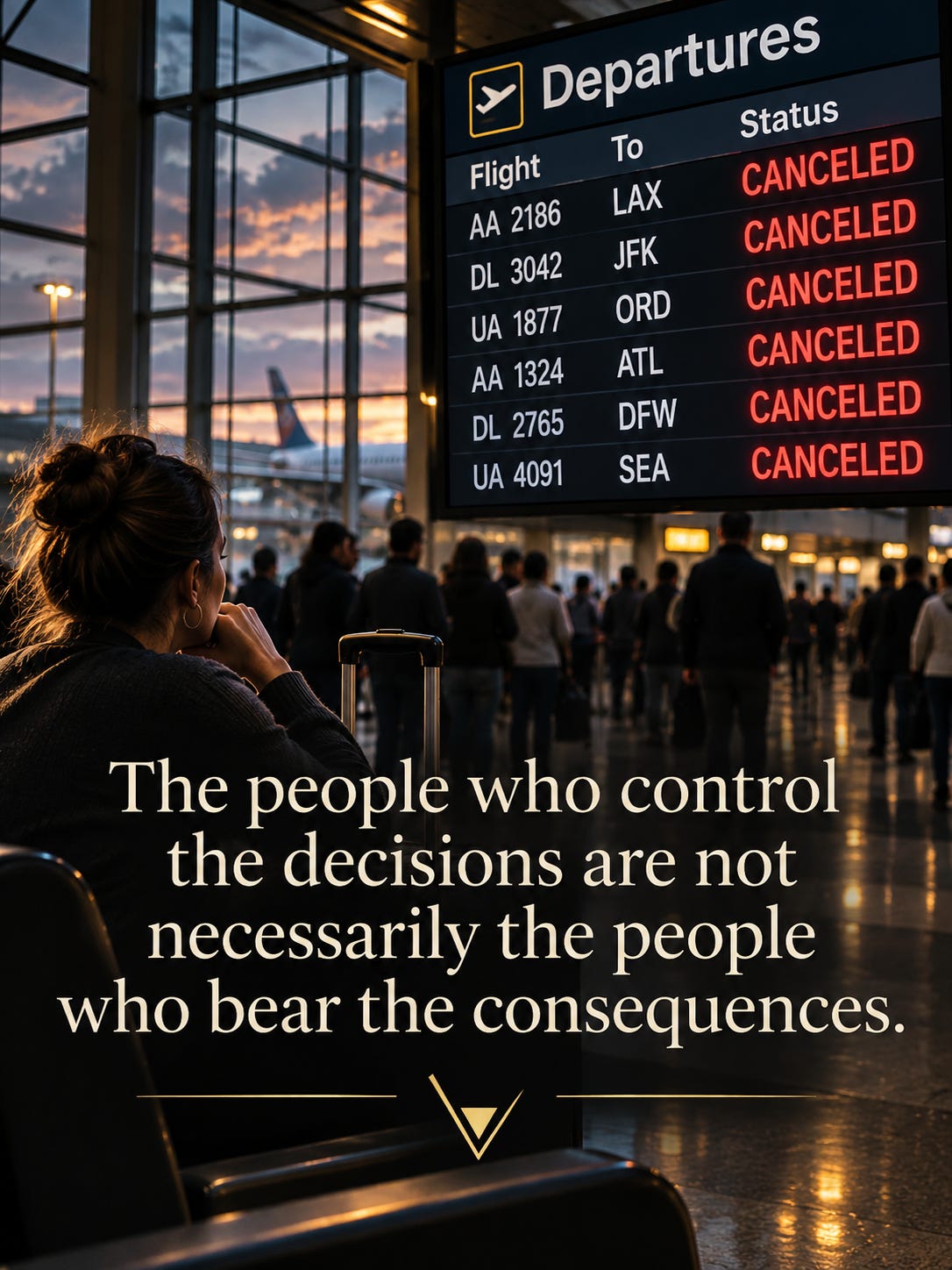

My sister finally made it home this morning after spending two nights stranded near Raleigh-Durham International Airport, paying approximately $600 a night for rooms in what she describes as janky, three-star hotels.
Her flight was canceled again last night, leaving her without a confirmed way home until today.
Not luxury accommodations. Not an indulgence. Just an ordinary place to sleep, at a price that would normally suggest something considerably better.
And the hotels weren't the only expense. Local reports described stranded passengers hearing of Uber fares reaching $200, while rental cars and available accommodations became increasingly scarce.
Fortunately, she was traveling for work. Her employer will likely cover the expenses.
But I keep thinking about the passengers around her.
What happens to the person who cannot afford even one night? The hourly worker who loses three days of wages? The parent who has to arrange emergency childcare? The elderly traveler living on a fixed income?
The same flight cancellation can be an inconvenience for one person and a financial catastrophe for another.
Neither passenger caused the disruption. Neither had the authority to prevent it. Yet their financial circumstances determine how much of the failure they can survive.
And this was no ordinary flight delay.
The nationwide aviation disruption on Friday, November 13, 2026 brought American air travel to a standstill for more than four hours. By Saturday evening, more than 15,000 flights had been canceled across two days, with thousands more delayed and hundreds of additional cancellations already extending into Sunday. More than 1.5 million passengers faced disrupted travel plans. Behind those numbers were missed wages, mounting hotel bills, separated families, and people left wondering when they would get home.
The scale of the disruption raises serious questions about the reliability of the infrastructure on which millions of Americans depend.
The United States has experienced major aviation system failures before. In January 2023, an outage involving the FAA’s Notice to Air Missions system temporarily halted domestic departures.
These failures expose how dependent modern aviation has become on interconnected infrastructure that most passengers never see, much less understand.
The FAA’s infrastructure vulnerabilities have also been the subject of federal oversight.
Aging systems, modernization challenges, and the difficulty of maintaining critical technology while introducing new capabilities are not problems that emerged overnight.
What investments had been prioritized? Which safeguards were in place? How were modernization risks assessed? And what information reached the people responsible for deciding when and how upgrades should proceed?
The timing of another development raises a related question about the pace of modernization.
On November 10, just three days before the nationwide ground stop, the FAA announced the expansion of its AI-assisted SMART system across all 22 air traffic control centers. The technology was designed to analyze hundreds of data streams and improve the efficiency of air traffic management.
Three days later, the nation's aviation system came to a standstill.
Officials attributed the disruption to telecommunications infrastructure problems, not the SMART system.
But how are new technologies integrated into aging infrastructure? What safeguards protect existing systems during modernization? Who independently evaluates the risks?
Technological advancement and institutional readiness are not necessarily the same thing.
When a critical system fails, the public deserves more than an explanation of what broke. It deserves an understanding of the decisions, investments, and risk assessments that preceded the failure.
During the same week, reports of a Microsoft service disruption and controversy surrounding Nvidia’s leadership raised different questions about the systems on which businesses, employees, investors, and governments depend.
Three different institutions. Three different circumstances. No established evidence of a common cause.
Still, something about their convergence deserves our attention.
We have built an extraordinarily sophisticated civilization around systems most of us do not understand, cannot independently verify, and have almost no authority to influence.
We trust that the aircraft will depart. That the software will function. That the people governing strategically important companies will exercise sound judgment. That intelligence will reach those who need it. That someone, somewhere, has considered what happens when things go wrong.
Most days, that trust is rewarded.
Until it isn’t.
And when it isn’t, the consequences have a remarkable tendency to travel outward.
When Microsoft experiences an outage, businesses dependent on its infrastructure must improvise. Meetings are missed. Work stops. Employees scramble to recover lost time. For some organizations, even a brief interruption can create financial consequences far beyond the cost of the software itself.
When questions arise about leadership and governance at a company as strategically important as Nvidia, the uncertainty can extend beyond the people directly involved. Employees, investors, customers, and business partners may all have interests at stake.
When aviation infrastructure fails, travelers are left searching for flights, hotel rooms, transportation, and explanations.
Different systems. Different failures.
But a familiar pattern.
The people who control the decisions are not necessarily the people who bear the consequences.
And the people bearing the consequences are rarely given enough information to understand the risks beforehand.
We often describe these situations as disruptions, a remarkably tidy word for experiences that can dismantle someone’s week, finances, or sense of security.
A disruption sounds temporary.
For the person who misses a paycheck, it may not be.
For the small business operating on narrow margins, it may not be.
For the employee whose savings are concentrated in company stock, uncertainty about leadership and governance may be more than an abstract concern.
And for the traveler without a financial cushion, another night in a hotel may simply not be an option.
We have become remarkably good at measuring the cost of maintaining systems and considerably less attentive to the cost of making people survive their failures.
But there is another dimension to these events, one that deserves more scrutiny.
What do we actually know about the decisions that precede a crisis?
We usually encounter institutional failure at the moment it becomes visible. A system goes offline. A flight is canceled. A leadership controversy becomes public.
But what happened before that moment?
Which vulnerabilities were already known? Which warnings were elevated? Which were dismissed? What alternatives were considered too expensive, too inconvenient, or politically undesirable?
And who had the authority to decide?
These are not accusations. They are questions that should be ordinary features of institutional accountability.
Consider Nvidia.
The company occupies an extraordinary position in the global economy. Its technology supports much of the infrastructure behind artificial intelligence, and its commercial relationships intersect with American industrial policy, export controls, and geopolitical competition with China.
Allegations involving the private conduct of powerful executives deserve careful scrutiny, particularly when reporting suggests possible implications for corporate governance or national security. But allegations must not be mistaken for established findings.
The more consequential question is how institutions respond when credible concerns arise.
Who knew what, and when?
Who had the authority to act?
What information was withheld, and for what reason?
If intelligence officials possess credible concerns about a potential national security vulnerability involving a strategically important company, what obligations do they have to inform the people or institutions at risk?
There may be legitimate reasons to protect confidential intelligence. Revealing an investigation can compromise sources, methods, and national security interests.
There may also be competing economic and diplomatic considerations.
That is precisely why the decision-making process deserves examination.
When intelligence, political relationships, commercial interests, and national security converge, which considerations prevail?
And how would the public ever know?
Then there is the question of incentives.
Who benefits when a dominant company becomes vulnerable?
Competitors may see opportunities to gain market share. Political actors may find additional leverage over industrial policy. Investors may reassess their positions.
None of this demonstrates that any party caused, encouraged, or coordinated a controversy. Benefiting from an event is not evidence of responsibility for it.
But examining incentives is essential to understanding the environment in which decisions are made.
It is possible for an institution to face a genuine crisis while other parties discover opportunities within it.
It is possible for a decision to be legally permissible and still expose others to enormous risk.
And it is possible for the public to know the outcome of a decision without ever learning why that decision was made.
We have encountered these tensions before.
During the COVID-19 pandemic, governments and institutions made consequential decisions under extraordinary uncertainty. Some people continued working from home while others lost their livelihoods, businesses, or financial security. Families, friendships, and communities fractured. People who questioned government policies and institutional decisions were ostracized, silenced, and sometimes professionally punished. Questioning authority became a test of social belonging rather than an essential part of public accountability.
And when questioning becomes socially or professionally dangerous, institutions lose access to the very information they need to make better decisions.
Respecting expertise does not require treating authority as infallible.
And accepting uncertainty does not mean accepting the absence of transparency or accountability.
One of the most damaging things an institution can do is communicate uncertainty as certainty, then expect public trust to remain unchanged when the picture becomes more complicated.
Trust is not the absence of questions.
It is the confidence that questions can be asked, evidence examined, and mistakes acknowledged.
These questions are not confined to governments and major corporations. They appear across business partnerships, organizations, and communities whenever unilateral decisions abruptly alter someone else's reality. Sometimes the decision is impulsive. Sometimes it has been quietly developing for months. Either way, one party exercises the freedom to choose while others are left navigating consequences they had no part in creating. Over time, those consequences can travel in both directions, eroding the trust, stability, and credibility of the institution that made the decision.
The right to choose does not eliminate responsibility for the consequences, particularly when those consequences extend beyond ourselves.
At an institutional scale, however, the distance between decision and consequence becomes much harder to see.
A senior executive may make a decision whose costs are distributed among thousands of employees.
A government official may authorize or delay an action whose consequences are experienced by millions.
A technology company may optimize its infrastructure around efficiency while customers assume risks they cannot meaningfully evaluate.
And a traveler may find herself standing at an airport counter, trying to understand why another night of lodging has become her financial responsibility.
The scale changes. The underlying questions remain.
Who knew what?
Who had the authority to act?
What incentives shaped the decision?
What alternatives were available?
And who was expected to carry the consequences?
This is a central concern of Decision Architecture™: the conditions that produce a decision deserve as much scrutiny as the decision itself.
We tend to evaluate judgment by examining the outcome.
Was the decision successful? Was it profitable? Was it legal? Did the organization survive?
But those questions are incomplete.
We also need to understand what information reached the decision-maker, how that information was interpreted, which human needs and institutional pressures influenced the choice, and whether the environment encouraged sound judgment or rewarded something else entirely.
Fear can narrow perception.
Greed can distort the evaluation of risk.
Lust, ambition, loyalty, self-preservation, and the desire to maintain power can all influence what people are willing to see, acknowledge, or dismiss.
None of these forces automatically produces misconduct. But pretending that decision-makers are somehow immune to them because they occupy positions of authority is a dangerous assumption.
The person making a decision does not become a different psychological organism upon entering a boardroom, government office, or executive suite.
And the higher that person rises, the farther the consequences of poor judgment may travel.
We have a tendency to celebrate resilience as though it were an unlimited human resource.
We ask employees to adapt. Travelers to be patient. Small businesses to remain agile. Families to prepare for uncertainty.
But resilience has a cost.
It requires time, money, health, emotional capacity, relationships, and access to alternatives.
Those resources are not distributed equally.
Money buys options. It buys another hotel room, a replacement flight, an emergency babysitter, a financial cushion, or the ability to walk away from an unstable situation.
Without those resources, uncertainty becomes something else entirely.
A missed shift becomes lost wages. Lost wages become a late payment. A late payment becomes a penalty. A temporary disruption becomes a lasting setback.
We should be careful not to mistake someone’s ability to afford a crisis for evidence of superior resilience, or someone’s inability to afford it for a failure of character.
And perhaps we should question a culture that celebrates people’s ability to endure preventable hardship more readily than it examines the decisions that created it.
No complex system can eliminate uncertainty. Not every outage is evidence of negligence. Not every leadership controversy signals institutional collapse. Not every technical failure could have been anticipated or prevented.
And not every unequal consequence is necessarily unjust.
Risk is an unavoidable feature of human cooperation.
But accepting risk is not the same as accepting unlimited exposure to decisions made without our knowledge or meaningful participation.
Nor does the complexity of a system absolve those governing it of the responsibility to examine foreseeable harm.
Sometimes systems fail despite responsible decisions.
Sometimes they fail because of irresponsible ones.
And sometimes the most troubling possibility is that the system is operating exactly as its incentives encourage it to operate, even when the human outcome is unacceptable.
Because what looks like efficiency from inside an institution may look like instability from the perspective of the person expected to absorb its costs.
What looks like strategic flexibility to a policymaker may look like uncertainty to a worker.
What looks like an acceptable operational risk on a spreadsheet may look like an impossible hotel bill to a stranded passenger.
The question is not whether every institution can guarantee perfect outcomes.
It cannot.
The question is whether those with the greatest authority are sufficiently accountable to the people who bear the consequences of their decisions.
Whether meaningful information reaches the people who need it.
Whether warnings can be raised without punishment.
Whether the costs of failure are considered before they are transferred to someone else.
And whether institutions are willing to learn when the people affected by their decisions tell them something is wrong.
My sister has finally arrived home in Southern California. Her employer will cover the expenses. In a few weeks, this may become an exhausting travel story she tells over dinner.
But somewhere among the stranded passengers is someone whose circumstances are very different.
Someone who cannot afford another night.
Someone whose employer will not cover the cost.
Someone who may have to choose between paying for a hotel and paying a bill waiting at home.
The same disruption. Radically different consequences.
We may never know all the decisions that preceded this week’s headlines. Some information will emerge through investigations. Some may remain confidential. Some questions may have entirely ordinary explanations.
But we should not have to wait for a system to fail before we are allowed to question how it works.
And we should not confuse the absence of complete information with an obligation to stop asking.
What if the most consequential information withheld from the public challenges not merely our trust in institutions, but our understanding of reality itself?
The true measure of an institution is not simply how efficiently it operates when everything goes right.
It is how responsibly it distributes the consequences when things go wrong.
Because a society that continually asks ordinary people to become more resilient should also be willing to ask whether its most powerful institutions have become sufficiently accountable.
And if we knew in advance who would bear the consequences of our decisions, and could not distance ourselves from those consequences, would we still make the same choices?