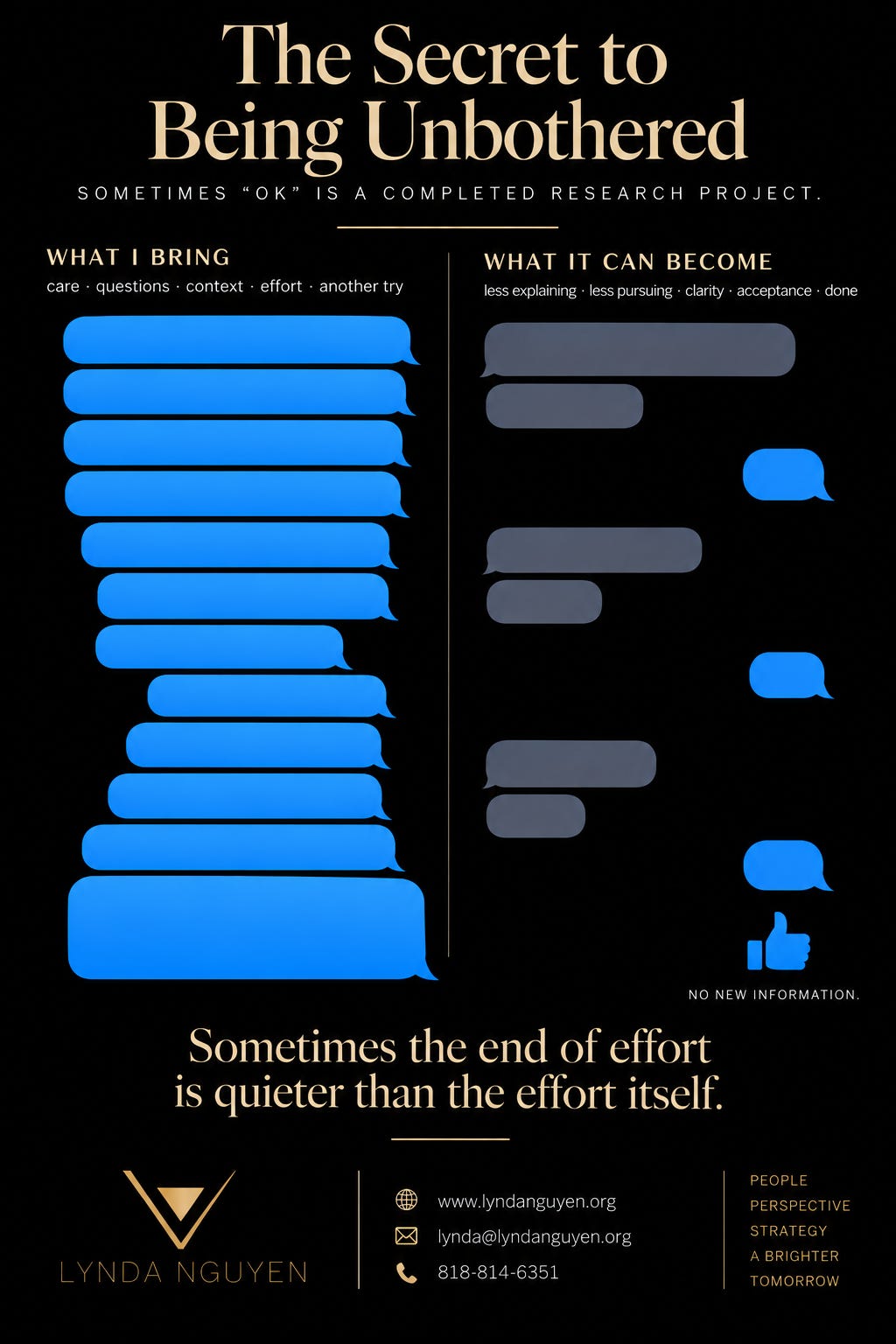

I am suspicious of people who say they are unbothered, usually because they are announcing it. Nobody has ever posted "protecting my peace" seventeen minutes after an argument because they had, in fact, achieved peace.
We have turned being unbothered into a cultural aspiration. Don't chase. Don't explain. Don't react. Match energy. Cut people off. Let them misunderstand you. Block them and glow. There is an entire internet economy built around appearing so emotionally untouchable that nothing another human does can disturb your nervous system.
I don't think that is what being unbothered looks like. Sometimes it looks like caring so much that you finally gather enough information to stop.
I am capable of extraordinary effort when I care about something or someone. This is both one of my better qualities and occasionally a terrible idea. I will initiate the conversation, ask the question, try to understand what happened, examine my part, tell you what I need, ask what you need, and try differently. I will make the thoughtful gesture. I will give the benefit of the doubt. I will consider whether timing, stress, fear, history or circumstance explains something that might otherwise look obvious.
I can also write a 2,000-word text. This is not hypothetical.
If I believe something matters and there is still information I don't have, I am willing to go looking for it. And then, occasionally, something happens. The 2,000-word texts become "Ok." Then “Thumbs Up” emoji.
This transition can be alarming if you don't understand the research methodology.
I am not particularly diplomatic once I have had enough. I don't have a secret second act in which I continue pursuing someone who has decided to misunderstand me. If I become convinced that nothing useful is going to come from another explanation, my interest in explaining can disappear with astonishing efficiency. But getting there may take me a while.
For years, I thought this was primarily about effort. I am someone who tries hard. If a relationship matters, I want to know I tried. If work matters, I over-deliver. If a problem looks solvable, I will probably attempt to solve it. If there is a conversation that might change something important, I would rather have it than spend six months pretending I don't care.
There is another explanation: I am gathering information.
Every attempt produces some. You tell someone clearly what you need and watch what happens. You ask a question and listen not only to the answer but to whether the answer survives contact with behavior. You make room for circumstances. You try another approach. You stop doing the thing they said was hurting them. You become more specific. You give someone another opportunity because the last three months really were unusually difficult.
None of those actions guarantees a different outcome, but each produces information. Eventually, repetition does too.
That is the part we don't talk about enough when we glorify effort. We have entire vocabularies for persistence: fight for it, work through it, don't give up on people, relationships take work, families are complicated, healing isn't linear, give people grace, communicate, be patient, try again. All of that can be true. It can also keep us working long after the work has stopped teaching us anything new.
At some point, the fifth conversation is not five separate incidents. It is information about what conversations can accomplish here. The fourth broken commitment is not another opportunity to become better at explaining why the commitment matters. The job that keeps rewarding your competence with more work and no corresponding opportunity is telling you something. So is the friendship in which you are always the person reaching out, the client who repeatedly ignores the boundary you have explained, and the person who says they understand and repeatedly behaves as though the conversation never happened.
The difficult part is not always getting the information. Sometimes it is deciding when you have enough.
I have stayed in the information-gathering stage longer than necessary because effort can feel like agency. As long as there is another conversation to have, there is another possibility. As long as I can explain something more clearly, show up differently, offer another solution, be more patient or try one more time, the outcome has not completely left my hands. There is comfort in that, even when the effort itself is exhausting.
The more capable we are of changing things, the harder it can be to recognize what is not ours to change.
Acceptance is harder because sometimes it means admitting there is no undiscovered combination of words, generosity, patience and effort that will produce the outcome you wanted. There may be nothing left to solve. That does not mean someone is terrible, that you were foolish for trying, or that the entire relationship, job, friendship or experience was a mistake. It means the available information has changed, and a decision that made sense with what you knew six months ago may no longer make sense with what you know now.
This is where I think "unbothered" becomes more interesting than the internet version. Being unbothered is not necessarily a personality trait. It may be the result of a completed decision process.
Before the decision, there can be enormous activity: questions, conversations, attempts, adjustments, hope, frustration and another attempt. From the outside, this can look like someone who cannot let something go. Sometimes it is. But sometimes a person is still trying because the evidence is genuinely incomplete.
A hard season is not necessarily a pattern. One disappointing response does not tell you everything about a person. People get scared. People get overwhelmed. People make mistakes. Organizations go through bad quarters. Friends disappear into their own lives. Partners fail each other and repair. Good people behave badly. A single moment deserves context.
The problem is that context can become infinitely renewable. There is always another explanation available if you are sufficiently committed to finding one. They are stressed. The timing was bad. The organization is restructuring. They didn't mean it that way. They are going through something. This isn't who they usually are. Next month will be different.
Any one of those things may be true. Understanding the conditions that produce a behavior matters. But explanation and information are not opposites. You can understand why something keeps happening and still recognize that it keeps happening.
A pattern is not simply the same thing happening repeatedly. It is information about the conditions under which something continues to happen. At some point, the useful question changes from Why did this happen again? to What keeps producing this outcome?
That shift is what Decision Architecture™ is concerned with: looking upstream of a decision at the conditions that made it make sense. Information, relationships, incentives, histories and circumstances all shape what becomes possible next. One of the most consequential moments in any decision is recognizing when the information has changed.
Not when we are angry enough. Not when somebody else tells us we should leave. Not when we have built a case against someone. When we know enough to make a different decision.
There is a strange cultural tendency to treat the person who stops trying as the person who suddenly stopped caring. Often, the opposite is true. They cared for a very long time. They asked, explained, adjusted, initiated, gave another chance and tried to distinguish a difficult season from an enduring pattern. They gathered information until the information became repetitive. Then one day, they stopped asking the same question.
This can be especially confusing because the end of effort is often quieter than the effort itself. The person who used to send paragraphs sends a sentence. The employee who used to bring ideas to every meeting stops volunteering them. The friend who always initiated decides to see how long the silence lasts. The partner who kept raising the same concern stops raising it.
Everyone relaxes because the complaint has disappeared.
Sometimes that is exactly the wrong interpretation.
Silence can mean peace. It can also mean the research is complete. There is a difference between having nothing left to say and no longer believing that saying it will produce useful information.
I don't want to become someone who gives up easily. I don't admire disposability disguised as boundaries. Human beings are complicated, and anything worth building will eventually require us to tolerate ambiguity, inconvenience, disappointment and repair. But I also don't want persistence to become a virtue independent of what persistence is producing.
Effort should teach us something. If I keep making the same intervention and receiving the same result, eventually I have to consider the possibility that the result is not an interruption of the pattern. It is the pattern.
And perhaps this is the part of being unbothered that nobody can perform on Instagram. There is no dramatic declaration required, no revenge, no public lesson about knowing your worth, and no need to become cold. You can still love someone and believe the information. You can appreciate what a job gave you and believe the information. You can understand why someone behaves the way they do and believe the information. You can have compassion for the circumstances and believe the information.
Understanding something does not require you to keep volunteering for it.
Eventually, being unbothered may simply mean you have stopped asking reality to submit additional evidence. You tried, learned, adjusted and tried again. At some point, you knew.
"Ok."
Sometimes that’s passive aggression.
For me, it’s a completed research project.