
I almost titled this essay In Defense of Sex Workers.
Did that grab your attention?
Perhaps you raised an eyebrow. Perhaps you wondered what, exactly, I intended to defend. Perhaps you had already formed an opinion before reading another word.
Good. That reaction is part of what interests me.
I’ve been thinking about the curious ways we assign moral credibility to people. How readily we associate certain professions with integrity, others with questionable character, and how little either assumption tells us about the person.
We are remarkably comfortable judging people by what they do for a living. Less comfortable examining what people actually do while living.
Years ago, I founded a nonprofit dedicated to bringing medically accurate sex education to high school students. In the aftermath of #MeToo, conversations about consent, boundaries, sexuality, and personal responsibility had become especially urgent.
At one of our conferences, I invited a woman to speak.
She was brilliant. Articulate, thoughtful, and highly educated. A librarian with a master’s degree.
She was also an adult film performer.
I remember an observation she made about educating boys that has stayed with me.
If someone wants to learn how to drive, we send them to driver’s education. We don’t expect them to watch Fast & Furious and emerge understanding traffic laws, defensive driving, and the responsibilities of operating a vehicle.
Why, then, would we expect boys to learn about sex, intimacy, and consent from pornography?
It was such an obvious observation that I wondered why it needed to be made at all.
We understand perfectly well that entertainment is not education when it comes to operating a car. Yet when it comes to sexuality, one of the most consequential dimensions of human relationships, we often leave young people to figure things out through whatever material happens to be available.
What interested me just as much was the woman making the observation.
Had I introduced her only as a librarian with a graduate degree, some people might have regarded her as a credible educator. Add the fact that she worked in adult entertainment, and suddenly the same intelligence, the same education, and the same words might be received differently.
Nothing about the woman had changed.
Only the information used to judge her.
Research suggests that social standing can influence whom we trust, sometimes before we have meaningful evidence of someone’s character.
In a 2023 study examining distrust and socioeconomic inequality, researchers found that participants entrusted more money to strangers presented as having higher socioeconomic status. Their decisions were influenced by signals of status rather than observed trustworthy behavior.
Other research has produced different results, reminding us that trust is shaped by context.
But the larger question remains.
How often do we mistake the appearance of credibility for evidence of integrity?
I have also encountered women whose experiences with the sex industry were anything but voluntary, including women who had been trafficked as children. Those experiences are not remotely interchangeable with consensual adult sex work.
A child cannot consent to commercial sexual exploitation. Coercion is not a contract. Survival under duress is not meaningful freedom of choice.
I have no interest in romanticizing an industry in which exploitation can occur, sometimes with devastating consequences.
But I am equally uninterested in pretending that exploitation, deception, and moral compromise are confined to professions society considers disreputable.
In fact, some of the most consequential examples occur in places we have been taught to admire.
Corporate boardrooms. Government offices. Financial institutions. Prestigious universities. Religious organizations. Respectable homes.
The architecture changes. The human capacity for dishonesty does not.
The Association of Certified Fraud Examiners examined 1,921 occupational fraud cases across 138 countries and territories in its 2024 Report to the Nations. Among the cases studied, fraud committed by owners and executives produced median losses of $459,000, compared with $60,000 for employee-level perpetrators.
The United States Securities and Exchange Commission filed 456 enforcement actions in fiscal year 2025, including cases involving securities fraud and other violations of federal securities laws.
Transparency International’s 2025 Corruption Perceptions Index found that 122 of 182 countries and territories scored below 50 on a scale measuring perceived public-sector corruption.
These figures measure different things. They do not establish how many executives or public officials are corrupt, nor do they imply that misconduct is universal among people in authority.
They do, however, make one thing difficult to dispute.
Prestige is not proof of integrity.
A title can establish institutional authority. It cannot establish honesty.
An advanced degree can demonstrate intellectual accomplishment. It cannot establish character.
A wedding ring can symbolize commitment. It cannot establish fidelity.
And a socially respectable profession can tell us remarkably little about what someone is willing to conceal.
Yet we continue to behave as though the external markers of respectability are reliable indicators of moral credibility.
Consider the transactions we openly condemn and those we quietly accept.
An adult who consensually exchanges sexual services for money may be regarded as morally compromised simply because the transaction is explicit.
Meanwhile, someone may enter a romantic relationship primarily for financial security, social advancement, access, or professional opportunity and receive considerable admiration for having made an excellent match.
A person may remain in a marriage for appearances while conducting an entirely different private life.
Another may profess loyalty to an organization while privately negotiating opportunities that benefit them at its expense.
A public official may speak passionately about serving the community while concealing financial interests that influence decisions.
An executive may publicly champion transparency while ensuring that inconvenient information never reaches the board.
The question is not whether these situations are identical. They are not.
The question is why we so often judge the visibility of a transaction more harshly than the dishonesty surrounding one.
Human relationships have always involved exchanges.
We exchange time, affection, attention, resources, protection, companionship, knowledge, labor, and care.
A parent spends years caring for a child without calculating a return. Friends support one another through difficult periods. Partners share responsibilities, ambitions, and financial burdens.
Reciprocity is not inherently corrupt. Nor does the presence of practical considerations invalidate genuine affection.
Love and material reality have never existed in separate universes.
The problem begins when the terms of an arrangement are deliberately misrepresented.
When someone professes devotion while secretly pursuing access.
When loyalty is promised but treated as expendable.
When affection is offered as a means of manipulation.
When one person believes they are participating in a relationship fundamentally different from the one the other person has constructed.
Not every expectation needs to be spoken aloud. Not every private thought constitutes deception. Human relationships require room for uncertainty, changing needs, and personal privacy.
But material dishonesty matters.
It matters because people make decisions based on what they believe to be true.
They invest years of their lives. They combine finances. They raise children. They decline other opportunities. They expose themselves emotionally, professionally, and sometimes physically.
Their decisions are shaped by the information available to them.
When material information is deliberately concealed, the other person’s ability to make an informed choice is compromised.
This is where the discussion becomes much larger than sex.
And much more uncomfortable.
We tend to imagine dishonesty as something committed by obviously dishonest people.
People unlike us.
People without our education, our values, our social standing, or our respectable professions.
But dishonesty rarely announces itself as dishonesty.
It arrives dressed as necessity.
As discretion.
As protecting someone’s feelings.
As maintaining stability.
As doing what is best for the organization.
As avoiding unnecessary conflict.
As something everyone does.
The more sophisticated the person, the more sophisticated the explanation can become.
Behavioral ethics research has long examined the distance between people’s moral self-image and their actual decisions. Concepts such as motivated reasoning and ethical fading help explain how individuals can reinterpret questionable behavior in ways that preserve a favorable understanding of themselves.
An uncomfortable decision becomes a practical necessity. A concealed interest becomes a private matter. A broken promise becomes an unfortunate consequence of circumstances.
None of this requires someone to wake up in the morning intending to be dishonest.
Sometimes the explanation develops alongside the decision.
Sometimes it develops afterward.
And sometimes the person offering the explanation believes every word.
That may be one of the more troubling features of human judgment.
We are not always reliable witnesses to our own motives.
I began thinking more deeply about this after receiving a handful of thoughtful responses to The Myth of the Rational Man within 24 hours of its publication. In that essay, I examined the relationship between power, desire, judgment, and accountability.
The responses were incredibly intelligent, occasionally amusing, and revealing in ways I hadn’t anticipated.
What interested me was how quickly a discussion about an individual’s judgment could shift toward the behavior of other people involved. Questions of biology, temptation, shared responsibility, and human nature entered the conversation.
There is nothing inherently wrong with examining those influences. Human behavior rarely occurs in isolation. But I noticed how easily a conversation about someone’s responsibility could become a conversation about why that responsibility might be diminished.
And that distinction matters.
Understanding what influences a decision is not the same as excusing the decision itself.
Someone violates an agreement, and we begin examining the circumstances.
Who encouraged it?
Who participated?
Who created the temptation?
Who should have known better?
Those questions may help us understand what happened. They do not necessarily answer who was responsible for honoring which obligation.
The presence of another willing participant does not erase an existing commitment.
The fact that human beings are susceptible to desire, fear, ambition, insecurity, or temptation does not make every decision inevitable.
We are influenced by our biology, our histories, our environments, and the incentives surrounding us.
We are also capable of reflection, restraint, and choice.
Otherwise, the entire concept of accountability becomes meaningless.
For the record, I’ve never cheated. Not because I’m immune to temptation, but because I have neither the appetite nor the administrative patience for maintaining two versions of my life.
Ending one relationship before beginning another has always seemed considerably less complicated.
Apparently, this is a radical position.
Humor aside, I don’t regard fidelity as evidence of moral superiority. People make mistakes. Relationships change. Human beings disappoint one another, sometimes profoundly.
But there is a difference between acknowledging human imperfection and constructing elaborate explanations to avoid responsibility for our choices.
This distinction matters far beyond romantic relationships.
It is a central concern of Decision Architecture™: the conditions that produce a decision deserve as much scrutiny as the decision itself.
Power changes those conditions.
It can reduce the likelihood of being challenged. It can create opportunities unavailable to others. It can surround people with individuals who have incentives to agree, accommodate, or remain silent.
It can also make the consequences of private decisions profoundly public.
A concealed conflict of interest may influence investments, hiring decisions, or the allocation of resources.
An undisclosed personal relationship may compromise professional judgment.
A misleading public statement may affect employees, shareholders, constituents, or communities who have no knowledge of the underlying circumstances.
The more consequential the position, the greater the importance of examining the conditions under which decisions are made.
Yet we frequently substitute reputation for scrutiny.
We assume that someone who has achieved extraordinary professional success must possess extraordinary personal discipline.
We mistake confidence for credibility.
We confuse eloquence with sincerity.
We interpret wealth as evidence of wisdom.
And we sometimes regard people who speak openly about uncomfortable realities as less trustworthy than those who have mastered the art of concealing them.
There is a certain irony in that.
A person who openly states the terms of an unconventional arrangement may be considered disreputable.
Another who conceals the terms of a conventional arrangement may remain socially admired.
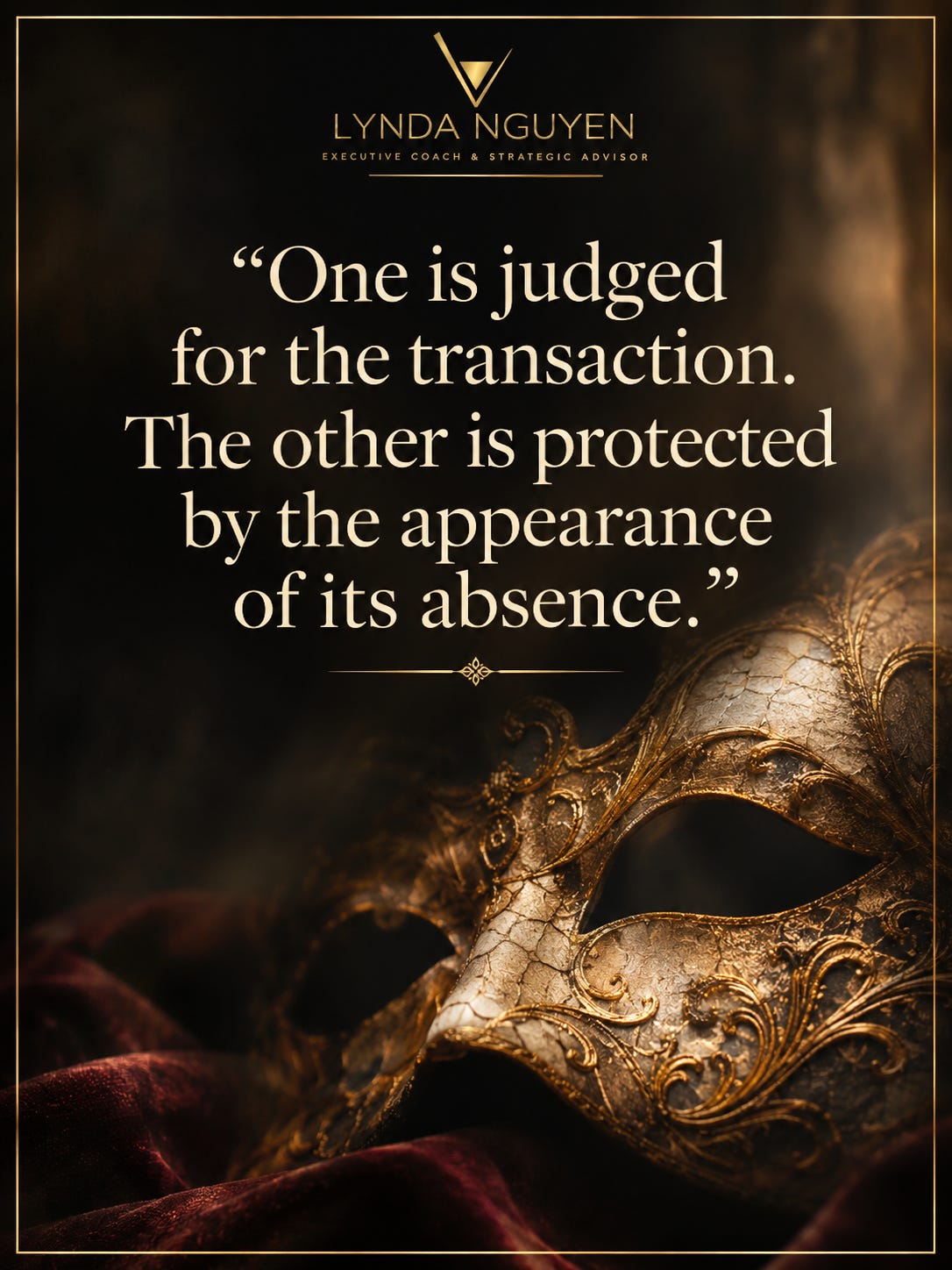
One is judged for the transaction.
The other is protected by the appearance of its absence.
Of course, transparency alone does not establish integrity. A disclosed arrangement can still be coercive, unfair, or exploitative. Consent must be meaningful, and power imbalances deserve scrutiny.
Nor should every relationship be reduced to an economic exchange. Human affection, generosity, devotion, and sacrifice cannot be adequately explained through the language of transactions alone.
But we should be able to distinguish between a relationship involving reciprocal needs and one maintained through deliberate deception.
Between an agreement we might personally dislike and a promise someone has knowingly broken.
Between conduct that challenges our social conventions and conduct that violates another person’s trust.
Those distinctions matter.
They matter in intimate relationships.
They matter in business.
They matter in government.
And increasingly, they matter in our interactions with artificial intelligence, where systems can simulate attentiveness, understanding, and emotional reciprocity while the commercial incentives and technological mechanisms underlying those interactions remain largely invisible.
As our relationships with technology become more sophisticated, the question of what we believe we are receiving, and what is actually being exchanged, becomes increasingly important.
We cannot make informed decisions about arrangements whose essential terms we do not understand.
Perhaps that is the thread connecting these seemingly unrelated worlds.
The sex worker, the executive, the politician, the romantic partner, the institution, and the technology company.
Each invites us to examine the relationship between appearance, incentives, disclosure, and trust.
Not because their circumstances are morally equivalent.
But because our judgments about them are often shaped by assumptions that deserve closer examination.
I think back to the woman who spoke at my conference.
The librarian with a master’s degree who also worked in adult entertainment.
She understood something important about the difference between performance and education.
Perhaps there is a similar distinction between the performance of integrity and its actual practice.
Integrity is not a profession, a credential, a political office, or a public reputation.
It is the consistency between what we profess, what we practice, and what we do when the truth becomes inconvenient.
And honesty is not demonstrated by how successfully we maintain a respectable appearance.
It is demonstrated by our willingness to tell the truth, honor our agreements, and accept responsibility when doing so costs us something.
Which brings me back to the title I almost used.
In Defense of Sex Workers.
The question was never why some people openly exchange intimacy for money.
The more interesting question is why we extend such extraordinary moral credibility to people who conceal the terms of their own transactions.
We have become very good at recognizing the kinds of dishonesty society has taught us to condemn.
It may be time to examine the kinds we have learned to respect.