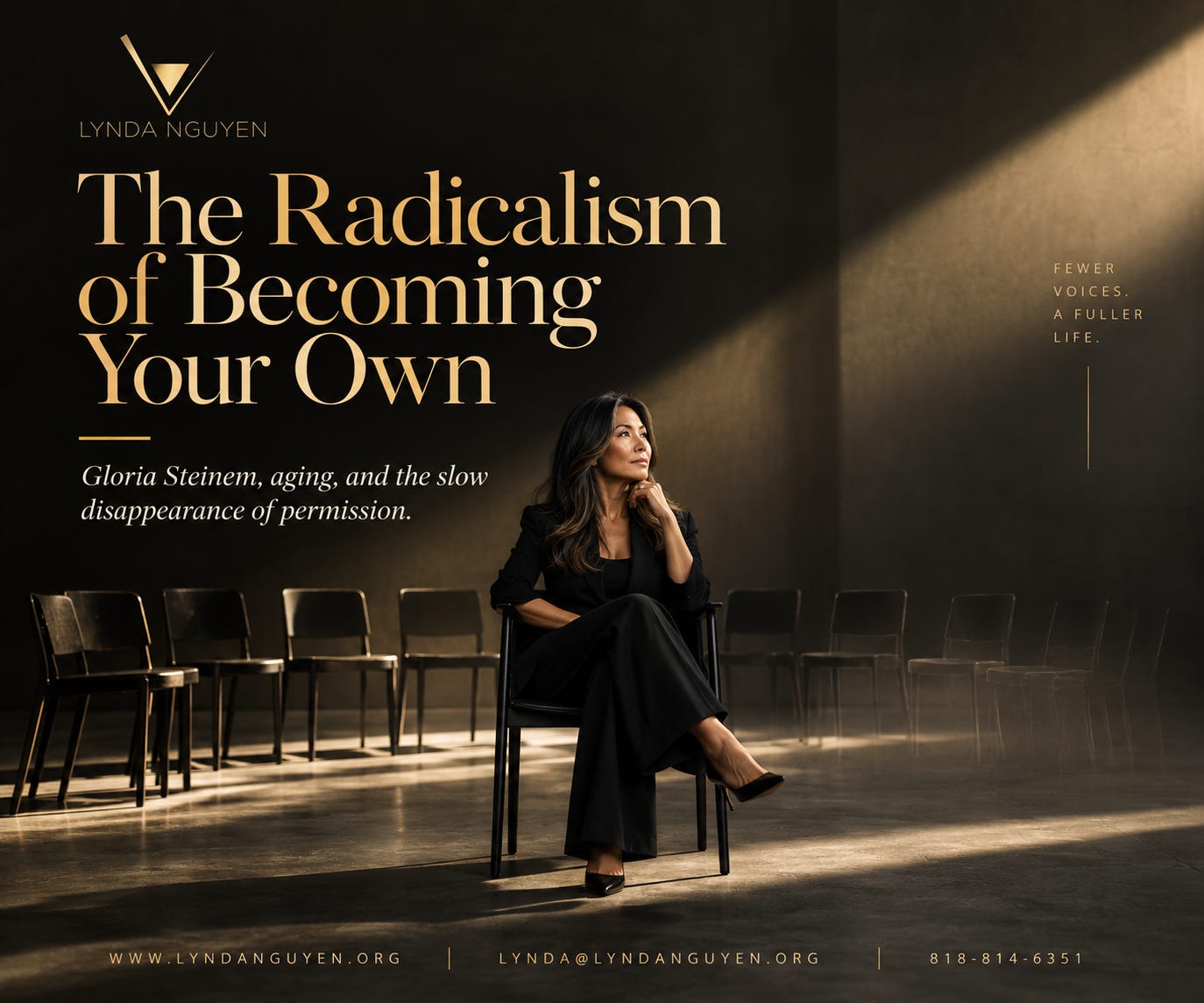

"Women may be the one group that grows more radical with age." — Gloria Steinem
Gloria Steinem died on September 2, 2026, at 92.
It is difficult to tell the story of women in America over the last sixty years without encountering her somewhere in it: what she built, what she changed, what she got right, what she got wrong, and the movement she helped carry into American life.
But there is something about that particular sentence that feels worth sitting with now.
Women may be the one group that grows more radical with age.
Not because women become more ideological as they get older, or because age produces some inevitable march toward a particular politics. Something else happens.
The audience gets quieter. The invisible committee we consult about our lives begins losing members. And eventually, we begin to question why we gave them a vote in the first place.
Will they like me? Will they choose me? Am I too ambitious? Too loud? Too difficult? Too old to begin again? Should I want marriage? Children? A career? All three? Should I stay here? Move there? Travel more? Build a life somewhere entirely different? Should I care more about how I look? Less? Is this selfish? Is this appropriate? What will people think?
For much of a woman's life, these questions can sit quietly inside decisions that appear entirely our own.
Then life gives us information.
We love people who leave. We survive things we were certain would destroy us. We achieve things we thought would finally make us feel secure and discover that achievement cannot answer every question. We disappoint people and discover the earth keeps rotating. We change our minds. We lose people. We begin again. And slowly, some of the rules lose their authority.
That is one form of radicalization: not becoming more extreme, but becoming more difficult to separate from your own judgment.
It is easy to inherit freedom and mistake it for atmosphere. Many of the choices available to American women today can feel so ordinary that it is possible to forget how recently they were constrained by law, institutions, economics, and social expectation.
Steinem came of age in a country where women's professional lives were dramatically narrower than they are now. Sex discrimination was woven into employment and education. Abortion was illegal in much of the country. Marriage could fundamentally alter a woman's economic and legal independence. Sexual harassment did not yet have a widely recognized name, much less an established place in employment law.
At 22, Steinem had an illegal abortion. Years later, she would become one of the most recognizable public advocates for women's reproductive freedom. But her influence extended far beyond a single issue.
She helped found Ms. magazine in the early 1970s, creating a mainstream platform where women could speak openly about experiences that had often been treated as private problems: domestic violence, sexual harassment, rape, abortion, childcare, economic inequality, political power. The magazine's preview issue sold hundreds of thousands of copies in days.
The response revealed something larger than demand for a new publication. Women wrote because they recognized themselves. Experiences they had assumed were individual failures, private humiliations, or simply things women were expected to endure were suddenly being described publicly by other women.
Freedom can begin with recognition. Before people can challenge a condition, they often have to be able to name it. Before they can organize around an experience, they have to discover they are not alone in having it. Steinem helped create language where silence had been.
She also helped co-found the National Women's Political Caucus alongside women including Shirley Chisholm, Bella Abzug, and Betty Friedan, pushing the movement beyond cultural recognition toward political representation and institutional power.
The work was not simply about changing what women believed about themselves. It was about changing the structures surrounding their choices. And much of what once looked radical eventually became ordinary.
That is one of the strange consequences of successful social change: when a freedom becomes ordinary enough, the people who inherit it can forget that someone had to make it possible.
Most of us will never know the names of all the women whose courage became part of the ordinary architecture of our lives. We will never know who endured the first day in the room where women were not welcome, who asked the question everyone had been taught not to ask, who left a marriage she could no longer survive, who demanded to be paid fairly, who told her daughter she could become something no woman in the family had been before.
We inherit one another in ways we rarely notice. Some women leave us laws. Some leave us language. Some leave us an example.
Laws matter. Money matters. Access matters. Institutions matter. But permission also has an architecture.
There are the rules written into law, and then there are the rules written into us: be desirable, be agreeable, do not become too powerful, do not become too needy, do not age visibly, do not remain single too long, be independent but not intimidating, be successful but make sure everyone remains comfortable with your success.
Modern women inherited considerably more freedom than the women who came before us. We also inherited contradictions. And this is where Steinem's observation about aging becomes interesting.
Aging cannot eliminate the architecture surrounding a woman. Ageism itself becomes another part of it. But age can change how much authority we grant that architecture.
At some point, a woman realizes that being approved of and being at peace with her own life are not the same thing. She discovers that disappointing her parents, defying the expectations of her culture, or unsettling the people whose approval once mattered most is sometimes the unavoidable cost of not disappointing herself. She stops treating every expectation placed upon her as information she is obligated to use.
The world has not given her permission.
She has stopped waiting for it.
There is another reason I keep returning to Steinem this week. Honoring the women who expanded our choices does not require us to make the same choices they made. In fact, that would defeat the point.
I consider myself a feminist. I also do not agree with every position Gloria Steinem held during a very long public life, nor with every direction feminism has taken since the movement she helped lead. Gratitude does not require ideological inheritance. Neither does respect.
One of the freedoms feminism gave women is the freedom to disagree with feminists.
A movement built around women's agency cannot ultimately require women to arrive at identical conclusions. The liberated woman does not have to reject marriage to prove she is free. She does not have to marry to prove she values family. She can marry a man, marry a woman, or never marry at all. She can build a life with a partner without needing marriage to make that love legitimate. She does not have to become a mother, nor reject motherhood. She can want power and softness. She can build a company, stay home with children, do both at different points in her life, or build a life organized around something else entirely. She can change her mind.
The feminist choice cannot simply mean choosing whichever option currently carries the feminist label. Freedom is not demonstrated by which choice a woman makes. Freedom is demonstrated by whether she is genuinely free to make it.
Steinem's own life contained that complexity. For decades, she resisted marriage, in part because of what marriage had historically required of women. Then, at 66, she married. Asked about the apparent contradiction, she pointed out that marriage itself had changed. The institution surrounding the decision was different, so the meaning of the decision could be different too.
We sometimes speak about autonomy as though it exists entirely inside a person: Be brave. Know yourself. Choose. But choices do not happen in empty rooms. They happen inside laws, economies, families, cultures, relationships, expectations, and histories. Change those conditions, and the same choice can mean something entirely different.
That is part of what Steinem's generation understood. Freedom requires internal courage. It also requires a world in which courage has somewhere to go.
There is an enormous industry devoted to convincing women that aging represents diminishing value: less desirable, less visible, less relevant, less beautiful, less powerful. There are losses that come with aging, and pretending otherwise does women no favors.
But there can also be an accumulation: evidence, discernment, economic independence, history, a longer memory of who we have been, the knowledge that reinvention is survivable because we have already done it, the recognition that attention and love are not the same thing, the understanding that being wanted and being valued are not interchangeable. And, eventually, a clearer sense of which voices deserve a vote in our lives.
About ten years ago, I lost two women whose lives had shaped what I understood to be possible for my own. My grandmother was a trailblazer who moved through the world with a certainty I did not fully appreciate until she was gone. I also lost one of the women closest to me, who was leading a women's movement in Los Angeles. Both women had, in very different ways, refused to wait for permission.
There are things I asked them then that I would ask differently now, with the perspective I did not yet have. What did they have to ignore in order to become the women I remember? What frightened them? Which expectations did they quietly refuse? Was the certainty I saw in them always there, or was it something they had to build?
That is one of the cruelties of losing women before we are finished becoming ourselves: by the time we understand some of what they gave us, they are no longer here to tell us what it cost them.
But their lives remain information. I know more about what is possible because I watched them live.
Grief changed me. It rearranged what seemed important and exposed how much time we can spend negotiating with rules that were never ours to begin with. After those losses, some of the borrowed rules became easier to see.
Grief is its own kind of radicalization.
This is part of why women grow more radical with age. The radicalism is not in what we choose. It is in who gets to decide.
There is a difference between becoming yourself and becoming your own. The first sounds like discovery, as though somewhere underneath everything is a finished person waiting to be uncovered. The second suggests possession, responsibility, stewardship.
This life belongs to me.
Not because no one else matters. Quite the opposite. Love asks things of us. Family asks things of us. Community asks things of us. Commitment sometimes requires inconvenience, compromise, sacrifice, and staying when leaving would be easier.
Becoming your own does not mean becoming accountable to no one. It means becoming increasingly conscious of what deserves authority over you. A life organized entirely around other people's approval is not freedom, but neither is a life organized entirely around avoiding obligation. The work is harder than either of those. It is learning what deserves our loyalty.
Age gives us something else, too. Eventually, we realize we have become part of someone else's architecture of permission. There is a younger woman somewhere watching what we tolerate, what we refuse, how we love unapologetically, what we leave, what we build, whether we apologize for our ambition or our desires, whether we begin again after loss, change careers, cross oceans, choose differently, take up space, and build lives that would have once required an explanation. She is learning what is possible by watching what we no longer ask permission to do.
We do not only inherit freedom. Eventually, we model it.
In her later years, Steinem continued gathering people in the Manhattan brownstone she had lived in since 1968. She arranged for the home to continue serving as a gathering place for social-justice work after her death.
When people spoke to her about passing the torch to younger generations, she resisted the metaphor. She wasn't interested in extinguishing hers so someone else could carry it. Everyone needed a torch.
That feels like the right way to remember her. Not by pretending that every woman must carry Gloria Steinem's politics unchanged into the future, not by turning a complicated human being into a monument, and not even by agreeing with her. But by recognizing the enormity of what it means to inherit choices that previous generations of women had to fight to make possible.
They changed laws. They entered institutions that had excluded them. They said things publicly that women had been taught to endure privately. They made themselves inconvenient. They argued. They organized. They failed. They contradicted themselves. They changed their minds. They kept going.
Eventually, some of the things they demanded became ordinary enough that their daughters and granddaughters could take them for granted. That is not a failure of the movement. It is evidence of its success.
Gloria Steinem spent much of her life helping women acquire choices their mothers did not have. The final freedom is quieter: becoming old enough to understand that having choices and granting yourself permission to make them are not the same thing.
Women grow more radical with age. Not because we stop loving, stop belonging to one another, or decide that nothing matters anymore. We become more discerning about what does.
The invisible committee gets smaller. The borrowed rules become easier to see. The voices that once sounded like authority become merely voices.
And a woman discovers that the torch in her hand was never meant to tell her where to go. It was meant to give her enough light to choose.
That is the radicalism of becoming your own.