

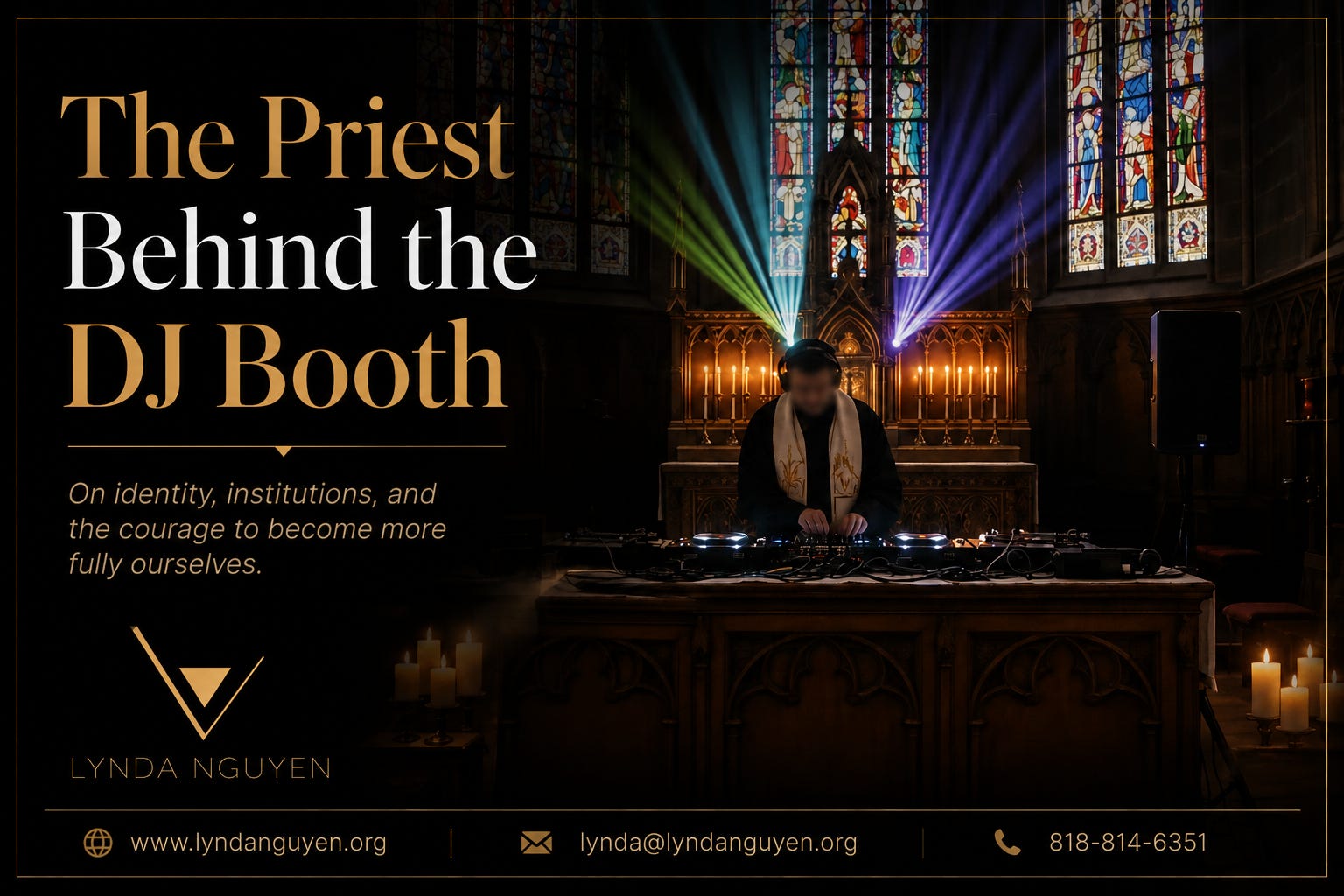
The first time I saw a Catholic priest standing behind a DJ booth, I caught myself smiling.
Not because it was funny, but because it disrupted a picture I didn’t realize I had been carrying. Priests belong behind altars, I thought. DJs belong in clubs and at festivals. One belongs to silence, ritual, and reverence. The other to lights, movement, and bass that you feel before you hear.
Yet there was Padre Guilherme, moving comfortably between two worlds that, in my mind, had never belonged together.
The longer I watched, the less contradictory it seemed.
He wasn’t becoming less of a priest by playing music. He wasn’t abandoning his vocation or exchanging the sacred for the secular. If anything, he seemed to be asking a question that many institutions have forgotten to ask: Does the sacred disappear when the setting changes?
It’s an interesting question because every generation inherits mental models about where certain identities belong. We don’t simply expect a priest to preach. We expect him to look a certain way, speak a certain way, and occupy certain spaces. Over time, those expectations become so familiar that we mistake them for the essence of the role itself.
History suggests otherwise.
The earliest Christians gathered in homes long before they built cathedrals. Gregorian chant, which now feels timeless and ancient, was once contemporary music. Every tradition that has endured has found ways to translate itself into a changing world without surrendering its deepest convictions.
Perhaps what I was witnessing wasn’t reinvention at all. It was translation.
That image stayed with me because, over the past year, my feeds have been filled with women over fifty becoming DJs. Not one or two, but enough that I stopped dismissing it as coincidence.
Many had spent decades in corporate leadership. Others had built businesses, raised families, climbed professional ladders, or become the person everyone else relied upon. Then, somewhere in the second half of life, they bought a controller, learned to mix music, and started playing for audiences they never imagined they would have.
I have a suspicion that very few people dream of spreadsheets when they’re children. They dream of creating music, moving a room, making people dance, and being part of something that brings people together.
Perhaps that’s why so many people find themselves searching for those experiences later in life. Not because they want to escape who they’ve become. Because they want to remember who they were before they learned to be practical.
The more I sat with it, the more I realized this wasn’t really about music at all.
A DJ reads a room. She senses energy before she changes it. She creates an atmosphere where strangers become a community, if only for a few hours. No one asks what her title was before she stepped behind the mixer. No one cares how many people reported to her or what was written on her business card.
For a little while, she is known only by what she creates in the present moment.
I wonder if that is what so many people are searching for in the second half of life. Not escape or even reinvention, but integration.
Both the priest and the women behind the mixer are refusing the same thing: allowing the world’s architecture of expectations to become the architecture of their own lives.
That may be one of the quiet privileges of growing older. We stop asking whether our lives make sense to everyone else and start asking whether they make sense to us. The roles remain. The responsibilities often remain. But they are no longer prisons. They become expressions of something deeper rather than definitions of who we are.
As I watched Padre Guilherme, I realized my surprise revealed more about me than it did about him. My mind had built an architecture around what a priest should look like. Seeing him behind a DJ booth challenged that architecture, and for a moment I mistook my own expectations for reality.
I suspect we do this far more often than we realize.
We inherit invisible assumptions about leadership, professionalism, success, age, creativity, and even holiness. Once those assumptions are in place, anything outside them feels wrong, even when nothing essential has changed.
Perhaps that was the lesson hidden inside a priest behind a DJ booth.
The longer I watched, the less it seemed like a story about music. It was a story about identity, and about the quiet courage it takes to let our lives express more of who we are than the roles we’ve inherited.
Sometimes the most meaningful transformation isn’t changing who we are.
It’s refusing to let someone else’s architecture define who we’ve been all along.
Padre Guilherme's Instagram:
www.instagram.com/padre.guilherme
Love this:
"Because they want to remember who they were before they learned to be practical."