
In nearly every high-growth organization, there comes a moment when the old playbook stops working.
The team is talented. The strategy is sound. The mission is clear. On paper, nothing looks broken.
And yet things begin to feel heavier than they should.
Meetings get longer. Decisions get revisited. Smart people start solving the same problem from different angles. Projects move, but not always in the same direction.
From the outside, it looks like a speed problem.
Inside the system, it is usually something else.
Friction.
Not the dramatic kind. Not conflict. Not obvious dysfunction.
The quieter kind.
A leader assumes alignment because everyone nodded in the meeting. A cross-functional partner interprets a priority differently than intended. A manager hesitates to make a decision because three other teams might be impacted. A talented employee spends more energy navigating ambiguity than doing the actual work.
None of it looks catastrophic.
Until it repeats at scale.
Research on team effectiveness, decision-making, and organizational execution consistently points to the same pattern: high-performing teams do not simply move faster. They reduce the number of places where work gets stuck.
Studies from Harvard Business Review on decision velocity and organizational clarity show that teams with clear decision rights, psychological safety, and shared operating norms consistently outperform teams with equally strong talent but inconsistent communication.
In other words:
Talent matters
.
Strategy matters.
But how people operate together matters more than most organizations realize.
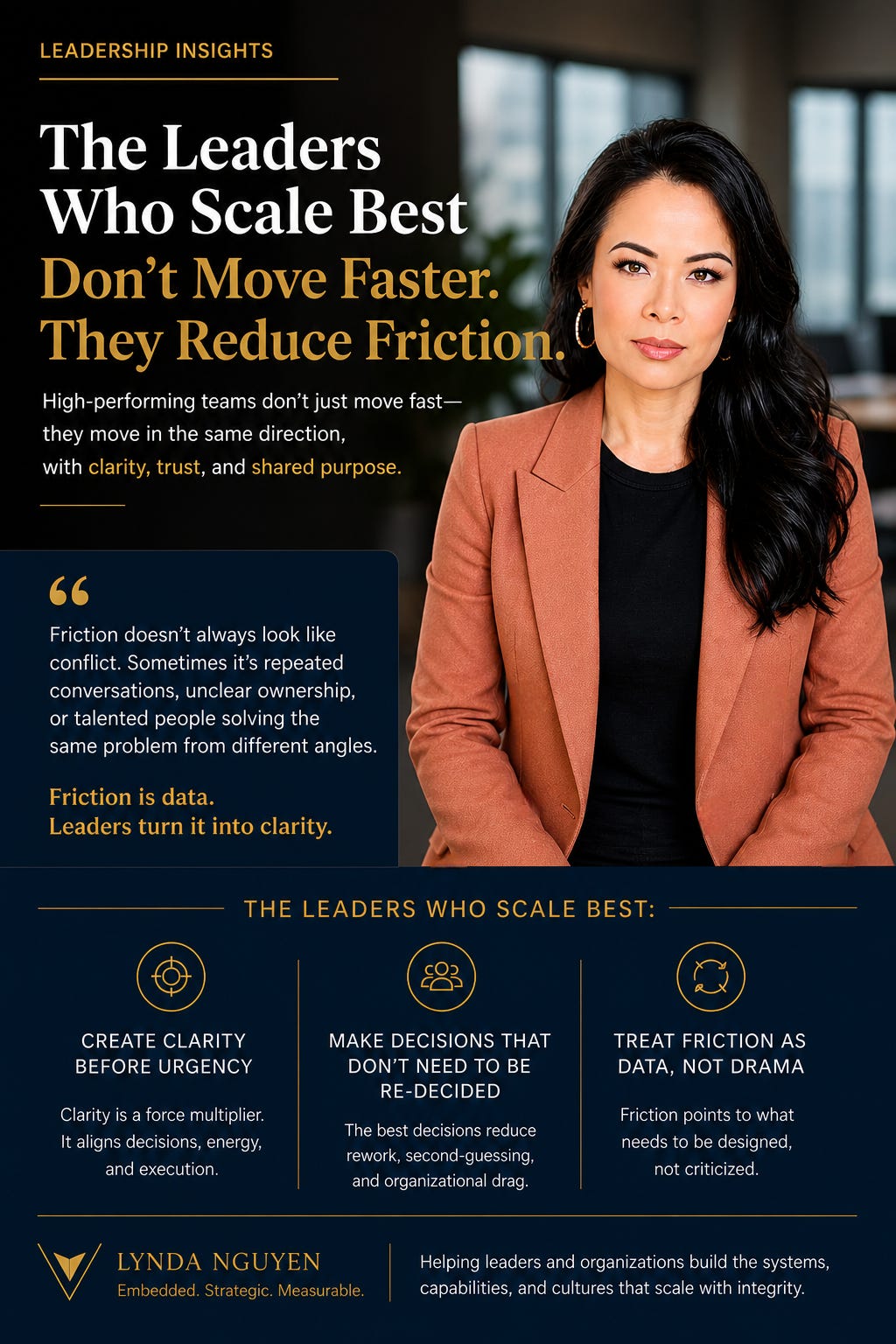
The leaders who scale best tend to do three things differently:
●They create clarity before urgency forces it
●They make decisions that do not need to be re-decided
●They treat friction as data, not drama
That last one matters.
Because friction usually shows up before performance issues do.
It shows up as:
●repeated conversations
●unclear ownership
●talented people asking for the same clarification twice
●strong teams moving, but not moving together
Most organizations try to solve this with more process.
More meetings. More dashboards. More documentation.
Sometimes that helps.
Often, it just adds more surface area.
The stronger leaders do something different.
They slow down long enough to ask:
●Where, exactly, is energy leaking from the system?
Because at scale, the goal is not to move faster.
It is to move cleaner.
And the organizations that learn that early rarely need to work as hard to sustain momentum.