
It began with an ordinary Sunday question.
I was thinking about going shopping and wondered whether Monday might be less crowded. Then I remembered it was Columbus Day.
Growing up, I learned about Christopher Columbus as the explorer who discovered America in 1492. We memorized the names of his three ships and celebrated the courage of crossing an unfamiliar ocean.
What I don't remember learning was what happened to the people who were already there.
Indigenous peoples had inhabited the Americas for thousands of years. Columbus did not discover an empty continent, nor was he the first European to reach North America. Norse explorers had arrived centuries earlier.
When Columbus reached the Caribbean, he encountered established Indigenous societies, including the Taíno. He claimed inhabited lands for Spain, participated in the enslavement of Indigenous people, and governed under systems of forced labor and tribute. His administration generated serious complaints, and in 1500 he was arrested and returned to Spain in chains. The colonization that followed brought devastating violence, displacement, disease, and population loss.
These are documented historical events, not simply modern reinterpretations.
Columbus's voyages undeniably transformed world history. But historical significance and moral celebration are not the same thing.
I wonder how differently we might understand the places we inhabit if we learned as much about the people who were already there as we did about those who arrived.
That question brought me back to California.
I have lived in the San Francisco Bay Area for most of my life. I know its roads, neighborhoods, hills, and changing seasons. I know where the light falls in the late afternoon and how the air changes as you move toward the coast.
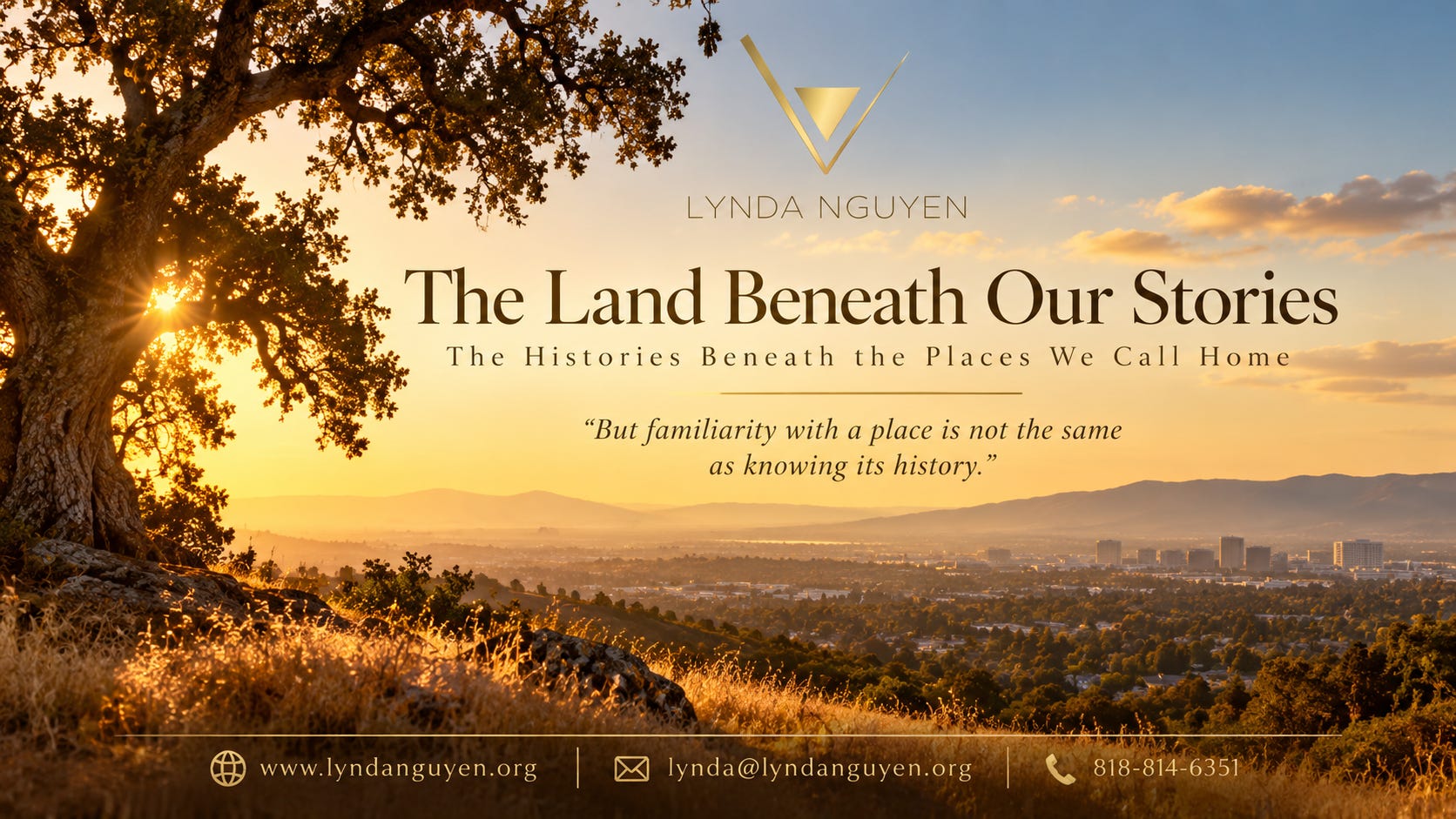
But familiarity with a place is not the same as knowing its history.
Santa Clara Valley, now home to some of the world's most influential technology companies, has a human history extending thousands of years before Silicon Valley acquired its name. The Tamien Nation identifies this valley as its ancestral homeland. The Muwekma Ohlone Tribe also traces ancestral connections to communities throughout the region. These are living peoples with distinct histories, identities, and ongoing relationships to the land.
Farther north, in the Sacramento region, Nisenan, Miwok, and Patwin histories are woven into the rivers, valleys, and landscapes that today support California's capital and surrounding communities.
Their presence is not simply a chapter in California's past.
It is part of California's present.
And yet, for many of us, Indigenous history enters our awareness only occasionally, through a museum exhibit, a land acknowledgment, a holiday, or a conversation about something that happened centuries ago.
We can spend decades inhabiting a place without learning the names of the people whose ancestral relationships with it continue today.
I find that worth examining.
I arrived in the United States as a Vietnamese refugee, still an infant, carried into a country that would become my home. My family came seeking safety, possibility, and the chance to build a life beyond the circumstances that had forced us to leave Vietnam.
I grew up understanding America as a place of opportunity, even while learning that belonging can be complicated.
There is something profound about building a home in a country that was not the place of your birth. You inherit its language, customs, institutions, and stories. Over time, its landscapes become inseparable from your memories. You develop attachments that are entirely real, even when your ancestral history began elsewhere.
But being welcomed into a place does not mean its history began with your arrival.
My family's experience of displacement is not equivalent to the histories of Indigenous peoples who experienced colonization and dispossession on their own homelands. Those histories have different causes, consequences, and continuing realities. I do, however, recognize how deeply questions of land, memory, language, and belonging can shape the lives of people across generations.
I also think about Vietnam itself.
Its history is far more complex than a single national identity. The country is home to numerous ethnic communities, each with distinct languages, traditions, and relationships to particular regions. Some maintain ancestral practices closely connected to forests, mountains, waterways, and agricultural cycles.
For those of us who grew up far from our ancestral homelands, much of that knowledge can become distant. We may know the names of our grandparents, the foods they prepared, or the stories they repeated, while knowing relatively little about the communities, landscapes, and traditions that shaped the generations before them.
I wonder how many people have never had the opportunity to ask those questions.
Where did my ancestors live? What did they understand about the land? Which practices survived migration, and which disappeared quietly along the way?
These questions do not automatically make everyone Indigenous. Indigenous identity carries particular histories of collective continuity, self-identification, community, and relationships to ancestral territories. It is not simply another word for having ancestors.
But nearly all of us have ancestral histories that reach beyond the borders and identities we currently inhabit.
There may be something valuable in becoming curious about them.
Over the years, my spiritual studies and experiences have also brought me into intimate contact with traditions that understand our relationship with the natural world differently from the dominant language of ownership and consumption.
One that has stayed with me is Pachamama, a concept rooted in Andean Indigenous traditions and often translated as Mother Earth.
The translation is familiar, but the worldview surrounding it deserves more than a passing reference.
In Andean traditions, relationships among people, land, community, and the larger living world are often understood through principles of reciprocity. The concept of ayni, for example, describes forms of mutual exchange and responsibility. Receiving carries an accompanying obligation to give, contribute, or care.
These traditions are specific to the communities that sustain them. They are not interchangeable with the beliefs of California's Indigenous peoples, nor are they spiritual concepts that need to be detached from their origins to become meaningful.
What I appreciate is the invitation to consider a different relationship with the earth.
Not merely what can be taken from it, built upon it, extracted from it, or purchased.
But what it means to live in relationship with it.
I have spent much of my professional life examining how systems shape human behavior, particularly how people learn, communicate, and experience belonging. In training and facilitation, cultural respect requires more than acknowledging differences. It asks us to recognize the histories, lived experiences, and knowledge people bring into a shared space, without assuming that any one person represents an entire community. A thoughtful framework provides consistency while remaining responsive to the people it serves.
That same principle applies to how we understand the land. Maps establish boundaries, laws define ownership, and institutions influence whose histories are remembered. Over time, these choices become so familiar that we rarely question them. Yet the opportunity to listen, learn, and adapt remains available to us. Respect becomes meaningful when what we learn changes how we behave.
I think about how easily we use the word development.
A hillside becomes a housing project. An orchard becomes an office park. A stretch of open land becomes a commercial center. We measure the investment, the economic output, the number of jobs created, and the value of the property.
These are legitimate considerations. Communities need homes, infrastructure, livelihoods, and places to gather.
But what else might belong in the conversation?
What ecological relationships existed there? What histories are attached to the place? Which communities have a longstanding connection to it? What responsibilities accompany the benefits we receive?
Our answers depend partly on what we have learned to notice.
I don't believe honoring Indigenous peoples requires romanticizing the past or imagining that every traditional society lived in perfect harmony with nature. Human communities have always been complex, with their own disagreements, adaptations, and competing needs.
Nor do I think appreciation should end with adopting beautiful spiritual language while overlooking the people who carry those traditions today.
Respect asks something more substantial.
It asks us to learn names accurately. To recognize that Indigenous nations are not relics of history. To listen when communities describe their own identities and priorities. To understand that different peoples have different relationships with their homelands, and that those distinctions matter.
It may also ask us to become more attentive to the ordinary places we inhabit.
The creek beside a walking trail. The oak trees that have outlived generations of residents. The hills visible from a freeway. The river running through a city whose modern name tells us very little about its earlier inhabitants.
These places hold histories whether or not we have learned them.
I can be grateful that my family found refuge in California while recognizing the Indigenous peoples whose ancestral homelands became part of my own story. I can appreciate what generations have built here while remaining curious about what existed before them. And I can honor the earth without claiming ownership of traditions that belong to others.
As I write this from Santa Clara County, I am on the ancestral homelands of Ohlone peoples, whose histories and relationships with this land extend back thousands of years. Among the Indigenous communities with ancestral ties to this valley are the Tamien Nation and the Muwekma Ohlone Tribe. Their histories are not confined to the past. Their communities, cultures, and connections to this place continue today.
Tomorrow, on Indigenous Peoples' Day, I invite you to visit "Native Land Digital" (https://native-land.ca/) and explore whose ancestral lands you inhabit. Let it be a starting point for learning their names, listening to their stories, and understanding the communities that remain connected to these places.
May we honor those who came before us, respect those who are here today, and care for what we leave to those who come after us.