
What if an organization had the information it needed and still made the wrong decision?
We tend to explain bad decisions by assuming something was missing. Leaders did not know. The data was incomplete. A risk had not surfaced yet. Someone failed to communicate what was happening close enough to the work.
Sometimes that is exactly what happened. But organizations also make poor decisions while the information that could have changed them is already somewhere inside the system.
Someone knows the timeline is unrealistic. Someone understands why customers are unhappy. Someone has seen a similar strategy fail before. Someone notices that the numbers being presented do not tell the whole story. Someone disagrees with the recommendation but can already feel where the meeting is going.
The information exists. Whether it can influence the decision is another matter.
Information does not travel through organizations untouched. It passes through hierarchy, relationships, incentives, reputation and power. People decide what to include, what to soften, what requires more evidence and what can be said plainly. They make judgments about timing and anticipate how a message will be received. Sometimes they learn that saying something once is acceptable and saying it twice carries a cost.
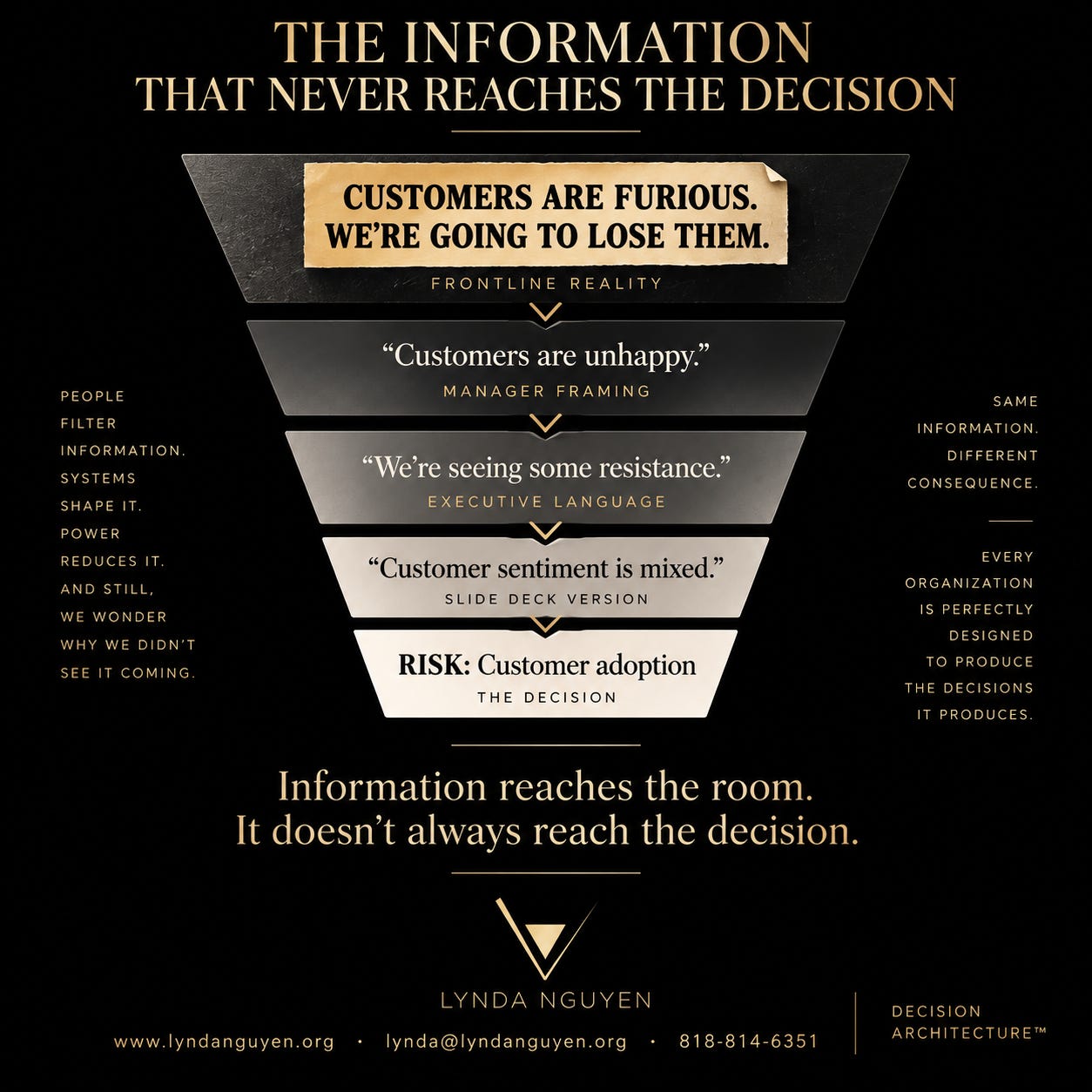
A frontline employee says, “Customers are furious and we are going to lose them.”
Her manager agrees with the concern but knows senior leadership is committed to the current strategy. By the next meeting, the language has become, “We are seeing some customer resistance.”
Someone adds it to a slide under Risks. The slide gets presented. Leadership has technically been informed.
Three months later, customers leave, and someone asks, “Why didn’t we know?”
You did.
The organization had the information. It did not preserve its meaning long enough for the information to affect the decision.
I know this dynamic partly because I have participated in it. I have sat in meetings, understood exactly what I thought was wrong, and edited myself before I spoke. Nobody had to tell me to be quiet. I was reading the room: who had already committed, how much appetite there was for disagreement, whether the decision was actually still a decision, and what would happen if I pushed harder than the room seemed willing to tolerate.
By the time I said what I knew, I had sometimes made it easier to hear. I had also made it less useful.
Organizations do not have to silence people explicitly. Humans are extraordinarily good at learning what an environment rewards, what it tolerates and what becomes expensive.
Researchers have documented this as a collective phenomenon: employees withhold information about organizational problems not because they don’t have it, but because they have learned that raising it carries costs. Others have examined the implicit beliefs people carry about when speaking up at work is risky or inappropriate, including assumptions about challenging authority.
That research helps explain why information may never be voiced. But silence is only one place information can disappear. People can speak and still not be heard accurately. A concern can be raised and softened. Data can be presented and discounted. A warning can be acknowledged without changing the plan. Someone can be thanked for their candor while everyone proceeds exactly as before.
Information can reach the room without reaching the decision.
Consider a senior executive presenting a strategy she has spent six months developing. She has already discussed it with the CEO. Resources have been tentatively allocated. The deck is polished. Twenty people are sitting around the table.
At the end she asks, “Does anyone see anything we’re missing?”
Nobody answers.
Calling that agreement requires assumptions about what the silence means. Who has authority in the room? Who is being evaluated by whom? How committed is leadership already? What happened the last time someone challenged a favored initiative? Is disagreement treated as useful information or resistance? Does everyone believe the decision is still open?
And what would it cost someone to disagree?
People do not calculate that cost from scratch every time. They learn from previous meetings, previous leaders and previous consequences. An organization teaches people which risks are worth raising, how much evidence they need before raising them, and whether persistence will be interpreted as commitment or resistance. Eventually, people become very good at reading those signals.
This does not happen only at work. Families, friendships and intimate relationships develop information systems too. We learn what can be said plainly, what needs to be softened, and what becomes expensive to raise. But organizations make the mechanism particularly visible because information often has to travel through multiple layers before it reaches the people with authority to act on it.
Communication tells us whether information was exchanged. Decision Architecture™ asks what happened to that information as it moved through the system.
Was the original meaning preserved? Who translated it? What was softened? What required additional proof? Whose interpretation became authoritative? What happened to information that contradicted a direction people were already invested in?
Those questions help explain why organizations are sometimes surprised by things that were not actually surprising.
The failed launch had warnings. The employee who resigned had been signaling disengagement for months. The project everyone later admits was unrealistic had skeptics from the beginning. The cultural problem leadership says appeared overnight had been discussed privately for years.
In hindsight, the information can look obvious because the cost of believing it has disappeared. Before the outcome, believing it might have required challenging a powerful person, delaying something people wanted, questioning a profitable strategy or becoming the person associated with the problem.
Every organization is perfectly designed to produce the decisions it produces.
Part of that design is formal: reporting structures, decision rights, approval processes and roles. Part of it is relational: who gets believed quickly, who has to arrive with proof, which questions are welcomed, which questions change the temperature of the room, and what happens when someone tells the truth before everyone else is ready for it.
A decision inherits the path the information took to reach it.
Better decisions require more than better information. They require examining what happens to information as it moves through the people, relationships and structures surrounding a choice.
Sometimes the warning was given. The problem was understood. Everyone who needed to know already knew.
The information still never reached the decision.