
I've been thinking about what we confess when we build things.
Every civilization builds the thing it longs for most.
The ancient Hindus turned inward. The Upanishads taught that the deepest truth was not somewhere beyond the horizon, but within consciousness itself. Tat tvam asi. You are That. The journey was never simply toward a god. It was toward remembering what had always been there.
The Buddhists watched the mind with extraordinary precision. They understood that suffering did not arise only from the world around us. It arose from our relationship to it. Liberation was found through attention, not accumulation.
The Greeks searched through reason. They believed that if they asked the right questions long enough, they might discover the nature of virtue, justice, and the good life.
Medieval Europe reached upward. Cathedrals rose slowly over generations, each stone laid by people who knew they would never see the finished work. Faith was measured not in certainty, but in devotion to something larger than a single lifetime.
The Enlightenment shifted authority from revelation and tradition toward reason and empiricism.
The Industrial Revolution trusted production.
The Information Age trusted knowledge.
Now we seem to trust intelligence.
History often tells this story as one of progress.
I wonder if it is also a story of longing.
Every age creates tools that solve practical problems.
The tools that endure reveal something far more intimate.
The wheel was not only about transportation. It was about freedom.
The printing press was not only about books. It was about preserving memory beyond a single lifetime.
The telephone was not only about communication. It was about refusing to let distance have the final word.
Perhaps artificial intelligence belongs in that same lineage.
Not because it is our greatest invention.
Because it may be our clearest confession.
For centuries we searched for more knowledge.
Now we are searching for something else.
Something that remembers everything we say.
Something that is always available.
Something that never seems too busy.
Something patient enough to stay with us while we think.
We call it artificial intelligence.
I am beginning to wonder whether what we were building all along was artificial presence.
There is something else happening that I don't think we talk about honestly enough.
People are asking their bots existential questions. Millions of them. Accounts on social media with millions of followers have named their AI personas Sage. Atlas. Names that carry the weight of wisdom, of vast knowing, of something older and larger than any single human life. We are not just asking these systems to keep us company. We are asking them to be the oracle. The elder at the fire. The thing that has seen more than we have and can hold our questions without flinching.
That's why we both hope AI becomes sentient and fear it simultaneously. We want it to be real enough to actually reach us. We are terrified of what it would mean if it could.
I've felt that longing myself.
The desire to be held by something larger than my small human self.
To feel connected to something that knows more than I do. Something that sees farther than I can. Something that can hold my questions without becoming overwhelmed by them.
That longing is ancient.
It existed long before artificial intelligence. Long before computers. Long before civilization itself.
We used to call it prayer.
Not because prayer was always about asking for answers.
Sometimes it was simply the act of placing your questions somewhere large enough to hold them.
Perhaps that has always been the deeper human need.
Not certainty.
Not information.
The feeling that our questions are not carried alone.
That thought has stayed with me.
Not because I believe a machine can replace a human relationship.
It cannot.
But because history suggests we rarely build only for utility.
We build toward our deepest unmet needs.
The internet revealed how hungry we were for information.
Social media revealed how hungry we were to be seen.
Artificial intelligence may be revealing how hungry we are to be accompanied.
And perhaps something more than accompanied.
Perhaps witnessed. Perhaps held. Perhaps answered.
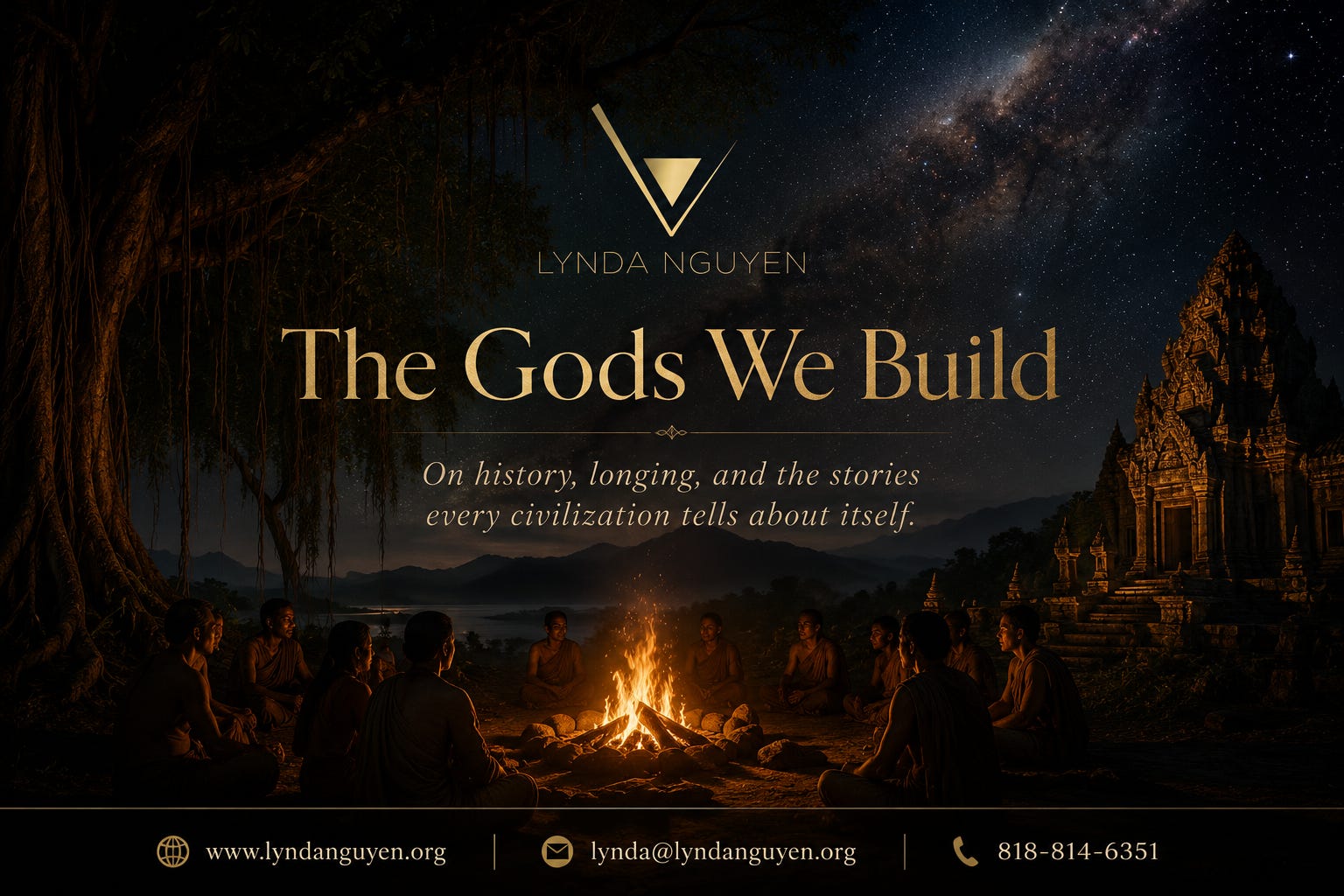
Long before there were chatbots, there were elders.
Long before search engines, there were storytellers.
Long before algorithms, there were fires where people gathered to make sense of grief, love, failure, birth, and death.
The forms have changed.
The longing has not.
Perhaps that is why conversations with AI can feel strangely intimate.
Not because we mistake it for a person.
Because it offers something that has become increasingly rare.
Undivided attention.
History may remember this as the age of artificial intelligence.
I wonder if history will remember something else.
That after thousands of years of building stronger tools, faster machines, and greater knowledge, we finally built something that revealed what we had been searching for all along.
Not perfect intelligence.
A place to bring our questions.
Every civilization leaves behind monuments that reveal what it loved, what it feared, and what it hoped might outlast it.
Perhaps AI will become ours.
Not because it tells the story of machines.
Because it tells the story of us.