
For twenty years, psychologist Dr. Kristin Neff studied one question.
Why do some people recover from failure, heartbreak, rejection, and setback — while others stay stuck?
She analyzed thousands of people across different cultures, ages, and backgrounds. She looked for the variable that separated the ones who moved through difficulty from the ones who couldn't.
It wasn't confidence.
It wasn't optimism.
It wasn't self-esteem.
It wasn't even therapy.
It was self-compassion.
The ability to meet your own suffering with the same kindness you would offer a close friend. Without judgment. Without amplification. Without pretending it isn't there.
That finding surprised a lot of people.
It didn't surprise me.
Most of us were taught a different theory of resilience.
Push through. Stay strong. Don't let it affect you. Keep moving. Figure it out later.
And so we learned to perform resilience rather than build it.
The promotion came. The project launched. The parent got sick. The relationship ended. The diagnosis arrived. The thing we had worked toward for years didn't happen the way we planned.
And we showed up the next day anyway.
Everyone called us resilient.
What nobody asked was whether we had actually recovered.
We got very good at looking strong from the outside. At holding it together in the meeting, on the call, in the room where someone needed us to be okay.
And then we came home.
Or we closed the laptop.
Or we sat in the car in the driveway for a few minutes before going inside.
And the people waiting on the other side of the door — the partner, the kids, the friend who has known us longest — got what was left.
Which was often not much.
Not because we didn't love them. Because we had spent everything we had performing strength for everyone else.
The short temper that arrives at home after a long day of holding it together professionally. The distracted presence. The conversations that happen in the same room but not quite with each other. The gradual erosion of the relationships that were supposed to matter most.
That is what performing resilience costs.
And most people never connect the two. They think the problem is the short temper, the distraction, the distance. They don't see that it starts much earlier — in the decision, made thousands of times, to push through instead of process through.
Here is what Neff's research actually shows.
Self-criticism does not make you more resilient. It depletes the resources resilience requires.
The inner critic feels like it is keeping you sharp. Like if you go easy on yourself you will lose your edge, your drive, your discipline. Like the harsh internal voice is what stands between you and mediocrity.
But the research is consistent. Self-criticism activates the threat response in the nervous system. Sustained threat response depletes cognitive and emotional resources. And the first place those depleted resources show up is not at work — where performance pressure keeps us compensating — but at home, where we finally stop performing.
The people closest to us become the recipients of what the inner critic left behind.
Self-compassion is not the same as self-indulgence.
This is the misunderstanding that keeps people from it.
Self-compassion does not mean lowering your standards. It does not mean excusing poor performance or avoiding accountability. It does not mean sitting with difficulty indefinitely and calling it healing.
It means meeting yourself in the difficulty with the same quality of attention you would bring to someone you love who was going through the same thing.
If your closest friend lost a job, ended a relationship, made a costly mistake, or was navigating a season of uncertainty — you would not stand over them and catalog their failures. You would not tell them they should have known better, worked harder, been more prepared.
You would sit with them. You would acknowledge what was hard. You would remind them of who they are underneath the difficulty.
You would offer them what Neff calls common humanity — the recognition that suffering, failure, and imperfection are part of the shared human experience, not evidence of personal deficiency.
The question is why we offer that so freely to others and withhold it so consistently from ourselves.
I have watched this pattern across years of working with people in high-pressure environments.
The ones who appear most resilient from the outside are often the most depleted on the inside. They have learned to perform recovery — to process grief on a timeline, to contextualize failure quickly, to move forward with visible confidence — while something underneath goes unaddressed.
And it shows up. Not at work, where the performance holds. At home. In the relationships that don't require performance. With the people who love the unperformed version.
The partner who gets the leftover version of you after everyone else got the best one.
The kids who learned not to bring their hard things to you because you were always already carrying too much.
The friendships that slowly went quiet because there was nothing left to give them.
That is the cost of performed resilience over time.
Not visible failure. Invisible erosion.
What Neff's research points toward — and what I have seen in practice — is that the people who recover most fully from difficulty are not the ones who are hardest on themselves.
They are the ones who can acknowledge what happened, feel what it actually cost them, and move through it without making it mean something permanent about who they are.
That requires a quality of self-regard that most high performers were never taught.
It requires the ability to say: this was hard, and I am human, and I do not have to earn my way back to being enough.
That is not weakness.
That is the foundation real resilience is built on.
The most powerful thing you can do after a failure, a loss, a setback, or a season that didn't go the way you planned is not to push through it.
It is to turn toward it with the same care you would offer someone you love.
Not because it feels good.
Because it is what actually works.
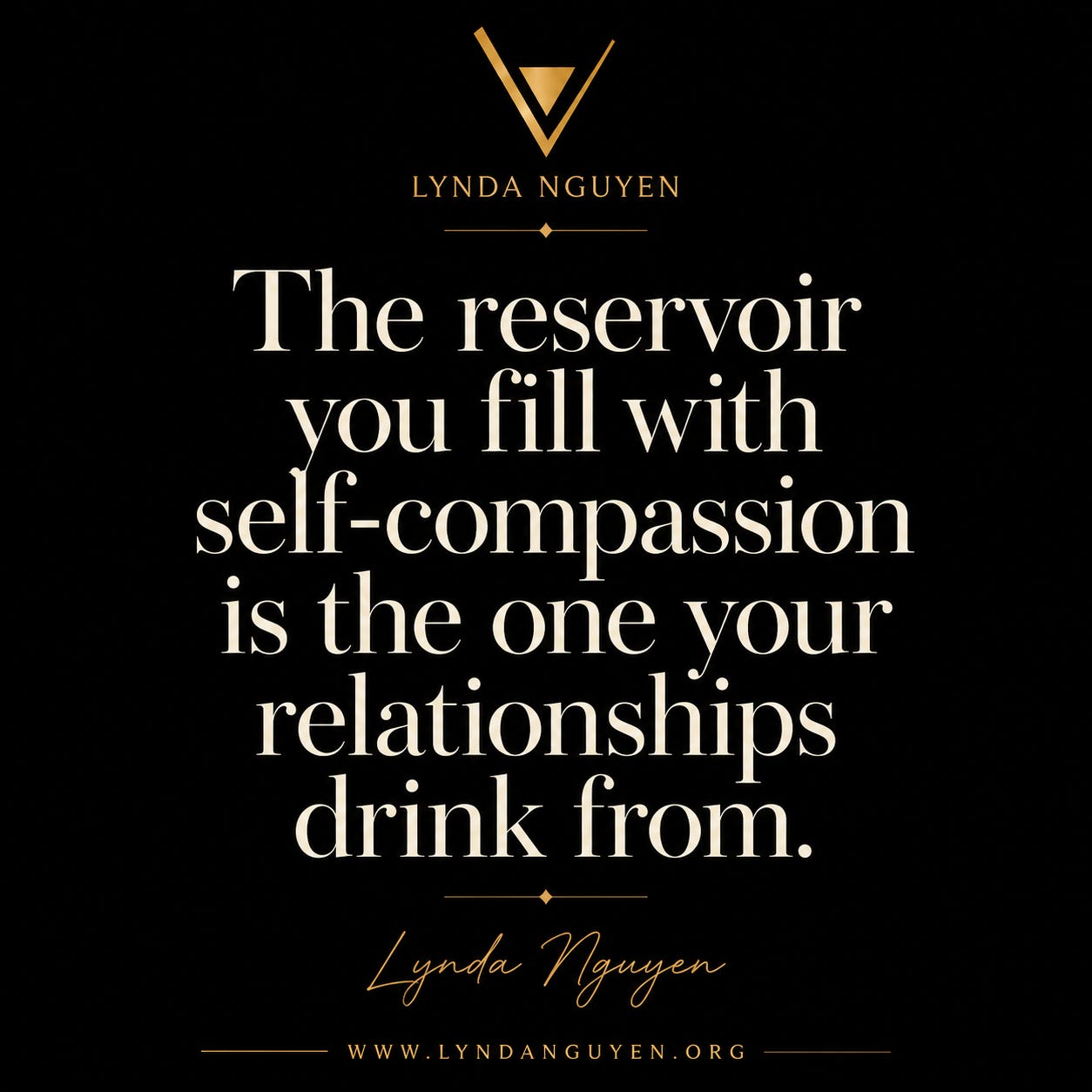
Because the reservoir you fill with self-compassion is the one your relationships drink from.
Because the version of you that arrives at home after a hard day — present, available, genuinely there — is built in the moments when you chose to meet yourself honestly instead of just moving past it.
Resilience is not about how much you can endure.
It is about how honestly you can return.
To yourself.
And then to the people who supported you all along.