
I was talking with some friends the other day about dating. We were talking about options. Specifically, how many of them we seem to have now and how strangely difficult that has made choosing.
Someone can be dating, talking to several people, have ten more somewhere in the queue, and still feel as though none of them is quite the one. There is always another person to meet. Another profile. Another introduction. Someone more attractive, more interesting, more successful, more emotionally available, more whatever-we-have-decided-matters-this-week. Someone, somewhere, who might be better.
At some point in the conversation, I started talking about McDonald's and In-N-Out.
McDonald's has spent decades expanding its menu. Burgers, chicken, fish, breakfast, coffee, desserts, different sizes, combinations, seasonal things. There is a lot to choose from.
Then there is In-N-Out. Burger. Cheeseburger. Double-Double. Yes, there are variations and a not-so-secret menu, but the basic proposition is almost absurdly simple.
And somehow I am still sitting in a thirty-minute line.
There is something interesting underneath our assumption that more choice necessarily creates a better experience. We tend to believe more options make us freer. Beyond a certain point, they don't make choosing easier. We compare more, second-guess more, and become increasingly aware of everything we gave up by choosing what we chose. After making a perfectly good decision, we can still wonder whether there was a better one three swipes away.
Modern dating may be one of our strangest experiments in this phenomenon.
For most of human history, people chose partners from relatively bounded worlds. Geography mattered. Community mattered. Social circles mattered. You were not carrying a catalog of potential romantic partners around in your pocket.
Now the field can feel nearly infinite. There are eight billion people in the world. Obviously, eight billion people are not available to date us, but technology has expanded our perception of who might be.
There is always another person, and possibility is intoxicating because possibility has not disappointed us yet.
The imaginary partner has never forgotten your birthday. They have never misunderstood your tone or become defensive at exactly the wrong moment. They have never bored you, irritated you, needed something when you were tired, or revealed some habit you find inexplicably maddening. They are remarkably easy to love for one very convenient reason.
We haven't met them.
The person in front of us has an unfair disadvantage. They are real.
I have been thinking about this alongside another story I hear often when people talk about being single. It is a story I have told myself too.
I love being single. I love my freedom. I don't want anyone controlling me. I can do whatever I want.
Except I can admit something now that I might once have dressed up differently.
I don't prefer being single.
I can be happy single. I have been happy single. I love freedom. I need autonomy. I like spaciousness and independence and being able to follow my curiosity wherever it takes me.
But given the choice between a good life alone and a good life deeply shared with someone, I know what I want.
I like partnership.
I like having a person.
I like being witnessed across time. I like building something whose meaning comes partly from the fact that neither person could have built it alone.
I no longer think those desires contradict one another.
What I think I confused at times was autonomy with optionality.
Optionality says, I can always choose something else.
Autonomy says, I am still myself while choosing you.
Those are very different freedoms.
One keeps every door open. The other allows us to walk through one without locking ourselves inside.
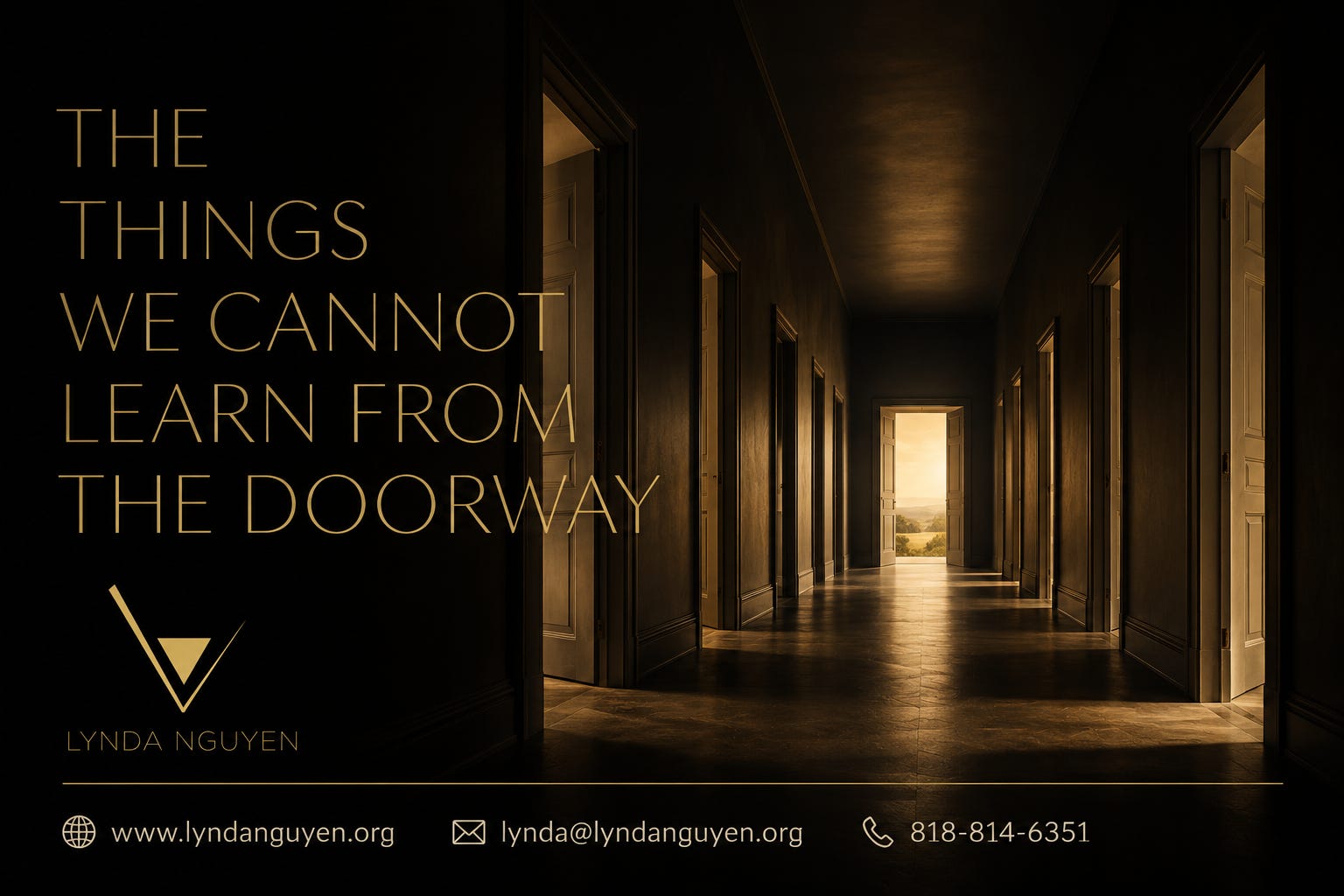
Keeping some doors open matters. But there is also a point at which a life made entirely of open doors becomes a hallway.
Choice and choosing are not quite the same thing. Choice is having alternatives. Choosing means deciding that something matters enough to allow some alternatives to disappear.
Almost everything meaningful eventually asks this of us. A relationship does. So does a craft. So does a career. So does a life.
I have started wondering if the larger question underneath all of this is not really about dating. Maybe it is about our relationship with the middle.
Beginnings are seductive. A new relationship is possibility. A new job is possibility. A new city, practice, business, friendship, creative pursuit. In the beginning, we can imagine what something might become without yet having encountered all the ordinary difficulty involved in becoming it.
Then comes the middle.
The instrument stops being exciting and asks us to practice scales. The new job stops being new and asks us to understand the people, the politics, the history, the systems, and why things work the way they do before we can meaningfully change them. The relationship moves beyond chemistry and begins revealing two actual human beings. The craft reveals the distance between being interested in something and becoming good at it.
This is often when another option starts looking particularly attractive.
Sometimes leaving is exactly the right decision. Some relationships are harmful. Some jobs are wrong. Some pursuits have simply run their course. Staying is not inherently virtuous, and endurance for its own sake can become its own form of avoidance.
But leaving is not the only expression of freedom.
Sometimes freedom is having enough agency to remain.
I wonder if we have become so practiced at preserving optionality that we occasionally leave before something has had enough time to tell us what it is.
Because some information is only available through duration.
A craft cannot reveal mastery to a beginner. A new job cannot reveal the full extent of our influence in the first few weeks. A mentor cannot recognize our patterns after three conversations. Another human being cannot deeply know us while we are both still presenting the versions of ourselves designed to be chosen.
We tend to imagine certainty should precede commitment. First I will know, and then I will choose.
But some forms of knowing work in the opposite direction.
Sometimes choosing is what produces the information from which certainty can grow.
That is not an argument for blind commitment or for staying when reality is repeatedly telling us to leave. It is simply an acknowledgment that there are things we cannot learn from the doorway.
We have to enter.
And once we enter, the choice begins to make demands of us.
If I care about another person, their reality enters my decision-making. If I care about becoming excellent at something, practice enters my calendar. If I care about building something meaningful at work, there will be days when the work is inconvenient, repetitive, political, or simply boring.
This is not necessarily a loss of autonomy. It is what happens when something matters enough to affect how we live.
Maybe optionality protects us from more than making the wrong choice. Maybe it also protects us from being changed by the choice we make.
Because investment creates stakes.
Once I have stayed long enough to care, I can lose something. Once someone knows me, they can reject something real. Once I have given years to a craft, failure means more than discovering I wasn't immediately talented. Once I have invested myself in a place or a piece of work, leaving costs something.
Options protect us from some of that grief.
They can also protect us from some of the depth.
I have done this outside romantic relationships too.
Years ago, I had a friendship I cared about deeply. Nothing terrible happened between us. We didn’t have a falling out. We simply stopped investing enough in the relationship, and eventually we lost touch.
At the time, some of our differences seemed more significant to me than they do now. Another friendship seemed more naturally aligned with the life I was living. We shared more of the same interests, moved through the world in similar ways, and had the kind of lifestyle compatibility that was easy to recognize. I gave that kind of alignment more weight than I would now.
Looking back, I think I mistook similarity for depth. Or at least assumed that similarity would naturally produce it. I regret that.
So without consciously deciding to choose one person over another, I did what we often do when something else fits more easily.
I invested where the similarities were easier to see.
Years later, this friend and I found our way back to each other. And as we began talking again, I realized how much I had missed her.
Not because the differences had disappeared. They hadn’t.
I had simply become old enough to understand that similarity and depth are not the same thing.
There are people who fit easily into the architecture of our lives and people who somehow understand the architecture underneath us. Sometimes we are lucky enough to find both in the same person. Sometimes we don't recognize the difference until enough life has passed to show us.
Nothing dramatic ended that friendship the first time.
We just didn't tend it.
And I think that is one of the quieter costs of optionality. We imagine the cost of choosing is everything we might miss by saying yes to one thing. We talk less about what we might lose by never investing deeply enough in what is already here.
And depth is where something else becomes possible.
We can be known.
The psychiatrist Irvin Yalom has a line I have returned to many times:
"It is the relationship that heals."
Yalom was writing about psychotherapy, but I have always thought the idea travels well. Technique matters. Insight matters. Expertise matters. But there is something that happens between human beings over time that cannot be reduced to technique.
The relationship becomes part of the medicine.
I think partnership can work this way too.
Being desired is not the same as being known. Being chosen initially is not the same as being known. Being followed, admired, flirted with, praised, wanted, or loved from a distance is not the same as being known.
Being known takes time.
Someone has to see enough versions of us that the polished one stops being particularly persuasive. They have to meet our confidence and eventually discover what frightens us. They have to hear the story we tell about ourselves and stay long enough to notice where the story is incomplete. They have to know what happens when we are tired, disappointed, jealous, ambitious, scared, bored, overwhelmed, successful.
Eventually, they see the contradictions. And eventually, if the relationship becomes safe enough, we tell them the things they cannot see.
The truth.
Not necessarily the dramatic truths. Often the ones that matter most are remarkably ordinary.
That hurt me. I'm scared. I'm jealous. I need more from you. I don't know what I'm doing. I was wrong. I want this more than I have been willing to admit.
There are two acts of courage in those moments. The first belongs to the person telling the truth. The second belongs to the person receiving it.
Because what happens next teaches the relationship what kind of truth it can hold.
Does vulnerability become ammunition later? Does insecurity quietly change how we are regarded? Does disagreement threaten belonging? Does the truth get minimized, mocked, corrected, diagnosed, punished?
Or can someone receive what is true without immediately deciding what it says about our worth?
Being known does not mean being accepted without consequence. Some truths should change things. Some disclosures require accountability. Some reveal incompatibilities that love cannot solve. Sometimes the truth is precisely what tells us it is time to leave.
Safety is not a promise that nothing we say will ever matter. It is something more mature.
You can tell me the truth, and I will meet the truth before I decide what it means for us.
I think that is one reason being deeply known, in partnership, by one person, can heal something that being liked by many never could.
Ten people can desire us and never really encounter us. Thousands of people can applaud a version of us without knowing the person underneath it. But one person who has seen us frightened, unreasonable, brilliant, boring, generous, selfish, ambitious, wounded, hilarious, exhausted and trying again can become evidence against an old belief that says we must remain edited in order to remain loved.
There is a cost to getting there. We have to stay long enough.
Not forever. Not regardless of what happens. Just long enough for reality to replace possibility. Long enough for repetition to become history. Long enough for another person to accumulate a memory of us.
There is an intimacy in someone being able to say, I've seen this version of you before.
Not as accusation. As recognition.
A partner recognizes the fear underneath an argument. A friend knows when "I'm fine" isn't particularly convincing. A mentor recognizes when confidence has become performance. A colleague notices that our unusual silence means something.
This is part of what it means to be known. Not simply that another person possesses information about us. They have witnessed us across time.
Maybe being known requires being findable. It requires remaining somewhere long enough for a partner, a community, a body of work, even a craft, to encounter more than our opening act.
I see this in mentorship all the time.
The mentors who have changed me most were not simply the people with the best advice. They knew me long enough to recognize my patterns. There is advice someone can give after reading your résumé. There is different guidance available from someone who knows where you become afraid, where you overreach, where you underestimate yourself, what you avoid, and what you are capable of when you stop performing competence.
That kind of guidance requires history.
Leadership does too.
Organizations spend enormous amounts of money trying to make people speak honestly. We conduct engagement surveys. We teach feedback models. We hold listening sessions. Leaders announce open-door policies and tell people they want candor.
Meanwhile, people are collecting different data.
They are watching what happens to the truth after someone tells it.
Who spoke up and stopped being invited to certain meetings? Who admitted uncertainty and quietly lost credibility? Who challenged a decision and became "difficult"? Who delivered bad news and somehow became associated with the bad news itself?
And who told the truth and discovered that the relationship could hold it?
Psychological safety is not created by repeatedly telling people they are safe to speak.
It is created by what happens after they do.
The same principle runs through partnership, friendship, mentorship, leadership, and even our relationship with our work.
Depth has a time requirement.
If every disappointment sends us back to the menu, we can become extremely skilled at selecting and never become particularly skilled at relating. If every frustrating season at work becomes evidence that we chose the wrong job, we may never discover what influence looks like after credibility has accumulated. If every plateau sends us searching for a new practice, we can spend a lifetime being fascinated by things without becoming masterful at any of them.
There will always be something else that looks easier from a distance. The imaginary partner is uncomplicated. The imaginary job has better leadership. The craft we have not yet attempted contains none of our current limitations.
Possibility has an enormous advantage over reality.
Reality has been tested.
The more interesting question, at least for me now, is not whether something else could theoretically exist. Of course it does.
That is not a failure of freedom.
That is the condition that makes choosing meaningful.
The question becomes whether what is here is worthy of being chosen again. Whether there is enough goodness, truth, curiosity, repair and possibility inside the thing itself to keep discovering what it can become.
This is what I hear differently now when I read Yalom's simple observation.
It is the relationship that heals.
Not merely because someone loves us. Relationships can wound us too. The healing relationship is the one in which reality is allowed to arrive, where we can become increasingly specific instead of increasingly edited, where autonomy does not require distance and commitment does not require captivity.
I used to think freedom had something to do with keeping my options open.
I think differently about it now.
There are eight billion people in the world. There will always be another person I could meet, another life I could imagine, another door I could leave open.
But being known requires standing still somewhere.
Long enough to tell the truth.
And long enough for someone to still be there after you do.