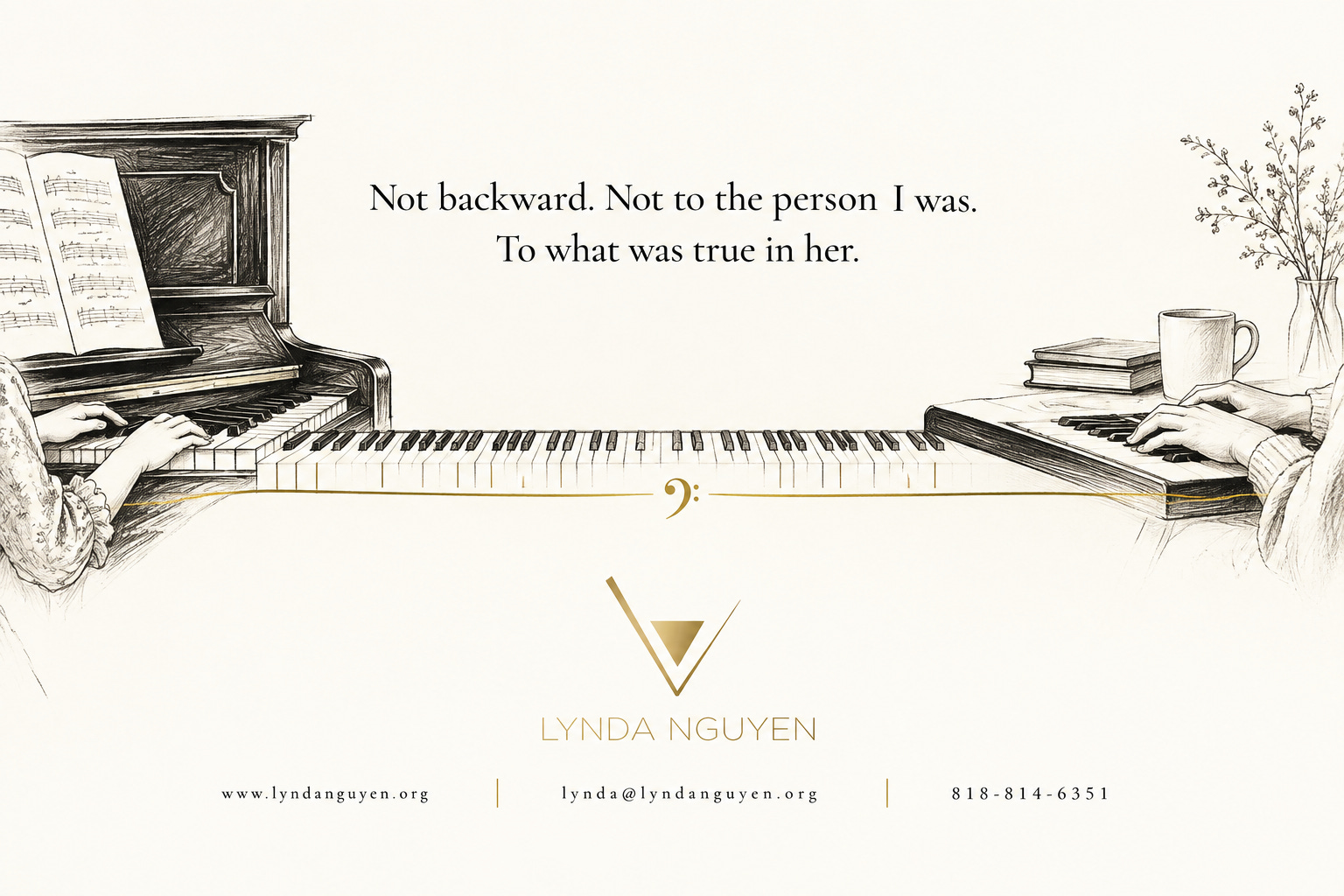

I practiced classical piano every day for thirteen years. I started when I was six and stopped in my late teens. Imagine the childhood piano version of The Joy Luck Club: scales, repetition, practice whether I wanted to or not. Piano was simply part of the architecture of my childhood.
Then I quit.
Abruptly.
After thirteen years of being required to play, the moment I had some say in the matter, I was done. I didn’t dramatically renounce classical music. I just stopped sitting down at the piano.
But I never stopped listening.
Decades later, I still turn on classical music in the morning. Not every morning, but often enough that I know what I am doing when I reach for it. I am steadying myself. Returning to myself. There are mornings when my mind is already several hours ahead of my body, running through decisions, conversations, work, people I love, things that could happen and things that probably never will. Classical music gives my attention somewhere to land.
Recently, I found myself listening to a passacaglia.
A passacaglia is a musical form built around something that repeats, traditionally a bass line or harmonic progression. Above that ground, the music changes. Variations emerge. They become more intricate, more expressive, sometimes almost unrecognizable from where the piece began. But underneath it all, something stays.
I haven’t been able to stop thinking about that.
We talk a great deal about reinvention. New chapters. New versions of ourselves. Starting over. Becoming someone different after the job ends, the relationship changes, the parent dies, the friendship disappears, the body ages, the plan fails, or the life we thought we were building turns out not to be ours anymore.
I’ve had enough loss, grief, release, and supposed reinvention in my own life to know the experience of looking around and realizing that very little resembles what came before. I used to call it reinvention. Now I think much of it was return.
Not returning to who I was at six, or sixteen, or thirty. There is no untouched original self waiting beneath the accumulated years. Experience changes us. Love changes us. Grief changes us. I would not want to emerge from a life having remained exactly the same.
But change and continuity are not opposites. Sometimes what looks like reinvention from the outside is subtraction from the inside. A role falls away. An identity stops fitting. A relationship ends. A plan you organized years around disappears. Some things are taken from you. Others you finally become willing to put down.
And beneath all that movement, certain things become more audible: how bravely you love, what makes you feel alive, what you care about when nobody is watching, what you cannot keep abandoning in yourself.
The bass line.
Returning to it requires honesty, especially when so much of who we learned to be came first through family and culture. Long before we have language for identity, we are absorbing instructions about what makes a good daughter or son, what success looks like, what we owe our families, what kind of work is respectable, who we are supposed to love, which risks are irresponsible, which parts of ourselves earn approval and which are better kept quiet.
Some of those inheritances become ours. I am grateful for much of what mine gave me: discipline, responsibility, endurance, an understanding that love is often expressed through what we do for one another. Other things fit until they don’t.
The work is not to reject what shaped us. It is to distinguish inheritance from truth.
By the time we are old enough to choose a career, a partner, a place to live, a definition of success, we have already inherited an architecture around those choices. Family, culture, belonging, approval, duty, and fear have helped determine which possibilities feel natural, which feel dangerous, and which we barely allow ourselves to consider.
Seeing that architecture gives us a chance to ask: Is this what I was taught to value, or is it what I actually value? Am I choosing it, or simply preserving the status quo?
Sometimes the answer is both.
Sometimes it changes a life.
Because we can become extraordinarily good at living a life that does not belong to us. We can collect the titles, earn the degrees, accumulate the accolades, build the respectable life, and make every defensible choice. We can even love the people we were supposed to love, or allow ourselves to love the people we actually love only as far as other people’s approval will permit.
And everyone around us may call it a good life.
That is what frightens me. Not failure, but reaching ninety years old, looking back across an entire life, and realizing how much of it was performance. That I knew what mattered and kept negotiating with it. That I repeatedly traded what was true for approval, security, status, or belonging. That I became so practiced at being who I was supposed to be that eventually even I could no longer tell where the performance ended and I began.
There are losses we cannot prevent. Time will take people from us. Bodies will change. Plans will fail. Entire versions of our lives will end without our permission. But there is another kind of loss: the life we relinquish ourselves, one small abandonment at a time.
I don’t want to arrive at the end of mine decorated with evidence that I lived successfully and discover that I did not live truthfully.
Different questions begin to matter. What do I believe because I believe it? What do I love when nobody requires me to love it? Who do I love when approval is no longer part of the calculation? What kind of life feels true when no one else gets a vote?
The answers are not always new. Sometimes they are startlingly old.
There is a spiritual dimension to this that I don’t entirely know how to name. I don’t mean that somewhere inside us exists a pristine, unchanging self untouched by experience. Life changes us too thoroughly for that.
I mean something simpler and stranger: after all that change, parts of ourselves can still feel less like discovery than recognition.
A piece of music does it. A place. A person who somehow sees through all the accumulated versions of us. A desire we thought we had outgrown. Something we encounter after years away and recognize immediately as ours.
There you are.
Perhaps that is what I mean by returning. Life happened. It changed us. It was supposed to change us. But beneath all those variations, something can remain recognizable, sounding quietly underneath the entire composition.
Maybe part of the spiritual work of becoming is learning to hear it again. Courage is living closer to what we hear.
There is an irony in all of this that I almost missed.
For thirteen years, I practiced piano every day. I learned difficult pieces. I prepared for recitals. I tried to play them correctly. I became good at something I had never chosen for myself.
I was performing. Literally, yes. But I understand the word differently now.
Eventually, I couldn’t do it anymore. The moment I had enough agency to stop, I stopped. For years, I thought that meant piano had never really belonged to me.
I don’t think that’s true anymore.
These days, I have a much smaller keyboard in my home. Every once in a while, I sit down and play. There is no teacher waiting for me to improve. No parent telling me to practice. No recital coming. No one to impress. Most of the time, no one is even listening.
I am not performing. I am playing.
From the outside, the actions might look almost identical. The same person. The same hands. The same keys. Perhaps even the same music. But performance needs an audience, even when the audience exists only in our heads.
Playing doesn’t ask me to prove anything.
And maybe, in a way I couldn’t have understood when I was younger, I am staying. Staying with what I recognize as true, even when expectation, approval, and proving would pull me somewhere else. Staying with what I love because I know now that loving something and having once been told to love it are not the same thing. Staying with myself long enough to know the difference.
The passacaglia changes constantly. The melody moves. The texture expands. Tension builds and resolves. The music travels somewhere it has never been before. And underneath it, the ground remains.
Maybe that is what a life can be. Not unchanged. Not protected from loss. But grounded in something true enough that we can change without disappearing.
My life has changed enormously. I have changed enormously. There have been endings I chose and endings I didn’t, people I have loved and lost, identities I outgrew, expectations I carried too long, pieces of myself I abandoned and eventually retrieved.
From the outside, some of it might look like reinvention. From inside, it feels increasingly like return.
Not backward. Not to the person I was.
To what was true in her.
Returning is only part of it. At some point, we have to stop abandoning what we return to.
The variations continue. The bass line remains.
And this time, I am staying.