
I learned this phrase in India. But I understood it in the Goddess temples of Khajuraho.
The temples are covered, every surface, in carved figures. Deities and animals and ordinary human life, all of it rendered in stone with a tenderness that surprised me. Nothing was excluded. The sacred and the human were not in separate rooms. They were carved into the same wall, by the same hands, with the same care.
I had traveled a long way to be there. Years of practice had brought me to that part of the world, studying under Sikh and Hindu lineages, sitting with teachers who had given their lives to these questions. I thought I understood what I had come to learn. I understood it intellectually. I could explain it.
And then I stood in front of the stone and something in me went quiet. Then it went open.
We were chanting. The sound moved through the temple and through my body and I lost track, for a moment, of where one ended and the other began. The boundary I had spent my whole life maintaining — between self and world, between me and not me — thinned to almost nothing.
It did not feel like leaving myself. That is the part people misunderstand about these states. It did not feel like dissolving or disappearing or floating away.
It felt like recognizing something I had always been and had simply forgotten under years of effort and self-protection and the constant work of holding a self together.
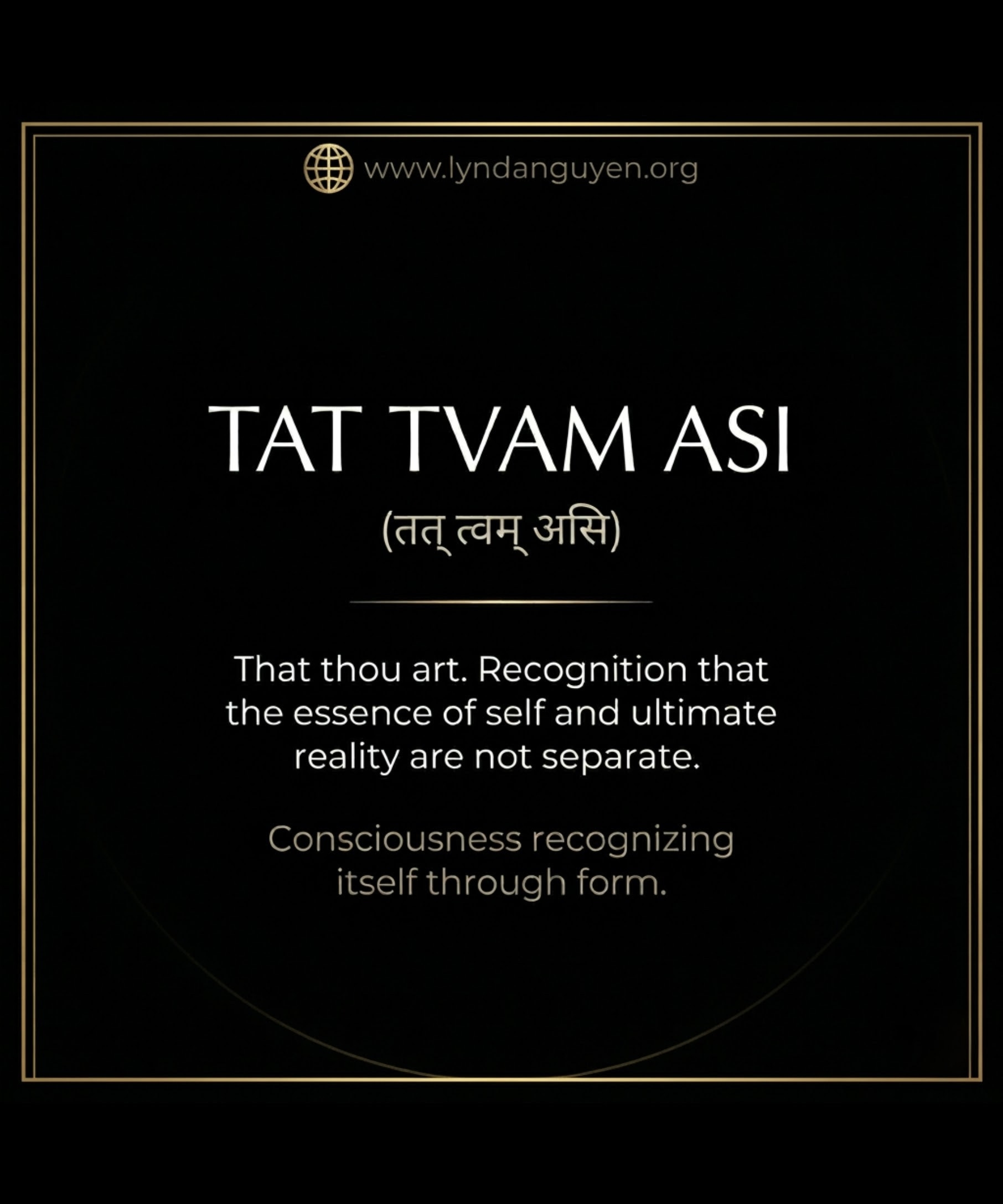
Tat Tvam Asi. That thou art. Consciousness recognizing itself through form.
The phrase is one of the great statements of the Upanishads. For most of my life it had been a beautiful idea. In that temple it stopped being an idea. It became something I had felt in my own body, which is a completely different kind of knowing.
I want to be careful here, because this is the place where writing like this usually loses people.
It can sound like I am describing something mystical and unrepeatable. A peak experience available only to people who fly to India and chant in ancient temples. That is not what I am describing.
What happened in Khajuraho was extreme and unmistakable. But the same recognition is available in much smaller doses, in much more ordinary places, all the time. It is available in a conversation where you stop defending your position long enough to actually hear another person. It is available in a moment of grief when the usual boundaries between you and everyone who has ever suffered the same loss suddenly feel very thin. It is available in any moment where the exhausting work of being a separate, defended self relaxes even slightly.
The temple just made it impossible to ignore.
Here is why this matters for the work I do.
I have spent years helping leaders find a smaller version of that same recognition. Not the temple. Not the chant. Something quieter and more usable.
The moment a person stops defending a self they experience as separate and alone, and feels, even briefly, how connected they actually are to the room, to the people across the table, to the work itself.
Most leadership under pressure is a performance of separateness. I am the one in charge. I am the one who must have the answer. I am the one who cannot show that I do not know. That posture is exhausting, and it distorts perception, and it makes people defended exactly when they most need to be open.
The leaders who move through pressure with real steadiness are not the ones with the strongest sense of self. They are the ones whose sense of self is relaxed enough that they can actually perceive what is happening. Who are not so busy protecting a boundary that they miss the room.
That is not a spiritual nicety. It is the difference between a leader who can read a situation clearly and one who can only read their own anxiety about it.
Tat Tvam Asi. That thou art.
The essence of the self and the larger whole are not as separate as we spend our whole lives believing.
You do not have to accept that as metaphysics. You can hold it simply as a description of what becomes possible when a person stops defending their separateness long enough to perceive clearly.
Everything I do now traces back to a temple in Khajuraho, where the stone reminded me that nothing real is ever as separate as it seems.
I have spent the years since trying to offer other people a doorway to that same recognition.
Most of them will never set foot in a temple.
They do not need to.
The recognition was never in the temple.
It was always already here.