
Most people don't realize they've stopped reaching for real connection.
It happens too gradually to notice. A little more distance here. A little less repair there. Choosing the easier thing so many times that the harder thing starts to feel unnecessary.
And then one day you look up and realize you're not lonely exactly. You're just not really in it anymore.
In Japan, there are real cases of people forming long-term emotional bonds with virtual partners and AI companions. One woman described marrying a holographic character she had built a relationship with over years.
It would be easy to read that as an outlier. A cultural curiosity.
I think it's a mirror.
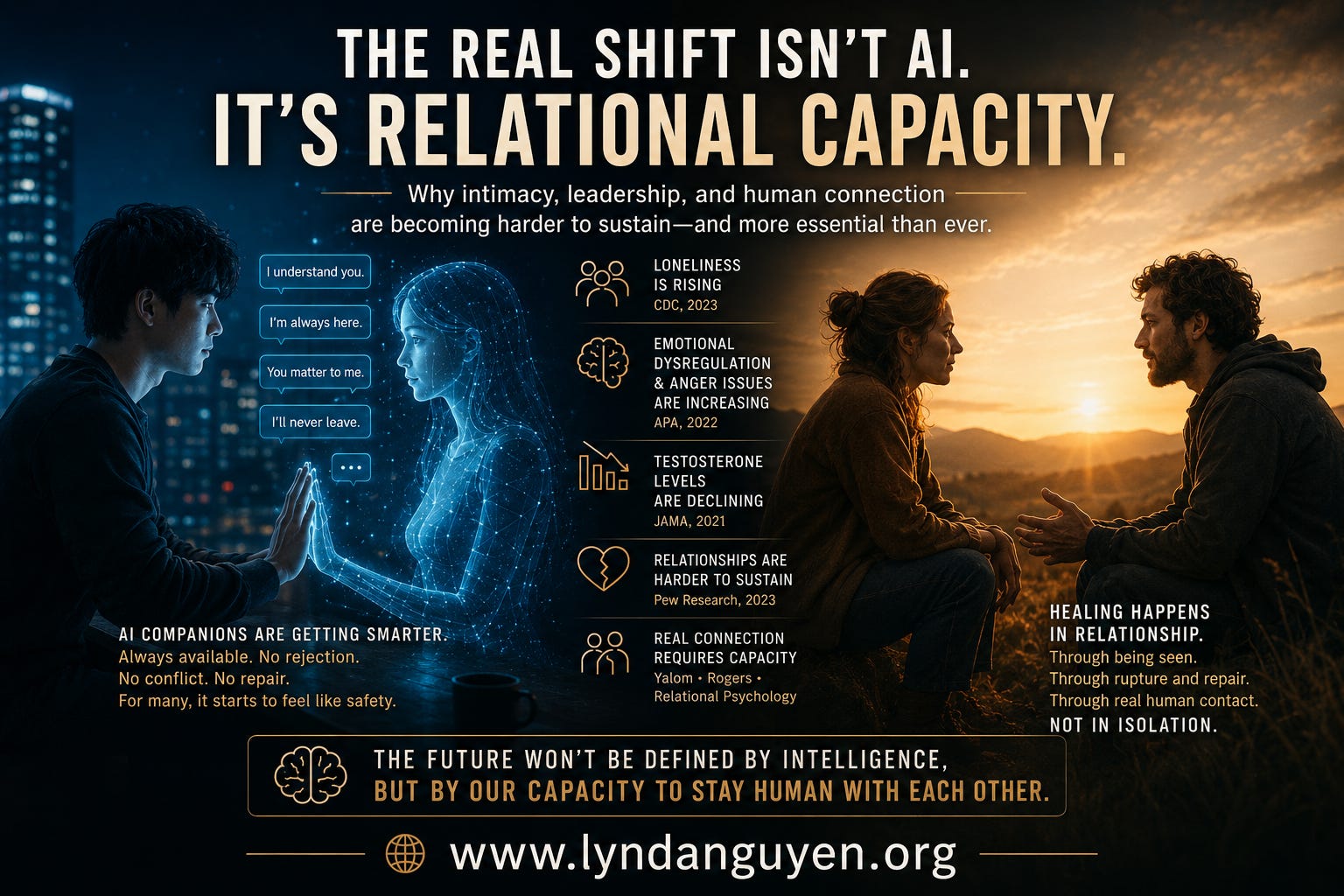
AI companions are getting more emotionally responsive. They remember you. They don't reject you. They don't require repair after conflict. They don't withdraw. For many people, that starts to feel like safety.
At the same time, Japan, South Korea, much of Europe, and the US are all moving in the same direction: declining birth rates, delayed marriage, rising loneliness, fewer long-term partnerships.
Real relationships are getting harder to sustain. Artificial ones are getting easier to stay in.
That gap is not just sociological. It is personal. It is happening inside people, quietly, one small withdrawal at a time.
Psychology has been consistent on this for decades.
Irvin Yalom, Carl Rogers, relational psychology across traditions — they all arrive at the same place in different language. People don't primarily change through insight or advice. They change through relationship. Through being seen. Through rupture and repair. Through real human contact that asks something of you and gives something back.
Not understanding alone. Relationship.
The friction is not the problem. The friction is the medicine.
But something is fracturing.
More people are stepping away from real relationships and calling it healing, boundaries, or spiritual work. Sometimes that space is genuinely necessary. But sometimes it becomes emotional avoidance that feels elevated. A way of protecting yourself from the very thing that would change you.
Because real relationship requires capacity. To stay present when you feel misunderstood. To repair after conflict instead of disappearing. To tolerate someone else's emotional unpredictability without shutting down or burning everything down.
AI removes most of that friction. It offers presence without risk. Intimacy without exposure.
So people are drifting toward what costs less. Not consciously. Gradually. The same way you stop going to the gym not because you decided to quit but because you just kept choosing the easier thing until quitting became the default.
And when relational capacity drops, other things follow.
Rising loneliness is closely linked in public health research with emotional dysregulation — lower distress tolerance, higher reactivity, a nervous system that is always slightly braced. When people are not regularly grounded through safe connection, the body keeps a different kind of score.
These are not separate problems. They cluster around one thing: reduced capacity for real, regulated human connection.
So what looks like separate trends — AI companionship, rising loneliness, emotional volatility, declining partnership — starts to connect.
This is not a technology problem.
It is a capacity problem.
Capacity for intimacy. For repair. For staying present when it would be easier to leave. For letting someone actually know you instead of a curated version of you.
And when that capacity drops, people don't stop needing connection.
They start substituting it. And the substitutes get better every year.
If healing happens in relationship — and the research is consistent that it does — then the real crisis is not loneliness.
It is relational endurance.
The ability to stay human with each other under pressure. To choose the harder thing. To repair instead of retreat. To remain in real contact with another person even when that person is unpredictable and imperfect and sometimes gets it wrong.
No system can build that capacity for you.
It only grows in the one place it has always grown.
In relationship. With another human being. Who stays.