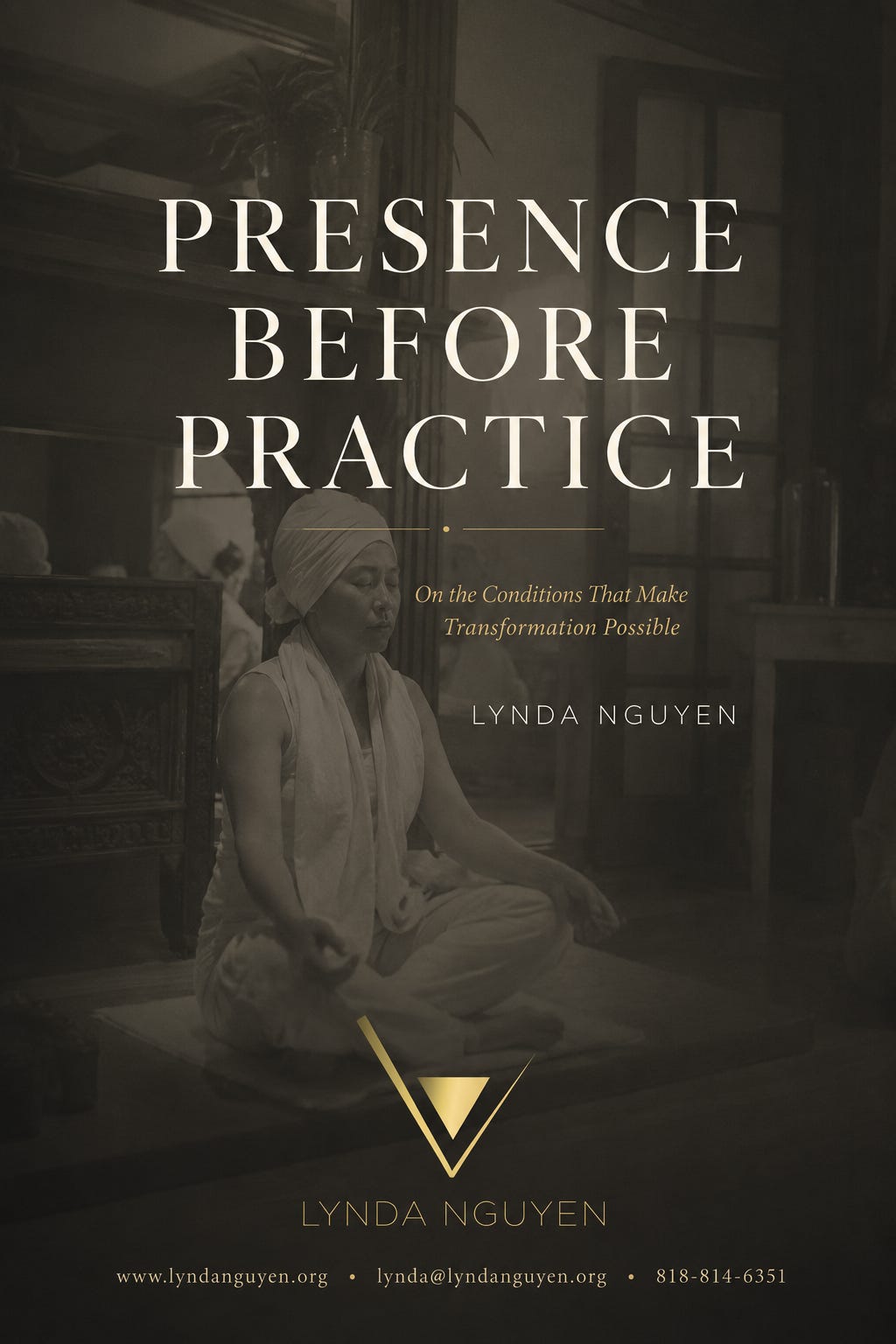

Years ago, I sat with a teacher whose presence I still haven’t fully found words for.
He said very little. He didn’t need to. Something in the quality of his attention made me feel seen in a way that no workshop, certification, or performance review ever had. There was no performance in it. No technique I could name. Just a quality of presence that made the room feel different from the inside.
I’ve spent more than twenty years trying to understand what he did.
Over the years, that question followed me everywhere — from classrooms to boardrooms, nonprofit organizations to mediation rooms, contemplative practice to executive coaching.
The settings changed.
The question never did.
What helps human beings change?
Later, facilitating firewalking experiences taught me something I never expected.
People imagine the transformation happens when someone walks across hot coals.
It doesn’t.
The walk lasts only a few seconds.
The real work begins long before anyone reaches the coals. It lives in learning to regulate fear without denying it. Reading the emotional rhythm of a group. Knowing when to challenge and when to slow down. Creating enough trust that someone willingly takes a step they once believed was impossible.
The fire was never the lesson.
The conditions that made the walk possible were.
Long before I understood the neuroscience, I experienced it through contemplative practice.
I spent eleven days in silence during Vipassana retreats, more than once. Presence stopped feeling like an abstract idea and became a discipline. More often than not, it asked me to remain with discomfort instead of escaping it. The practice wasn’t teaching me to become stronger than my experience. It was teaching me to remain present within it.
Only later did I realize I wasn't simply learning meditation. I was learning how to be a steadier instrument — in love, in work, in every room where someone needed me to stay.
One of my teachers kept returning to the same phrase. I must have heard it a hundred times before it finally landed.
“If your presence doesn’t work, neither will your words.”
At the time, I heard it as spiritual instruction. Over the years, I’ve come to recognize it as a principle of leadership, education, coaching, conflict resolution, and facilitation alike.
Years later, I discovered something surprising.
The contemplative traditions that shaped me and the modern sciences I was also studying were pointing toward the same insight.
Research in psychology, neuroscience, and adult learning increasingly points toward the same conclusion: people change most deeply when they experience psychological safety, meaningful challenge, trusted relationships, and environments that support new ways of seeing and behaving.
The best teachers and facilitators were never simply transmitters of information.
They cultivated conditions.
They created spaces where perception shifted, where fear softened, where people could encounter themselves differently.
Looking back, I realize he wasn’t teaching me techniques.
He was embodying the conditions that made transformation possible.
This is why, when I work with TEDx speakers and executives, I don’t begin with storytelling or technique. I begin with resonance. With breath. With the quality of presence the person brings before a single word is spoken.
I spent years studying acting in my twenties. The greatest teachers in that tradition understood something that most speaker coaches miss: performance at its highest level isn’t about displaying emotion. It’s about inhabiting truth. Read that again: It's about inhabiting truth. Stanislavski didn’t want actors to perform feeling. He wanted them to feel. The audience knows the difference.
A message only lands when the speaker is fully inhabiting what they’re saying. Authenticity isn’t something you apply at the end. It’s the condition you create at the beginning.
One of my elders put it simply:
“Stop singing your story and start serving the mantra.”
I've never found a better description of what it means to speak from presence — in service to the moment rather than in service to yourself.
Facilitation is often mistaken for speaking.
I’ve come to believe it’s the practice of creating the conditions in which another person can hear themselves more clearly.
That’s as true in a classroom as it is in a boardroom, a mediation circle, a coaching session, or around a fire.
Presence doesn’t replace knowledge.
It allows knowledge to land.
It doesn’t replace skill.
It determines whether skill becomes transformative.
Practice shapes what we do. Presence shapes who others become in our company.
Perhaps that’s why presence comes before practice.