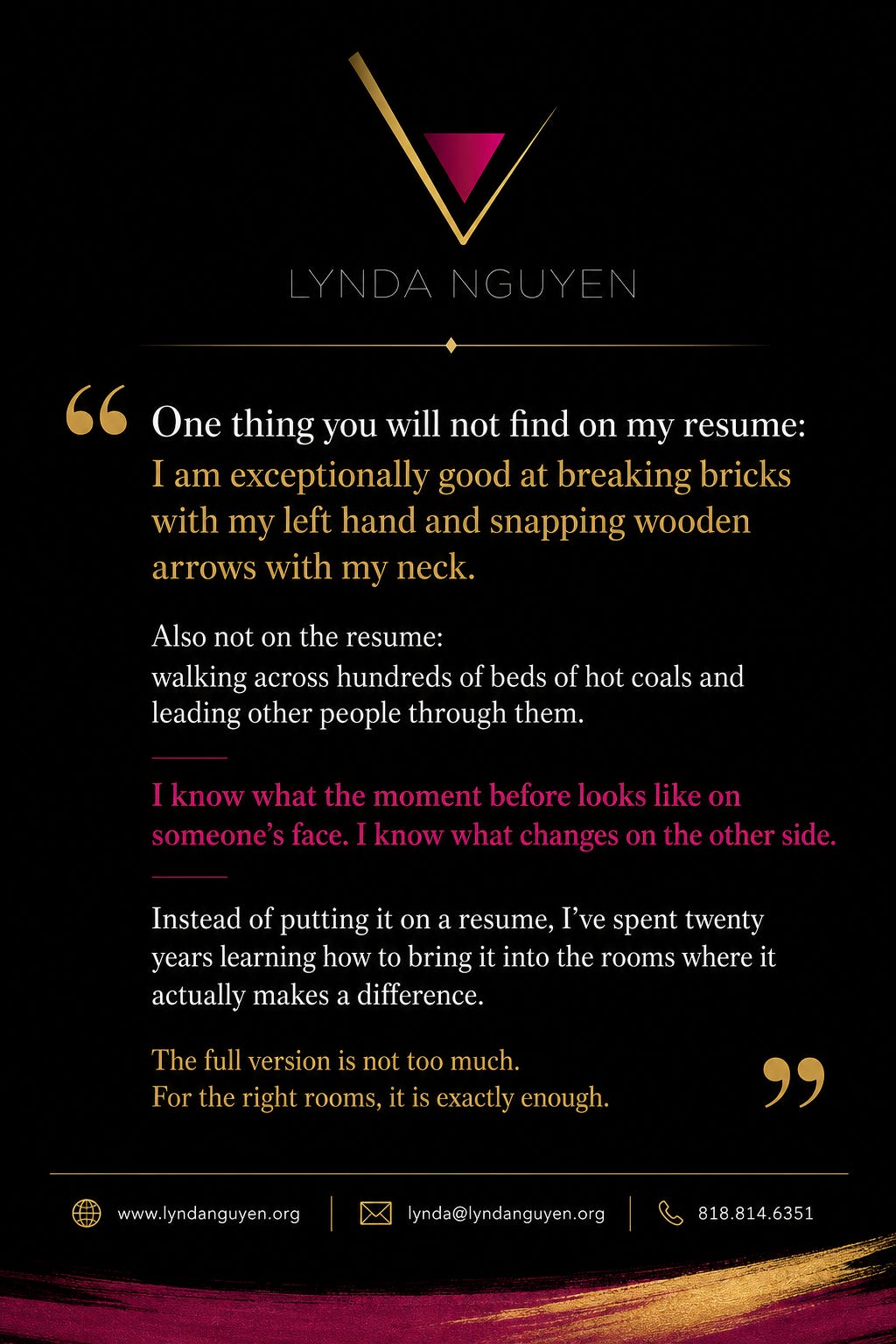

One thing you will not find on my resume: I am exceptionally good at breaking bricks with my left hand and snapping wooden arrows with my neck.
Measured. Controlled. Done it dozens of times. Never once put it in a cover letter.
I have also walked across hundreds of beds of hot coals and led other people through them. Executives. Teams. People who arrived certain they couldn’t and left knowing something about themselves that no workshop ever produced. I know what the moment before looks like on someone’s face. I know what changes on the other side.
Also not on the resume.
For years, I learned to live in two versions of myself.
One gets me in the room.
Clean career arc. Recognizable credentials. Embedded enterprise leadership. Google. Meta. Genentech. TED. Harvard negotiation training. Academic degrees. Executive coaching certifications with the right acronyms. Coached 60+ TED(x) clients too. It parses. It scans. It does not frighten the ATS.
The other one actually does the work.
That version includes time in India studying under Sikh and Hindu lineages with teachers who had been practicing longer than I have been alive. Pranayama and breath work studied at the source, not from an app. Clinical and medical hypnotherapy credentials and experience. Somatic and trauma-informed training. Work with veterans. Medicine circles. Grief that had no bottom and no timeline. A nonprofit built from nothing after #MeToo because something needed to exist and I was the person who could build it.
It includes the kind of presence that isn’t learned in a classroom, but in rooms where something real is happening and someone has to stay steady when it gets hard.
It includes the brick.
For a long time, I only sent the first version.
Not because I was ashamed of the second. Because I learned early that certain rooms don’t have language for it. That “somatic” makes some hiring managers nervous. That twenty years of integrative training—the kind that lives in the body and shows up in a room before you’ve said a word—doesn’t translate cleanly into a competency grid. That firewalking and grief work and nervous system mastery don’t fit neatly into a resume column.
So I got good at translation.
I learned to map experience into neuroscience language. To lead with what was legible and let the rest appear later, once I was already in the room.
I got very good at it. That’s not a brag. It’s an exhaustion report.
Recently, I showed someone the full version.
A leader I trust. Someone who has been in enough rooms to know the difference between credentials and capacity.
I showed him everything. The India years. The somatic work. The nonprofit. The fires. The medicine circles. The karaoke-room, fully-alive, uncurated version of me that doesn’t perform professionalism—it inhabits presence.
He looked at it and said: next time lead with this. I’d hire you.
And I didn’t believe him.
That’s the part I keep sitting with. Not the validation. The inability to receive it. Somewhere in years of learning to make myself legible, I started to experience the full version of myself as something that needed to be edited down to be acceptable—even when someone was standing in front of me saying the opposite.
Here is what I know from standing at the edge of fire with people who are certain they cannot cross.
The thing that stops them is never the fire. It is the story they are telling themselves about what they are capable of. A self-assessment formed so early and reinforced so often it starts to feel like fact.
Crossing doesn’t happen because fear disappears. It happens because something shifts enough for action to move anyway. Quiet enough to hear what’s actually true underneath the narrative.
I have helped hundreds of people reach that point. And I am still learning it in myself.
That is the bind I kept missing. The work is the credential. And I had to hide the work to use the credential.
There is a pattern I’ve seen on both sides of this work.
In corporate spaces, the integrative work reads as “too much.” Too unstructured. Too experiential. Too hard to quantify.
In integrative spaces, the corporate experience reads as “too much” in the opposite direction. Too institutional. Too compromised. Too far inside systems that people assume dilute clarity.
So you sand yourself down in both directions until you’re understandable everywhere and fully known nowhere.
What I’ve learned is this: the combination is not the problem. It is the point.
Because I am not two people with two resumes. I am the bridge between them. The same perception that reads a nervous system reads a boardroom. The same training that tracks what a body is doing when the words say otherwise is what lets me see the pattern underneath an organization in crisis. Most people have depth in one world. The rarer thing is someone who can stand in both at once and translate what neither side can see on its own.
That is what makes someone like me valuable inside an organization, not adjacent to it. Not a consultant who arrives and leaves. The person who can sit in the room every day and see the pattern before it becomes a problem. That is not a combination of credentials. It is a single capacity.
The reason I can sit with a C-suite leader in genuine pressure and not collapse into it is not the credential. It is the training underneath it. Nervous system work. Embodied practice. Years of learning how to stay present in intensity without performing stability. The reason I can walk into organizational chaos and see what is actually happening beneath the surface is perception training—the ability to track what is unspoken, to read the room below the language of the room.
None of that fits neatly into a resume. All of it shows up immediately in the room.
That training comes from somewhere. For me, it came from years in India. From grief that reshaped how presence works. From medicine work and clinical training and holding space in moments where there was no script. From a family that crossed fifteen days of open water on a wooden boat in 1980 with nothing but faith and each other. From a 22-year-old mother who held me the entire way and taught me, before I had words for anything, what it looks like to stay present through the unsurvivable.
That is also on the resume. Just not in the format most systems recognize.
I am not retiring the translated version. I still know how to speak different languages in different rooms, and that skill matters. But I am done treating translation as erasure. I am done leading with the version of myself that was designed to be easily categorized.
The full version is not too much.
For the right rooms, it is exactly enough.