
When I became a founder, something shifted in how I walked into rooms. Not because I had studied harder or discovered a better leadership framework.
Because the people in those rooms had become mine to steward.
Without thinking about it, I found myself reading the room before anyone spoke. I noticed who seemed regulated and who didn't. Who looked unusually quiet. Where tension already existed. What the room seemed to need before the agenda even began. It wasn't hypervigilance. It wasn't micromanagement. It was simply paying attention.
I hadn't learned to notice. My identity had changed. And my awareness expanded with it.
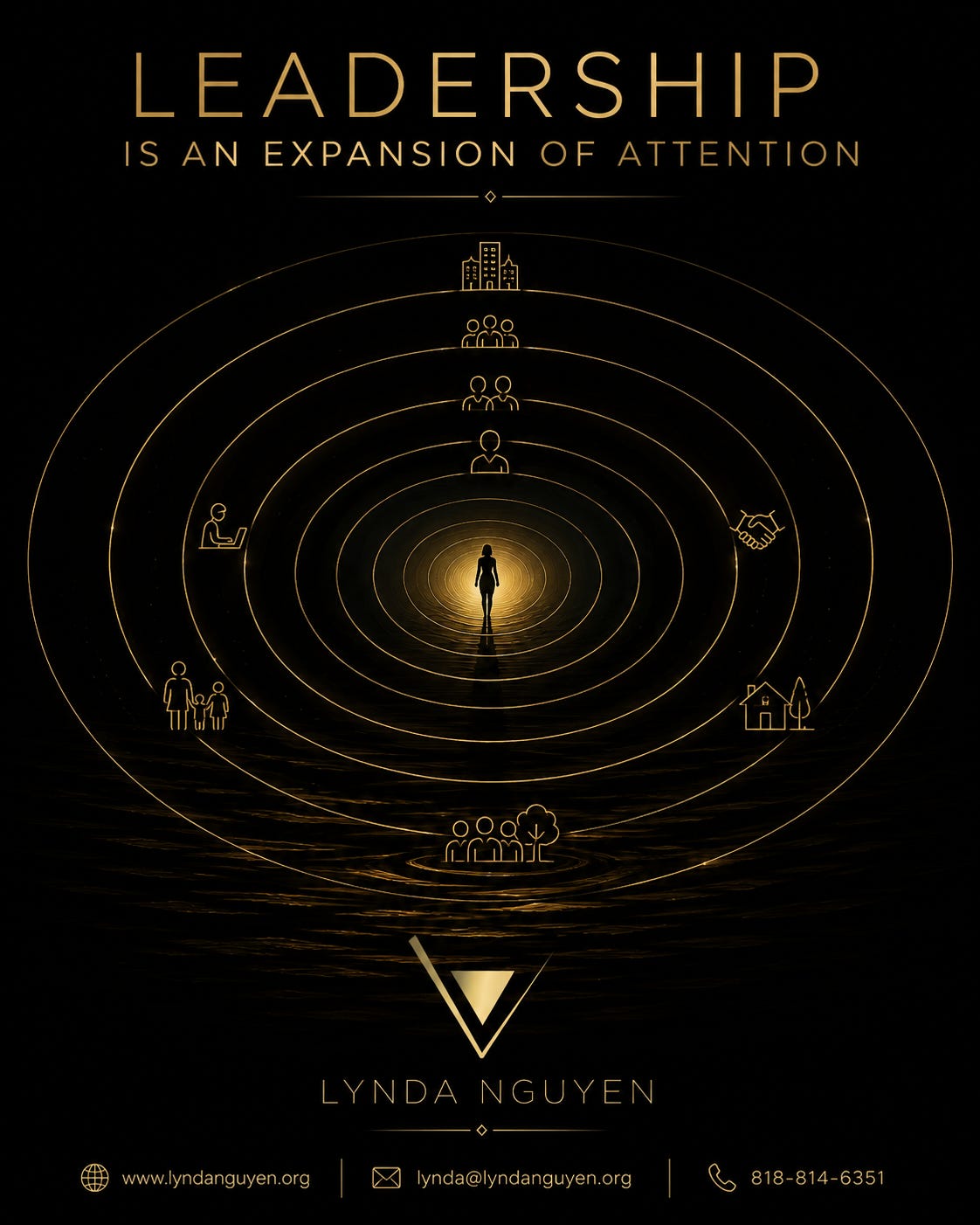
That has made me wonder if perhaps the most significant shift in leadership isn't authority. It's attention.
As people grow, what changes isn't simply the number of decisions they make. It's what they begin noticing without being told. An individual contributor naturally focuses on the work in front of them. A manager starts noticing who is overwhelmed before anyone asks for help. A director begins seeing friction between teams before it becomes conflict. A founder lies awake thinking about cash flow, culture, the customer who quietly disappeared, and the employee whose energy has seemed just a little different these past few weeks.
The work hasn't merely become more complex. The boundaries of awareness have expanded.
Most leadership skills can be taught. You can teach someone how to negotiate, delegate, facilitate meetings, read financial statements, or communicate a vision.
Awareness is different.
No one can teach you to notice.
Simone Weil wrote that attention is the rarest and purest form of generosity. William James, who spent his life studying the nature of consciousness, believed that the ability to voluntarily bring back a wandering attention was the very root of judgment, character, and will. Both were pointing at the same thing: that what we notice is not a neutral act. It is an expression of who we are. People can teach observation. They can offer frameworks, reminders, and checklists. But awareness isn't sustained by instruction.
It emerges from identity. We naturally notice what we experience as ours to carry.
A parent doesn't need a checklist to notice their child has become unusually quiet. A seasoned nurse notices subtle changes in a patient's breathing before they're fully conscious of it. An experienced founder senses something shifting inside an organization weeks before it ever appears on a dashboard. Not because they're trying harder. Because those realities have become part of who they are. Identity quietly determines the boundaries of awareness.
Neuroscience offers a complementary explanation. The default mode network — the part of the brain active when we're not focused on a task — is where we process other people's inner lives. Empathy, social cognition, perspective-taking all live there. Leaders who are perpetually task-focused rarely activate it. Their attention isn't simply narrowed by culture or habit. It is structurally occupied. Which may explain why some leaders genuinely cannot see what is directly in front of them. It isn't indifference. It is a nervous system that has never been given room to expand.
Consider relationships. Someone whose identity is simply, I'm dating, naturally pays attention to different things than someone whose identity has become, I'm building a life with another human being. Neither person is necessarily less loving. They're simply inhabiting different identities.
One is planning the weekend. The other is already noticing how conflict is repaired, how money is discussed, whether each person feels emotionally safe, what traditions are quietly forming, and whether both people are becoming more themselves or slowly disappearing inside the relationship.
As your identity shifts from me to us, another person's inner world gradually enters your own field of awareness. You notice the groceries before they're gone. You remember the difficult conversation they have on Thursday. You pick up their favorite tea because you know this week has been heavy. You hear something in the silence of their voice that most people would never catch. None of those moments are dramatic. Most are invisible. Yet they are often the moments that make someone feel deeply loved.
Consideration is simply awareness expressed through action.
The healthiest partnerships are rarely built by people trying to become mind readers. They are built by two people whose identities have expanded enough that they naturally carry a shared life.
Contemplative traditions have known this for centuries. You don't become more present by trying harder. You become more present by loosening your grip on a self that needs protecting. A person preoccupied with being right, being seen, being indispensable cannot pay full attention to anyone else. Their awareness is already occupied. Presence isn't a technique. It is what remains when we stop needing the moment to confirm something about us.
The same pattern appears in organizations. The leaders who cause the most damage aren't usually the ones who don't care. Most of them believe they do. What's missing isn't intention. It's range. Their attention stops at results, at performance, at what they can measure. The people producing those results remain slightly out of focus.
The leaders I most admire don't simply see themselves as generating revenue. They see themselves as stewards. Robert Greenleaf, who spent decades studying what separates great leaders from merely effective ones, distilled it to a single question: do those served grow as persons? Not as performers. Not as producers. As people. They understand that every hiring decision changes a family. Every promotion shapes someone's confidence. Every difficult conversation ripples through teams. Every cultural compromise eventually reaches the customer.
Their attention has expanded because their sense of responsibility has expanded.
Perhaps this is true everywhere.
Parents, partners, teachers, entrepreneurs, leaders. We don't become wiser simply because we've accumulated more knowledge. We become wiser because, little by little, our identity expands beyond ourselves. And as it does, our awareness expands with it.
That may be what growth really is. Not becoming responsible for more things. But becoming the kind of person whose presence makes more possible.