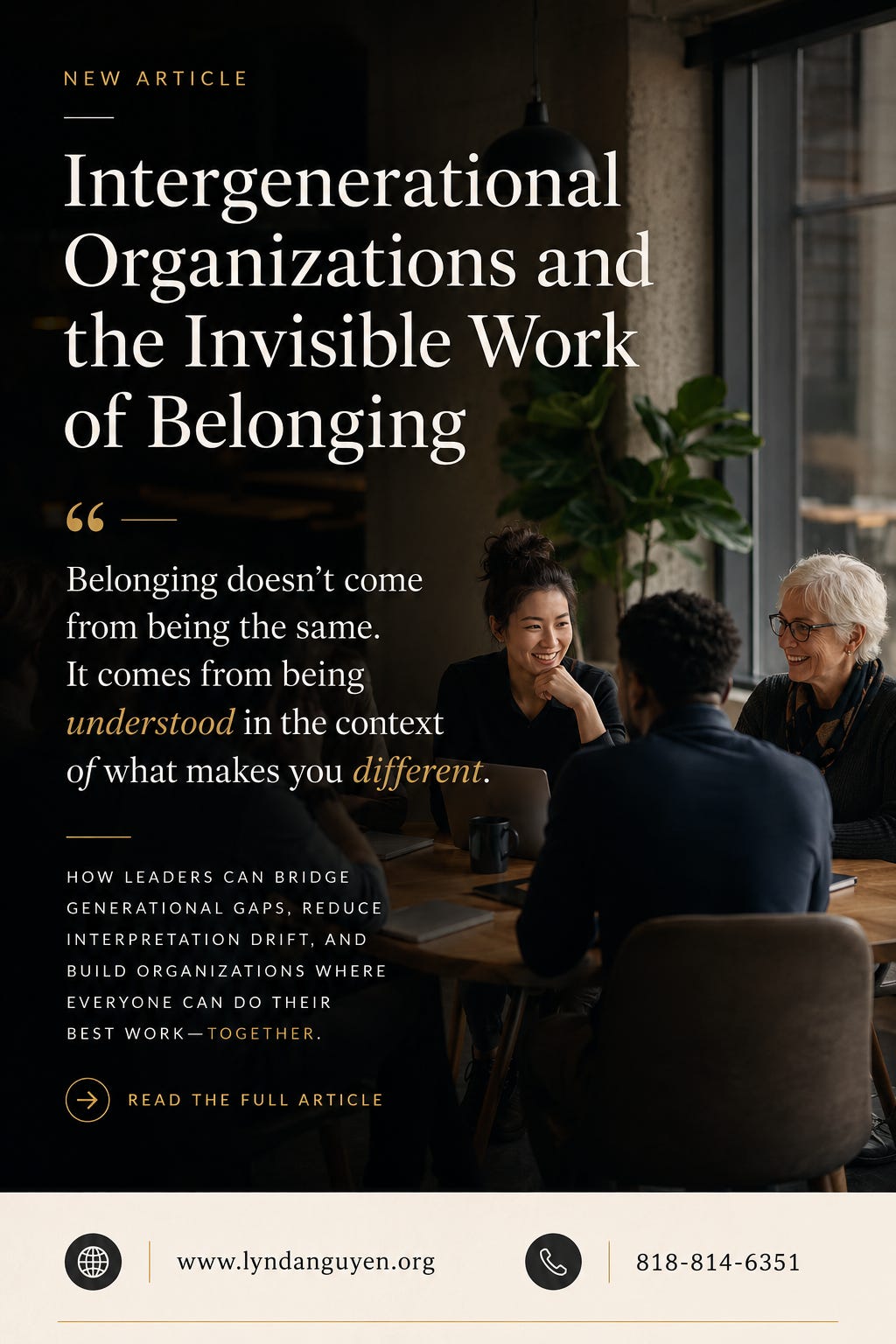

Most breakdowns in organizations don’t look like breakdowns. They look like people working hard in slightly different directions. Same tools. Same meetings. Different interpretations of what is actually happening. And over time, that gap stops feeling like a problem. It starts feeling like “how things are here.” That’s usually where belonging quietly starts to erode.
Belonging doesn’t fail loudly
When people stop feeling like they belong, they rarely name it. They adjust. They get more careful with language. They stop checking assumptions as often. They start carrying more of the context in their own head instead of sharing it out loud. Nothing breaks. Everything gets heavier.
The real issue isn’t disagreement. It’s interpretation drift.
Most organizations think alignment is about shared goals. But in practice, the real breakdown happens earlier—at interpretation. What did that decision actually mean? Is this direction fixed or still flexible? How direct is too direct here? What happens if I challenge something in real time? People don’t need identical opinions to work well together. They need stable interpretation of each other’s intent. Without that, every interaction carries extra cognitive load. And that load quietly drains belonging faster than any formal culture issue ever will.
Intergenerational organizations amplify this
Not age. Not tenure. But the era people were trained in.
Some were shaped in environments where clarity came from hierarchy and documentation. Some were shaped in environments where clarity came from speed and iteration. Some were shaped in environments where clarity came from constant informal coordination. So when they land in the same org, they’re not just bringing different skills. They’re bringing different assumptions about how work behaves. That’s where things start to drift—quietly.
After COVID, this became impossible to ignore
Distributed work removed a lot of the informal correction loops that used to keep interpretation aligned. People weren’t just missing meetings. They were missing context signals—tone, timing, micro-adjustments that happen in shared physical space. I built work post-COVID around this exact gap—less about traditional “unconscious bias” framing, and more about how perception, intent, and interpretation shift when people no longer share the same lived signals of work.
What became obvious very quickly: most misalignment wasn’t rooted in intent. It was rooted in signal distortion. People weren’t trying to exclude each other. They were reading different versions of the same moment.
Where bias actually shows up at work
Not in obvious or dramatic ways. In small interpretive shortcuts that compound over time: silence gets read as agreement, speed gets read as confidence, directness gets read as authority or aggression depending on who’s speaking, visibility gets mistaken for contribution. None of this is malicious. But it quietly shapes who gets heard, who gets looped in, and who starts adapting their behavior to stay legible. That adaptation is where belonging starts to thin.
The hidden cost: people start translating themselves
This is the part I see most teams miss. When interpretation isn’t stable, people don’t disengage immediately. They become translators. They pre-soften their opinions. They over-contextualize everything. They adjust tone before substance. They anticipate misunderstanding before it happens. And slowly, they stop showing up directly in their own thinking. Not because they don’t care. Because it costs less to be understood than to be precise.
What actually restores belonging
It’s not more messaging. It’s not more values. It’s reducing interpretation variance inside everyday interactions.
That means making a few things unambiguous: how decisions actually get finalized here, what kinds of disagreement are expected vs avoided, what signals are meaningful vs incidental, where people are allowed to be wrong out loud without losing standing.
Belonging improves when people stop having to guess how they’re being read.
Intergenerational organizations aren’t fragile. They’re layered systems that were never fully translated into a shared operating language. And most of what gets labeled as “culture issues” are actually interpretation issues that have been allowed to accumulate. The work isn’t to smooth out difference. It’s to make interpretation stable enough that people can stop editing themselves just to stay correctly understood. That’s usually where belonging starts to come back online.
The work I tend to gravitate toward sits right here—at the point where belonging, performance, and interpretation overlap. Because once people stop having to translate themselves just to be understood, most of the system starts working again.