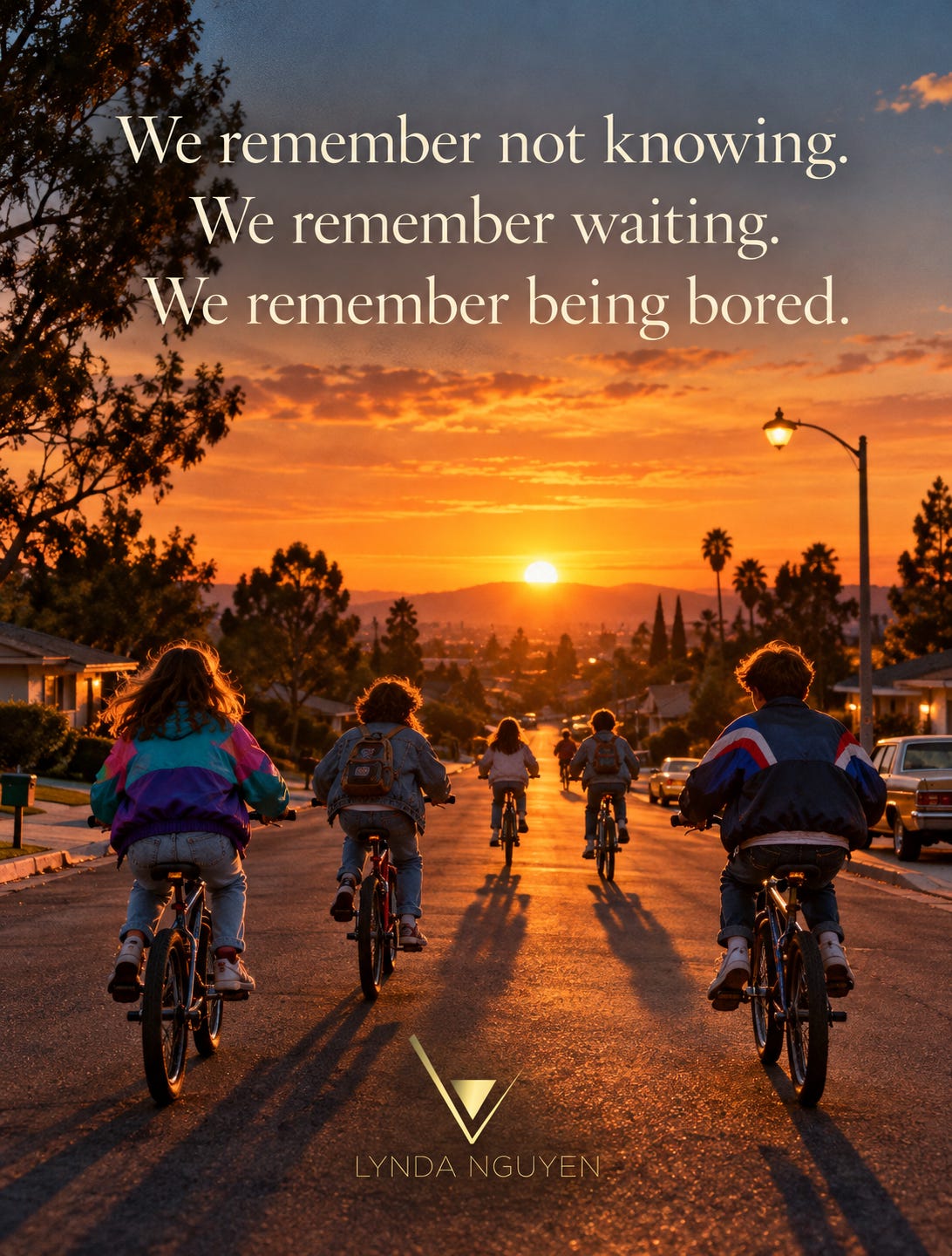

I grew up in the 80s, in the Bay Area, when children were entrusted with house keys, bicycles, and entire afternoons without adult supervision.
We drank from garden hoses, rode bikes and skateboards into neighboring towns, and operated under a sophisticated parental tracking system known as be home before the streetlights come on.
Nobody knew exactly where we were. Occasionally, neither did we.
At nine, I could ride to the other side of town with my cousins, get lost, scrape my knees, and develop questionable first-aid skills. I remember patching them up with the confidence of a seasoned emergency-room physician and approximately none of the training. If everybody could still ride home, the expedition continued.
I also loved taking things apart to see how they worked. Sometimes I managed to put them back together. Sometimes, somehow, there were extra screws.
My childhood was an interesting combination of enormous freedom and considerable responsibility.
My grandmother owned a deli restaurant, where I did homework in the back room while eating pickles straight from a giant white tub. Growing up Asian, straight A's were expected. If the restaurant was short-handed, I came out front to greet customers.
My mother ran a small daycare, which meant I might be helping change diapers while simultaneously trying to finish a book report.
I was enrolled in an interdisciplinary program involving academics, hospitality, early childhood education, and unpaid family labor.
Nobody called it leadership development. There were things that needed doing, and we did them.
But when I finished, I was free. I'd jump on my bicycle and ride halfway across town to 7-Eleven for a Slurpee before dinner. That was the reward. A bicycle, a ten dollar bill, and the freedom to go somewhere simply because I felt like going.
Looking back, I wonder how much of our adult relationship with work, commitment, and uncertainty was formed during those ordinary afternoons.
There's something amusing about being Gen X at this stage of our careers.
We spent decades waiting for the Boomers to retire. Some of them are still here. Retirement is a concept they support in theory, provided it applies to somebody else.
Meanwhile, we've been keeping things moving through recessions, reorganizations, outsourcing, the dot-com collapse, the financial crisis, remote work, and every technological revolution that promised to make our jobs easier.
We went from handwritten memos to email, Rolodexes to LinkedIn, filing cabinets to the cloud, and offices with doors to open floor plans where everyone could hear everyone else's conference calls.
Every time we learned a system, somebody introduced another one. And every time, we figured it out.
We inherited much of the Boomer work ethic. We believe in showing up, keeping our word, taking responsibility, becoming genuinely good at something, and building relationships that last.
But we've also learned to reinvent ourselves. We can change careers, learn new skills, build businesses, and walk away from institutions we've spent years helping to grow.
We can be loyal without being immovable. We can embrace change without treating everything as disposable.
And that combination extends beyond work.
Growing up, I usually had one best friend at a time. We knew each other’s families, shared dinners and holidays, and felt at home in each other’s houses. We were part of each other’s everyday lives. No calendar invitations necessary.
We knocked on doors. We called. We showed up.
We made mixtapes, wrote handwritten notes, passed them between classes, and kept little pieces of one another's lives for years. I kept some of those notes well into adulthood.
There was something about receiving a piece of paper someone had actually held, written on, folded, and given to you. The effort was part of the affection.
We weren't just there for the celebrations or emergencies, but for the ordinary moments, difficult seasons, and uncertainties of daily life. We understood that friendships and relationships weren't always convenient.
Sometimes your best friend annoyed you. Sometimes your partner disappointed you. Sometimes someone said something stupid and needed to be told so.
You talked. You argued. You went home upset. You thought about what happened. You sat with your feelings.
And eventually, you had to use your words.
Remember that?
Use your words.
An entire philosophy of human relationships, usually delivered by an exasperated adult to a child crying because somebody took the good crayon.
We learned to have difficult conversations face-to-face, in real time, without AI preparing three versions of what to say, each calibrated for warmth, clarity, and emotional maturity.
We improvised.
We read faces, listened to tone, adjusted our approach, and occasionally changed our minds halfway through a conversation.
No editing. No deleting. No asking ChatGPT to make us sound more emotionally intelligent.
We had to actually be emotionally intelligent.
Today, we have language for attachment styles, boundaries, triggers, and every variety of relational disappointment. And somewhere along the way, the internet became remarkably enthusiastic about advising people to leave.
Cut them off. Block them. Move on.
Let them.
No. Sometimes don't let them. Talk to them.
People cannot meet needs they haven't been told about. They have different histories, different ways of expressing affection, and occasionally the emotional intelligence of a household appliance.
That's why we communicate.
We also remember how difficult it could be to find someone genuinely sincere. Someone kind. Dependable. Someone whose affection was real and whose intentions were good.
They might not have been perfect. Neither were we.
But we understood the difference between a person who wasn't healthy for us and a good person who was still learning how to love us.
Now we can have five conversations going at once, another hundred possibilities waiting, unsolicited opinions from everyone, and a dating culture that resembles an endless series of job interviews with people simultaneously interviewing the entire metropolitan area.
And how's that working out for everybody?
A lasting relationship requires history. You have to spend enough time with someone to discover who they are when they're tired, disappointed, afraid, excited, or changing. You have to learn whether they can apologize, whether you can listen, and whether both of you are willing to grow.
We used to have a three-strikes rule, at least. Now somebody can be eliminated before they've even stepped up to the plate.
I think this is connected to something much larger: our relationship with uncertainty.
Consider how much of life requires us to act without guarantees.
Will this relationship last? Will the business succeed? Will our children be okay? Will the career we've built still exist in another decade?
When we commit to another person, we cannot know who either of us will become in ten years. When we start a business, we cannot guarantee that customers will come. When we accept a leadership position, we don't know which crises we'll inherit.
And yet we choose. We commit. We learn as we go.
Gen X had a different apprenticeship in uncertainty.
We remember not knowing. We remember waiting. We remember being bored.
Boredom sent us outside. Curiosity made us take things apart. Independence required us to solve problems, sometimes without an adult immediately intervening. Responsibility taught us that other people were counting on us.
And relationships taught us to stay in the room long enough to understand another person's point of view.
Somewhere in those experiences, we learned to trust ourselves to figure things out.
Getting lost didn't mean the adventure was over. Making a mistake didn't mean we were incapable. We learned to assess what was happening, make a decision, and deal with the consequences. Sometimes the solution worked. Sometimes we had to try again.
That kind of confidence is difficult to develop when every unknown must be resolved before we act.
I see the same tension in adulthood. We want certainty about our careers before making a move, certainty about another person's feelings before allowing ourselves to be vulnerable, and certainty about an outcome before committing our time, money, or reputation.
Sometimes we want so much certainty about life that we postpone choosing how to live it.
So much of what makes life meaningful requires us to show up, stay present, and commit without knowing how the story ends.
The ability to sit with uncertainty gives us room to think, listen, reconsider, and make decisions without demanding that every possibility be accounted for. It also allows us to change our minds without treating the original decision as a failure.
Those experiences followed us into the workplace. They shaped how we made decisions, handled conflict, worked with people who disagreed with us, and adapted when circumstances changed.
Experience taught us that having more information doesn't always make a decision easier. At some point, someone still has to exercise judgment, take responsibility, and move forward.
Which makes the modern workplace particularly entertaining.
Corporate America has developed an extraordinary number of tools for coordinating human activity.
We have project management platforms, productivity dashboards, collaboration channels, weekly check-ins, daily stand-ups, status reports, and meetings to discuss why the project is behind schedule.
One suspects the project might be behind schedule because nobody has been allowed to work on it.
Research by Rob Cross, Reb Rebele, and Adam Grant, published in Harvard Business Review in 2016, found that time spent on collaborative activities had increased by 50 percent or more over the preceding two decades.
Microsoft's 2025 Work Trend Index reported that the most frequently interrupted employees encountered meetings, emails, or chat notifications approximately every two minutes during core working hours.
Every two minutes.
That's barely enough time to remember why you opened the spreadsheet.
I sometimes wonder what would happen if we gave capable people a clear objective, the resources to accomplish it, and enough autonomy to exercise their judgment.
Revolutionary, I know.
Someone would probably schedule a meeting to discuss the risks.
Which brings me to something I wish more hiring managers would recognize.
Gen X is at an extraordinary point in its professional life.
We've accumulated decades of experience, navigated multiple technological revolutions, built businesses and teams, survived economic upheavals, and learned how to deliver results through circumstances nobody could have predicted.
And many of us are nowhere near finished.
Many of us have become remarkably proficient with artificial intelligence. We're willing to learn new industries, rethink old assumptions, reinvent ourselves, work hard, and help develop the people who will eventually succeed us.
We have institutional knowledge. We have scars. We have stories about software implementations that should qualify us for combat pay.
And we remember the value of good manners and a good mentor.
Someone who showed you how something worked, trusted you with responsibility, and allowed you to struggle a little before stepping in.
Now we're in a position to offer that to someone else.
We want younger professionals to succeed. We want to share what experience has taught us, give people meaningful responsibility, and help them develop their own judgment.
A successor isn't supposed to be a smaller version of yourself. They're supposed to become capable of building things you haven't imagined yet.
The best leaders eventually make themselves less necessary. They develop people who can make decisions without waiting for permission, navigate disagreements without escalating every uncomfortable conversation, and adapt when circumstances change.
They teach people how to think. Then they give them room to do it.
Yet experienced candidates can find themselves overlooked in favor of someone presumed to be more adaptable simply because they're younger.
That's an expensive assumption.
If you're hiring for leadership today, pay attention to the Gen Xers in the talent pool.
Consider the value of someone who understands commitment and reinvention, who can work independently, navigate difficult conversations, change their mind when new information emerges, and genuinely wants to help the next generation succeed.
And the Gen Xers leaving corporate America in their early fifties?
Don't mistake them for people winding down.
Some are starting companies, becoming independent advisors, developing intellectual property, writing books on an island in Southeast Asia, and finally building the things they've been thinking about for twenty years.
They're also becoming more honest about what they want from life and love, questioning the fears and old assumptions that have shaped their choices in both. There's something powerful about that kind of honesty. It changes how we love, how we work, and how we lead.
They've sat through enough strategic planning meetings to know the difference between a good idea and a beautifully formatted presentation about a good idea.
They know how to execute. And many now have the freedom to decide where that energy goes.
What interests me most about this generation is what we've managed to carry forward through all that change.
The commitment remains. So does the loyalty, the willingness to work hard, the ability to have an uncomfortable conversation, and the understanding that lasting relationships require more than good intentions.
We still believe in using our words.
And we've learned to change our minds.
We've lived long enough to discover that some of our strongest convictions were incomplete, that people can surprise us, and that experience sometimes requires us to reconsider what we thought we knew.
We're willing to update our worldview when life gives us a good reason to.
That's a remarkable combination to bring into a boardroom, a new business, a friendship, or a long-term partnership.
I think about my grandmother's deli, the giant tub of pickles, my mother's daycare, the book reports, and the bicycle rides to 7-Eleven.
I think about the scraped knees, the cousins, the things I took apart, and the freedom to explore a world without knowing exactly where every road would lead.
Nobody was preparing us for artificial intelligence, remote work, digital economies, or careers that would reinvent themselves several times over.
We were simply growing up, learning to contribute, explore, keep our word, use our words, and figure things out.
Decades later, those lessons still serve us. There's a generation of experienced people ready to lead, mentor, create, and contribute in ways organizations would be wise to recognize.
Some of us will do it from inside corporate America. Others will build something entirely our own.
We've spent our lives figuring things out as we go.
I see no reason to stop now.