
Fire has no shadow.
You've stood beside fire your entire life without noticing.
Shadows form when something blocks light. But fire doesn't block light.
Fire is light.
A flame emits photons in every direction simultaneously. It doesn't stand between light and the world. It becomes part of it. When light from another source hits a flame, the photons don't get blocked. They mix. No shadow forms.
You cannot cast a shadow with light.
It's physically impossible.
Something you've looked at your entire life has been quietly teaching leadership.
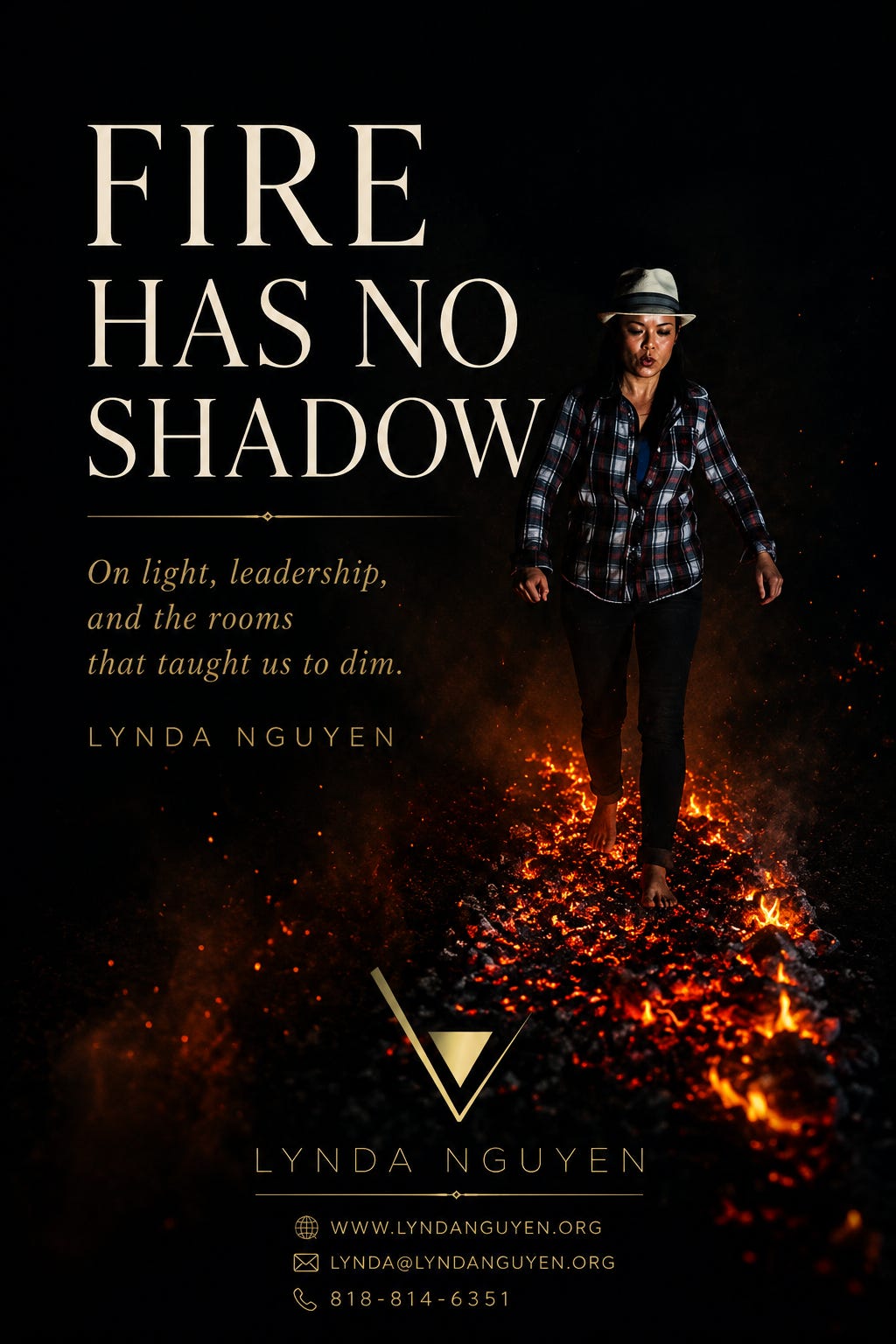
I have walked across fire. Literally. Hundreds of times, and led others across it too.
What I learned, not from reading about it but from standing at the edge of the coals and moving anyway, is that fire responds to presence.
Hesitation is what burns.
The people who get hurt crossing fire are almost always the ones who pause in the middle. Who second-guess. Who slow down at the moment the commitment to move forward is most needed.
The ones who cross cleanly are the ones who decide before they step. Who bring their full presence to the movement. Who don't negotiate with the fire once they're in it.
That's not a metaphor.
That's a physics lesson about what happens when you meet something powerful with your full self rather than a managed portion of it.
I've been thinking about what this means for the way we lead.
And the way we learn not to shine.
The leaders who cast the longest shadows aren't always the loudest ones in the room.
Sometimes they're the ones who seem most helpful.
I've watched a particular pattern more times than I can count. A senior leader. A mentor figure. Someone who positions themselves as a guide, a champion, a person invested in your growth. Their advice is always generous. Their feedback is always thoughtful.
But look at the pattern over time.
Every time you get close to moving beyond them, in confidence, in capability, in visibility, something shifts in the conversation. A hesitation they introduce. A risk they highlight that somehow only they can help you navigate. Feedback that plants doubt at exactly the moment you were about to outgrow them.
It may not be conscious. That's what makes it so difficult to name. It doesn't feel like sabotage. It feels like mentorship.
Their help is entangled with their need to remain necessary.
The effect is consistent: you leave the conversation slightly less certain than when you arrived. You stay a little closer to them than you might have otherwise.
This is not fire.
This is an object standing between you and the light.
The Vedic traditions saw something profound in light long before we could describe its physics.
In Hindu thought, jyoti, inner light, is the nature of the Self. The Atman doesn't accumulate. It radiates. The deepam, the diya, is not merely ritual. It is a symbol of consciousness that cannot be diminished by giving.
A flame doesn't diminish by lighting another flame.
Neither do you.
Two flames don't share a finite amount of light between them. Each one burns at full intensity. The room doesn't get darker when you add another candle.
It gets brighter.
I've felt this. There have been a few people in my life who didn't seem to know they were supposed to dim. And in their presence, neither did I. The brightest, most unapologetic humans I had ever known. So busy shining, so completely given over to it. I found myself shining my brightest too. For a long time. Not because they encouraged me to. Not because they made space for me. Because their light somehow gave mine permission. Their fullness made my fullness feel possible.
That is what two flames do in the same room.
They don't compete. They compound.
And yet most of us learned, somewhere, to dim.
Not because we were told to directly.
Because we read the room correctly.
I learned early that shining too brightly in certain rooms had a cost. Not the dramatic cost of being told to quiet down. The quieter cost of watching people go absent behind their eyes. Of feeling the room cool slightly whenever I shared something I was proud of. Of understanding, without anyone saying so, that my advancement threatened my access. That my visibility made me less available. That the price of belonging was accommodation.
So I learned to calibrate.
To make myself available instead of visible.
To accommodate instead of illuminate.
I learned what I needed to learn to stay. Most of us do.
The question that took years to arrive was whether I was still reading that room long after I'd left it.
Neuroscience has a name for this. Learned inhibition. When we repeatedly experience a social consequence for a particular behavior, the cooling of the room, the glazed eyes, the quiet withdrawal of warmth, our nervous system learns to anticipate that consequence and inhibit the behavior before it even begins.
We carry the architecture of old rooms into new ones.
We dim ourselves for audiences that no longer exist.
Fire has no shadow.
Not because it is trying to be fearless.
But because its nature is to give light.
The most luminous leaders I have ever been around weren't the ones who managed their light most carefully. They were the ones whose nature had become emission. They weren't performing generosity. They were simply, consistently, giving off light and it had never occurred to them that someone else's brightness diminished theirs.
Because it doesn't.
That's not how light works.
The question isn't whether you're shining too brightly.
Fire doesn’t ask whose room it’s in.
It owns it.