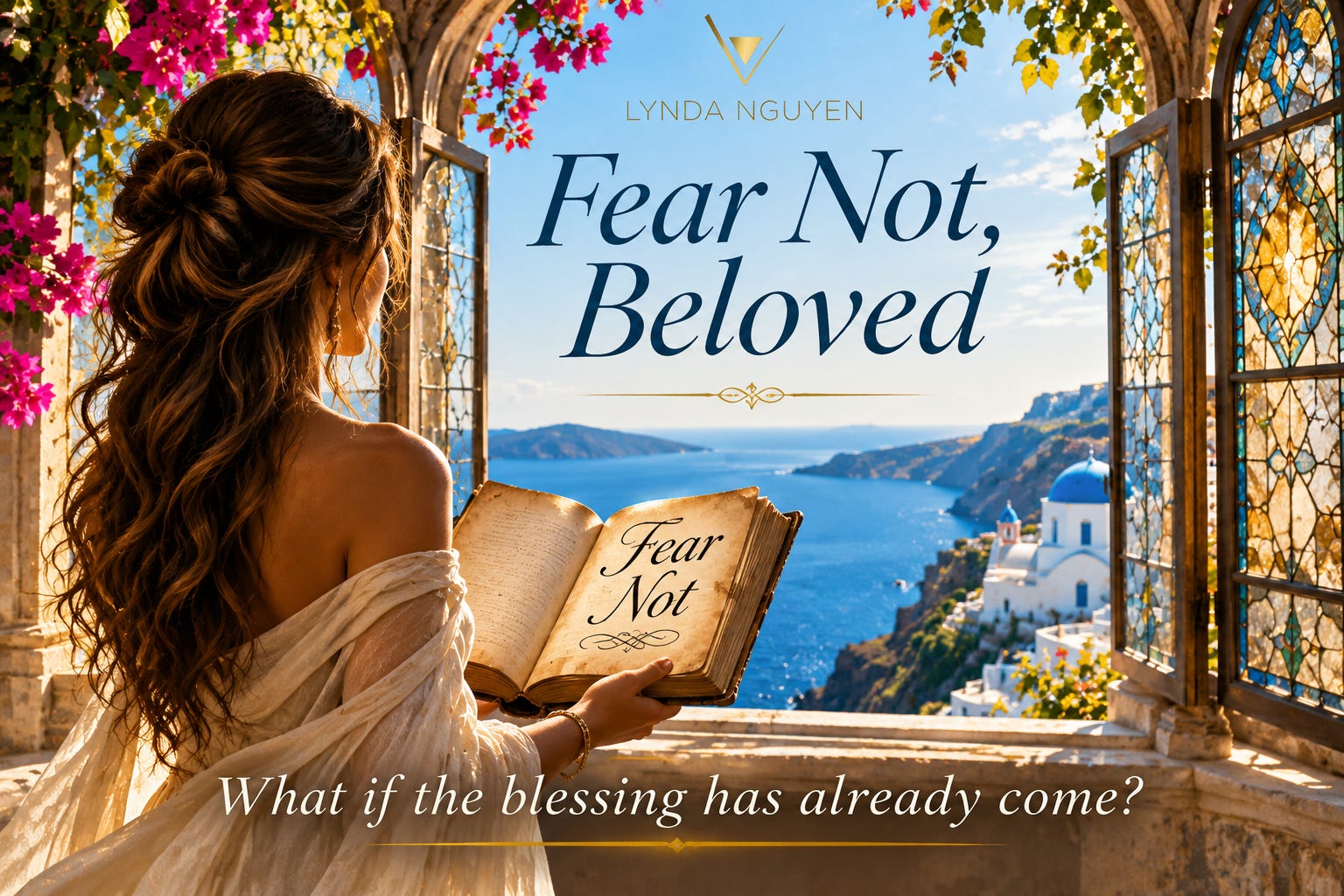

“Fear not: for I have redeemed thee, I have called thee by thy name; thou art mine.” — Isaiah 43:1, KJV
Throughout the Bible, across generations of prophets, kings, ordinary people, and extraordinary circumstances, the same reassurance returns.
Fear not.
God speaks these words to Abraham before the promise of descendants has been fulfilled. Moses tells the Israelites not to fear as they stand before the Red Sea, with Pharaoh's army approaching behind them. Joshua hears them as he prepares to lead his people into unfamiliar territory. An angel speaks them to Mary before she learns how profoundly her life is about to change. Shepherds hear them beneath a sky suddenly filled with heavenly messengers.
More than hundreds of biblical passages contain some variation of this reassurance, depending on the translation and how the expressions are counted. Across centuries, humanity encounters the same instruction, delivered in moments of danger, uncertainty, transformation, and sometimes unimaginable blessing.
And so often, the reassurance comes before anything has changed. The sea has not parted. The child has not been born. The promise has not been fulfilled. The future has offered no evidence of what it holds.
Yet the words remain.
Fear not.
Isaiah's language carries an intimacy that has endured for thousands of years. “I have called thee by thy name; thou art mine.” A reassurance of belonging offered to people who cannot yet see their way forward.
Human beings have always struggled with uncertainty. We imagine terrible futures, rehearse losses that haven't occurred, and experience the emotional consequences of events that exist only in our minds. We can frighten ourselves with possibilities, then organize our decisions around preventing them.
Someone can fear abandonment while being deeply loved, anticipate financial ruin while new opportunities are opening, or experience suspicion in the presence of genuine kindness. We can feel threatened by the very changes we've spent years hoping would arrive.
The feared event may never happen. Our response to it, however, can change everything.
Fear is among our oldest survival mechanisms. Without it, our ancestors would have been remarkably easy prey. Our brains evolved to detect danger, and respond quickly when survival depended on seconds rather than careful deliberation.
The amygdala participates in detecting and learning about threats, working with brain networks involved in evaluating context and regulating emotion. When something is perceived as threatening, the body mobilizes. Heart rate increases. Attention shifts toward potential danger. We prepare to act.
This is enormously useful when a car suddenly crosses into our lane.
It becomes more complicated when the perceived threat is an unexpected expense, an unfamiliar professional opportunity, an uncomfortable conversation, or the vulnerability of loving someone who has the freedom to leave.
Anticipated threats can produce genuine physiological responses, particularly when uncertainty intersects with earlier experiences of loss, rejection, or disappointment. The body can respond to what we believe might happen, even when nothing threatening is occurring in the present moment.
Neuroscientist Amy Arnsten’s research has described how intense stress can weaken the prefrontal networks responsible for planning, working memory, and flexible judgment.
At the very moment we most need perspective, our capacity to access it may be compromised. And because the feeling is happening inside us, we can mistake its intensity for evidence of its accuracy.
We feel afraid, therefore something must be wrong. We feel rejected, therefore someone must be rejecting us. We feel uncertain, therefore the situation must be unsafe.
Emotion becomes interpretation. Interpretation becomes conviction. Conviction becomes behavior. Eventually, behavior produces consequences that can seem to confirm the original fear.
One of the more troubling features of human decision-making is how readily we exchange long-term well-being for immediate emotional relief.
We send the message. Cancel the meeting. End the relationship. Reject the promotion offer. Make the accusation. Withdraw affection. Spend the money. Walk away.
Sometimes these decisions are necessary and considered. Other times, they are the fastest available route out of an uncomfortable feeling.
Psychologist George Loewenstein's research on hot-cold empathy gaps helps explain why decisions made during emotional intensity can differ dramatically from those we would make in a calmer state.
In the moment, an action can feel urgent, even inevitable. Hours later, the body has settled. The emotional state has shifted. The interpretation that seemed unquestionably true begins to look less certain.
But the action remains. The words have been heard. Trust has been damaged. An opportunity has passed. Someone on the receiving end has formed their own understanding of what happened.
A temporary sensation can create permanent damage.
Consider how quietly this can unfold in relationships.
Two people find something meaningful together. There is affection, companionship, commitment, laughter, and the growing comfort of being known. The relationship offers much of what they once hoped to find, yet somewhere beneath that happiness lives the fear of losing it, or of being so completely engulfed by it that they lose themselves.
One begins holding back affection, questioning moments that might otherwise have passed unnoticed, or preparing emotionally for a disappointment that hasn't arrived. A small misunderstanding becomes more significant than it needs to be. An apology is delayed. A tender gesture is withheld. A conversation that could have brought clarity or drawn them closer is avoided because vulnerability feels too risky.
None of these moments seems especially consequential on its own. But over time, the accumulation changes something. Spontaneity gives way to caution. Conversations become more guarded. The ease that once made the relationship feel so beautiful begins to disappear.
Two people who genuinely care for each other can find themselves standing in a relationship neither intended to create.
Research by psychologist Geraldine Downey and colleagues on rejection sensitivity has examined how anxious expectations of rejection can influence behavior and conflict within romantic relationships. Their findings help explain how fear can shape the very interpersonal conditions that eventually reinforce it.
Someone can finally receive the love they've longed for and become so consumed with the possibility of losing it that they gradually dismantle the connection they wanted to preserve. Sometimes through a single impulsive decision. Other times through a hundred small acts of self-protection, each one seemingly reasonable until the accumulated damage becomes impossible to ignore.
The same dynamic appears in organizations and in our relationship with success. A leader afraid of losing authority begins micromanaging capable employees, eventually driving away the people whose loyalty they wanted to preserve. An entrepreneur with a promising idea hesitates to bring it into the world, fearing not only failure but the visibility, and expectations that success might bring. Someone who has struggled financially finally begins earning more, yet continues making decisions shaped by the expectation that stability cannot last.
Fear can become a powerful organizing principle, influencing how we interpret information, where we direct attention, and which possibilities we allow ourselves to pursue. Over time, these patterns can become so familiar that we stop recognizing them as choices.
We call it being realistic. Being careful. Protecting our peace. Knowing how people are. Learning from experience.
And sometimes, without realizing it, we've built an entire life around anticipating disappointment.
We spend enormous energy studying why people fail to achieve their desires. We discuss discipline, motivation, goal-setting, confidence, and the importance of believing in ourselves. Entire industries are devoted to helping people pursue love, wealth, success, recognition, and happiness.
What happens when those things finally arrive?
A person can spend years longing for a loving relationship, only to discover that being loved requires a vulnerability they have spent just as many years avoiding. Someone can work tirelessly toward financial independence and become overwhelmed by the responsibility of sustaining it. Professional recognition brings visibility and scrutiny. Opportunity introduces responsibility. Peace removes the distractions that once kept us occupied.
Receiving something changes our relationship with the possibility of losing it. Before we have something, we can imagine its arrival with relatively little risk. Once it becomes real, there is something tangible to protect, and it begins asking things of us: responsibility, vulnerability, courage, commitment, and the willingness to grow into a life we once only imagined.
We pray, visualize, affirm, and devote ourselves to manifesting something into our lives, yet sometimes remain emotionally prepared for its opposite. We imagine abundance while anticipating scarcity, welcome love while rehearsing abandonment, and ask for peace while remaining suspicious of its arrival. Our expectations shape what we notice, the opportunities we pursue, and the choices we make when something unfamiliar begins to feel possible.
What if the greatest manifestation block isn't our inability to believe something good could happen, but our difficulty believing it could stay? Receiving requires the willingness to inhabit a reality we once only imagined, without allowing the fear of losing it to determine how we experience it. Otherwise, we may spend so much energy trying to manifest a blessing that we fail to recognize when it has already arrived.
Imagine finally arriving somewhere beautiful after years of difficult travel, only to spend the entire visit worrying about the journey home. The beauty is there, the opportunity is real, and the experience is available, but our attention has already moved to its ending.
I've thought about this for years, and one of the most memorable explorations of fear I've encountered happens to be a comedy about the afterlife.
Recently, I rewatched Defending Your Life for probably the fifteenth time. I've recommended this film to clients for years, partly because it's wonderfully funny, but mostly because of the question at its center: How much of our lives are governed by fear?
I've long believed that beneath the complexity of human emotions are two fundamental forces: fear and love. Much of what we experience, express, and choose can be traced back to one or the other. This is also a central spiritual teaching in A Course in Miracles, which explores fear and love as opposing foundations of perception.
Some spiritual traditions describe emotional states through vibrational frequencies, often expressed in hertz (Hz). In David R. Hawkins's Map of Consciousness, fear is assigned a level of 100, courage 200, and love 500. Other contemporary spiritual teachings place authenticity even higher, sometimes at 800 or 900, suggesting that living in complete alignment with who we are represents one of the highest states of consciousness.
The distinction is that love, however deeply felt, does not always mean we are living truthfully. We can love our families and communities while seeking approval, avoiding difficult conversations, or compromising parts of ourselves to preserve belonging. In romantic relationships, we may fear surrendering our independence or revealing needs that could jeopardize the connection. Over time, these compromises can distance us from who we know ourselves to be. Authenticity asks us to remain true to our hearts and ourselves, even when it challenges the expectations of those we love.
Albert Brooks plays Daniel Miller, a man who dies and discovers that the afterlife involves reviewing scenes from his earthly existence. His life is examined according to how he responded to fear. His hesitations, missed opportunities, and seemingly reasonable acts of self-protection reveal just how much of his life was shaped by what he feared might happen.
And then he meets Julia, played by Meryl Streep.
Julia is open, courageous, and wonderfully unafraid of life. They fall in love, but when their judgments arrive, Julia is permitted to move forward while Daniel is sent back to Earth. After an entire lifetime of allowing fear to determine his choices, he's about to lose the woman he loves.
In the film's final moments, Daniel escapes his departing tram and desperately reaches for Julia's. He has no guarantee of success, no carefully calculated outcome. For once, he chooses love despite his fear, and everything changes.
What makes his decision so moving is that the uncertainty remains. He cannot know whether reaching for Julia will change his fate. He only knows what allowing fear to make his decisions has cost him.
Research on avoidance and exposure learning offers a useful parallel. Repeatedly escaping feared situations can reinforce anxiety, while approaching manageable uncertainty can help us learn that anticipated outcomes are not inevitable and that discomfort can be tolerated.
But learning requires experience. We cannot spend our entire lives avoiding vulnerability and expect to become comfortable with intimacy. We cannot demand guarantees before every important professional decision and expect to develop confidence in navigating uncertainty.
Life rarely offers certainty in advance. We don't know whether a relationship will last, whether a business will succeed, whether an investment will pay off, or whether the people we trust will always honor that trust. Yet we continue to love, build, invest, create, and begin again.
I think about the extraordinary amount of human energy devoted to preventing imagined pain. The conversations rehearsed before they happen. The betrayals anticipated without evidence. The opportunities declined because of failures that exist only in our imagination. The affection withheld to avoid appearing vulnerable. The love postponed until every possible threat has been eliminated.
We can spend years praying for a different life while continuing to make decisions that preserve the familiar one. We can ask for love and then interrogate or fear its sincerity, ask for abundance and remain governed by scarcity, ask for peace and become restless when nothing is wrong.
What if the blessing has already come?
What if the opportunity is already here, the affection is genuine, the door is open, and the circumstances are more promising than we've learned to expect?
The Bible returns repeatedly to the language of fear because the human experience returns repeatedly to uncertainty. Abraham leaves what is familiar. Moses approaches the sea. Mary receives news that will change her life. Their stories unfold through choices made before the outcome is known.
And through them, the reassurance continues.
“Fear not: for I have redeemed thee, I have called thee by thy name; thou art mine.”
There is such tenderness in being called by name, in the assurance of belonging before the outcome is known, in the possibility that we are permitted to receive goodness without first resolving every uncertainty that accompanies it.
I wonder how differently we might live if we recognized how much of our suffering begins in anticipation. How many relationships might be spared unnecessary conflict or separation, how many opportunities might survive our first instinct to retreat, and how much joy might become available if we stopped rehearsing its disappearance.
We will still experience fear. Our nervous systems will continue doing what they evolved to do. But we can become more aware of the distance between what we feel and what we choose. We can question an interpretation before treating it as truth, recognize when our protective instincts are responding to the past, and allow an uncomfortable emotion to pass without requiring it to determine our future.
And when something beautiful arrives, we can remain present long enough to experience it.
Daniel spent an entire lifetime allowing fear to shape his decisions. In the end, one different choice changed his story.
He reached for love.
I return to those ancient words, spoken across generations to people standing before futures they could neither predict nor control.
Fear not.
Because one day, we may look back and discover that some of our greatest losses were never caused by the things we feared. They were caused by what we did while we were afraid.
And some of our greatest blessings began when we finally allowed ourselves to receive them.