
In January 2015, George Pickering walked into a Texas hospital carrying a gun.
His son, George III, had suffered a massive stroke. Doctors had declared him brain-dead and preparations were underway to remove him from life support. Pickering did not believe them. He believed his son was still there.
So he did something extreme. He barricaded himself in his son's hospital room, armed, and demanded more time.
During the hours that followed, Pickering held his son's hand and asked him repeatedly to squeeze it. Eventually, he felt something.
His son squeezed back.
George III later recovered enough to leave the hospital.
It is tempting to make this a story about a father who knew better than the doctors. That is the cleaner story, and probably the more dangerous one.
Medicine requires standards precisely because love can distort perception. Families can deny what is happening. Hope can become its own form of evidence. A father's conviction, however fierce, cannot be allowed to replace neurological criteria, clinical expertise, or the responsibility physicians have to their patients.
And yet.
Pickering knew something.
Or believed he did.
The distinction matters because human beings have always had more than one way of knowing, and we have never entirely agreed about which ones deserve authority.
Modern institutions are built largely around legible knowledge. We trust what can be measured, documented, replicated, credentialed, diagnosed, audited, cited, and defended. There are very good reasons for this. Legibility protects us from superstition, bias, charisma, wishful thinking, and the person who is spectacularly confident while spectacularly wrong.
But not everything we know arrives in a form that can defend itself.
A nurse walks into a patient's room and senses something has changed before the monitor confirms it. A mother notices something in her child that a standardized assessment has missed. A partner hears “I’m fine” and knows enough about the person they love to hear what the words aren't saying. A leader interviews a candidate whose credentials are perfect and cannot shake the sense that something does not fit. A musician knows the song needs one more note, or none.
Ask these people how they know and the answer may initially be unsatisfying.
I just know.
We tend to become suspicious there. We should. But suspicion and dismissal are not the same thing.
Michael Polanyi called it tacit knowledge: knowledge that exists without being fully available to conscious explanation. "We can know more than we can tell."
Anyone who has become genuinely good at something understands this. An experienced facilitator can feel a room change before anyone says anything. A physician may recognize a familiar constellation of symptoms without consciously working through every variable. A chef knows by touch that the dough is wrong. An athlete reads another body in fractions of a second. A seasoned leader notices that the person who always challenges ideas has stopped challenging them.
Expertise does not always announce itself as analysis. Sometimes analysis has happened so many times that it has become perception.
I recognize this territory because some of the most consequential turns in my own life began before I could explain why I was taking them.
Close to twenty years ago, much of my professional life had been spent working with grade-school-aged children. Through extensive volunteer work with working adults, I began noticing another pull. I wanted to work with adults professionally. Eventually, leaders. I wanted to spend more of my life around people who were actively examining who they were becoming, questioning what they believed, and growing with intention.
There was no career plan attached to this. I did not have a five-year strategy that ended in leadership development or executive coaching. I had an inclination.
Then someone I knew invited me to a conference.
The location was inconvenient and out of my way. There were perfectly reasonable reasons not to go. I went anyway.
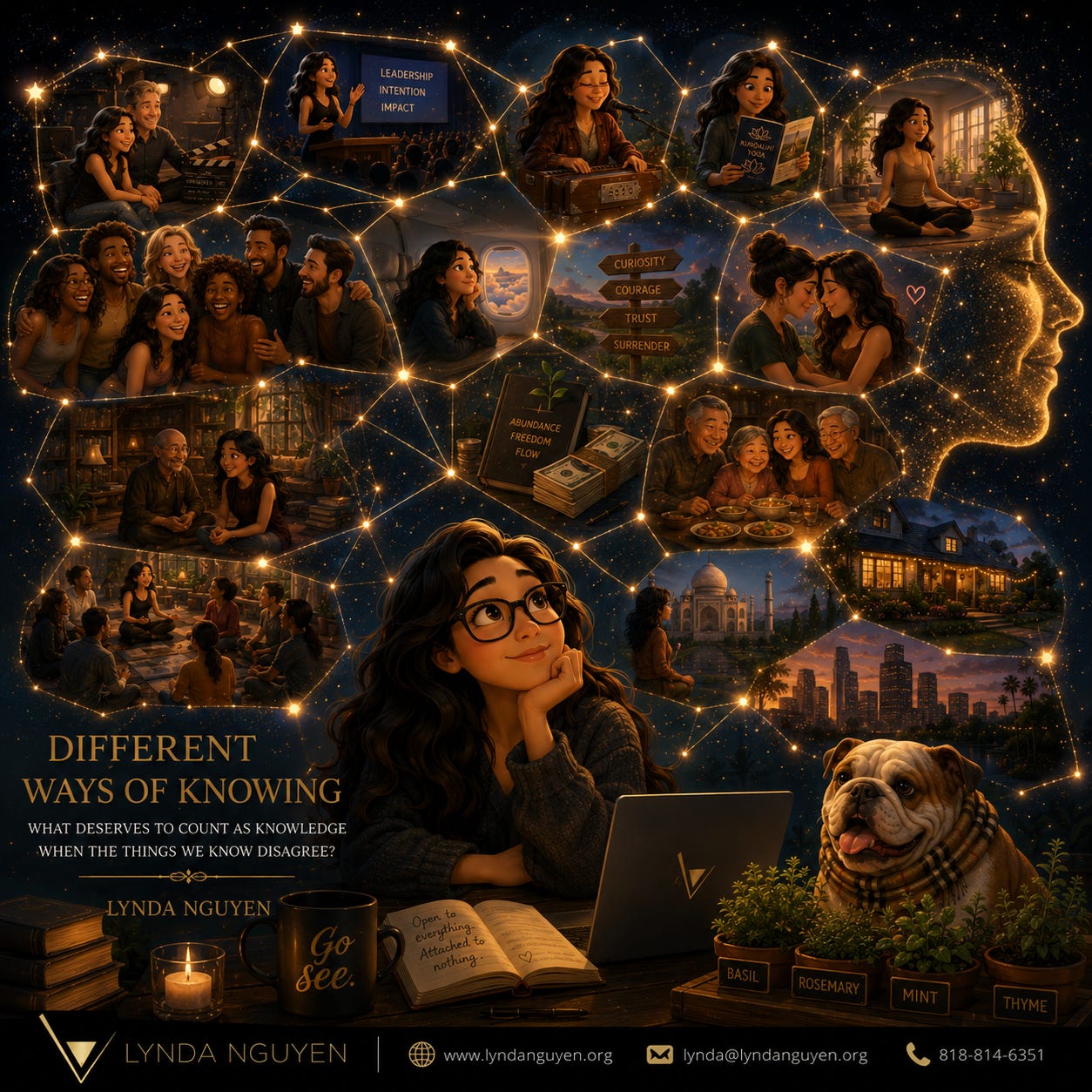
What I could not have known was that I had been drawn to that same place five years earlier. Back then, I had driven out of my way because of another pull I couldn't entirely explain. Wayne Dyer, one of my earliest spiritual teachers, was there for the filming of a movie, and I spent much of that week as an extra, sitting with him and participating in the experience. One of the ideas associated with his work was to remain open to everything and attached to nothing.
I remember leaving that week with an inkling that something in my life was changing. Not a prediction. Not a voice telling me what would happen next. Nothing I could have put into a plan.
Just a direction.
Five years later, I returned to the same place for that conference. That decision catapulted me into the world of coaching and facilitation. By the following year, I was leading the conference myself. I continued leading it for four years while immersing myself more deeply in coaching, facilitation, leadership, and work that would eventually become a substantial part of my professional life.
Around that period, another one of these inexplicable pulls appeared.
There was a kirtan concert at the Exploratorium in San Francisco that I wanted to attend. I had never been to one before, and none of my friends wanted to go. Of course they didn't. This was becoming something of a pattern.
So I went alone.
After the concert, I picked up a brochure about Kundalini Yoga. I remember looking at it and thinking, I don't understand this world.
But there was a pull.
The following week, I went directly to an ashram in San Francisco. On my first day there, I committed to two years of intensive study.
This sounds slightly unhinged when I write it now.
It also became one of the most formative periods of my life.
As I went deeper, another question began surfacing. Much of my practice had been oriented toward transcendence: consciousness, discipline, devotion, awakening. I remember thinking that I had spent plenty of time trying to awaken the crown. What about the sacral? What about the body, intimacy, creativity, desire, relationship, all the parts of being human we cannot transcend by becoming more spiritual?
That curiosity led me toward Tantra.
Then life did what it sometimes does when we have begun asking a question before we know what kind of answer we are looking for.
My friends and I threw a party in San Francisco. A man there introduced me to a woman who would later become my dearest friend and partner. I still remember our first meeting because whatever happened between us registered before I had language for it. The energy was palpable.
I was also terrified.
Nothing about terror proves that something is meaningful. Fear can be warning, memory, attraction, projection, or simply the nervous system confronting something unfamiliar. But I knew enough to pay attention.
That relationship eventually brought an invitation to India.
I said yes. Again.
The years that followed accelerated my development in ways I still find difficult to compress into a neat explanation. I immersed myself in traditions, teachers, practices, relationships, and communities that challenged what I thought I knew about spirituality, intimacy, identity, leadership, and myself. India led to other teachers and other rooms. Eventually there was Los Angeles, new partnerships, new communities, projects, and relationships that altered the direction of both my personal and professional life.
Sometimes I describe those years by saying I lived lifetimes in a few years.
Looking backward, I can construct a remarkably coherent story. Wayne Dyer. A growing interest in intention and the inner life. A conference I could easily have skipped. Coaching. Facilitation. Leadership. A concert nobody wanted to attend with me. A brochure for a tradition I didn't understand. An ashram. A person. India. Los Angeles. A different life.
But I did not experience them as a sequence.
I experienced them as a series of inclinations.
Hindsight is a gifted storyteller. Once we know where we ended up, we can arrange earlier events into a narrative that makes the destination seem inevitable. I don't know that any of these moments predicted my future. I don't know whether returning to the same location five years later was synchronicity, coincidence, selective attention, or simply the kind of pattern human beings become capable of seeing only after enough life has accumulated around it.
I don't need to know.
What interests me is that I kept responding before I understood what I was responding to.
Long before modern psychology developed language for tacit knowledge and pattern recognition, human beings had already been wrestling with the question of how we know.
Several schools of Indian philosophy asked not only whether something was true but by what means we had come to know it. Direct perception, inference, and reliable testimony could constitute different pathways to knowledge. Buddhist traditions developed ideas of insight that distinguished direct seeing from merely possessing information about something. Sufi traditions have long distinguished conceptual knowledge from a more intimate knowing that comes through encounter and experience.
What interests me is the question these traditions share with modern epistemology:
How do you know what you know?
Because I just knew.
It sounds confrontational in English, as though someone is demanding proof.
It can be a much more generous question.
What produced this knowing?
Did you measure it? Were you taught it? Have you seen this pattern a thousand times? Did someone trustworthy tell you? Did your body register something before your mind did? Are you recognizing something familiar? Are you afraid? Are you hoping? Are you remembering?
Because intuition has a credibility problem, and it has earned some of it.
"I have a feeling" can describe extraordinary pattern recognition. It can also describe prejudice.
"My body is telling me" can be meaningful information. Bodies also carry old experiences and can respond to resemblance as though it were recurrence.
"I prayed about it" can describe serious spiritual discernment. It can also become a convenient way of giving divine authority to something we already wanted.
"I just know" can mean that thousands of observations have been compressed into a conclusion faster than conscious reasoning can reconstruct them.
It can also mean I have no idea why I believe this.
The problem with intuition is not that it is irrational. The problem is that intuition rarely comes with footnotes.
That does not make it useless. It makes it worth interrogating.
Something in me knows.
What is that knowing made of?
This is where the usual argument between intuition and evidence becomes too crude. We talk as though human beings must choose between trusting their gut and trusting the data, when the more interesting work happens in the conversation between them.
Research on expert intuition has shown why this matters. Intuition becomes more reliable in environments where patterns actually exist and where people receive enough feedback to learn those patterns over time. The firefighter who has entered hundreds of burning buildings may notice danger that a novice cannot articulate because his nervous system has been educated by experience.
Feeling certain, however, is not the same as being calibrated.
The intensity of a knowing tells us how strongly we experience it. It does not tell us how accurate it is.
This distinction becomes especially difficult when what we are noticing has not yet produced an obvious outcome.
A colleague tells you everything is fine. Their work is still excellent. They show up to every meeting, meet every deadline, answer every question. There is nothing you could document as a problem.
But they have stopped offering the ideas they used to volunteer. They no longer stay after a meeting to keep talking. The person who once challenged you has started agreeing quickly. Their performance has not changed, but their participation has.
No single moment proves anything.
But human beings do not only perceive events. We perceive patterns between events.
Sometimes the person noticing the pattern is right long before there is enough evidence to persuade anyone else. By the time the evidence becomes legible from the outside, the people closest to it may have been noticing it for months.
And sometimes they are wrong.
An anxious person can perceive abandonment where there is exhaustion. A suspicious leader can perceive disloyalty where there is disagreement. A frightened parent can perceive danger where there is independence.
A feeling does not always deserve authority. It almost always deserves inquiry.
Organizations struggle with the same problem at scale.
We have become extraordinarily good at measuring what organizations produce. Revenue. Retention. Engagement. Conversion. Productivity. Performance. Customer satisfaction. Attrition.
Then someone says something that cannot yet be entered into a dashboard.
People are getting quieter.
Something is changing in the meetings.
Our best employee has stopped pushing back.
Customers aren't complaining, but they don't seem delighted anymore.
The culture feels different.
These observations are easy to dismiss because they lack the authority of a number.
Then six months later, the number moves.
Metrics are often excellent at telling us what has happened. Human attention can sometimes notice what is beginning to happen.
The answer is not to replace measurement with instinct. The opportunity is to build cultures in which early human perception can become a reason to look more closely rather than something we either blindly obey or casually dismiss.
There is a related problem in the way institutions encounter knowledge developed outside institutions.
For generations, communities have accumulated knowledge through sustained observation of land, weather, plants, animals, seasons, bodies, and one another. Much of that knowledge was historically dismissed because it did not arrive through methods recognized by the institutions doing the evaluating.
But long observation is also information.
Sometimes what one institution calls anecdote is another community's longitudinal study.
That does not mean every inherited belief is accurate. It means the method by which knowledge becomes visible can influence whether we recognize it as knowledge at all.
This is also why credentials are both enormously useful and incomplete. A credential tells us something important: someone has undergone a recognized process of learning and evaluation. It cannot tell us everything they know. And the absence of a credential cannot tell us everything they do not.
Some of the most consequential judgments of our lives happen in precisely this uncomfortable territory.
You are offered a job that looks perfect on paper and something in you resists.
Someone you love tells you they are okay and you know enough about them to stay another ten minutes.
Every metric in the organization looks healthy, but you start asking questions anyway.
The diagnosis says one thing. Your body keeps saying another, so you seek another opinion.
You meet someone and trust them immediately.
You meet someone and don't.
Sometimes these perceptions save us. Sometimes they deceive us.
The work is not learning to obey every internal signal. It is becoming curious enough to ask where the signal came from, what experience shaped it, what evidence supports or contradicts it, and what other form of knowing could test it.
Data can interrogate intuition. Intuition can tell us where to look for data. The body can notice what language has not caught up with. Language can help us discover that what felt like instinct was actually fear.
None of these ways of knowing is sufficient for every circumstance.
Which brings me back to George Pickering.
His story does not prove that parents know better than doctors. It certainly does not justify what he did. An armed standoff in a hospital is not a model of discernment.
What makes the story difficult is that underneath an indefensible act was a claim about knowledge.
The institution knew something about his son's condition.
The father believed he knew something about his son.
For a brief and terrifying period, those two forms of knowing collided.
Most of us will never face a moment that extreme. But eventually almost everyone encounters a quieter version of the same conflict. The evidence says one thing. Experience says another. Someone we trust sees something we cannot. Our body reacts before our reasoning catches up. A number contradicts a story. A story reveals something the number cannot contain.
We find ourselves saying the least persuasive sentence in the language of evidence:
I cannot prove this yet.
But I know something.
For years, when I encountered those moments in my own life, I often did something simpler than declaring the feeling true.
I went to the conference.
I went to the concert alone.
I picked up the brochure.
I walked into the ashram.
I got on the plane to India.
I took the opportunity.
I met the person.
I said yes.
And I’m saying yes, again.
I fell in love, again, without knowing where the love will lead..
Not because I knew what any of it meant.
Because something seemed worth knowing more about.
Intuition does not always have to be an answer. Sometimes it can simply be an invitation to investigate.
Go see.
Sometimes there is nothing there. Sometimes what we find corrects what we thought we knew.
I still read the research. I look at the numbers. I interrogate my assumptions and want evidence strong enough to challenge what I believe. I have spent much of my professional life teaching people to make better decisions, so I am hardly indifferent to data.
But there have also been moments when I have looked carefully at everything the evidence could tell me and decided to go anyway.
Sometimes I followed the data. Sometimes I threw it out.
My life is better because I learned there was a time for both.
The question is not simply whether to trust our gut.
It is:
How did I come to know this?
And once we have asked that as honestly as we can:
What does this knowing ask us to pay attention to now?