
There is a particular kind of intelligence that can become very good at explaining why now is not the time. You need more money. A better job. A clearer plan. The market needs to improve. The relationship needs to settle. The children need to get older. You need six months of savings instead of three. You need to know where you will live, how much it will cost, what happens if it fails, and preferably what happens after that.
All of these can be reasonable considerations. That is what makes waiting so convincing. There is almost always a rational argument for remaining inside a reality that already exists.
I have been thinking about what happens when we reverse the order. Instead of asking reality what is possible, what happens when we decide what is possible and then ask reality what would have to become true?
Not because reality doesn’t matter. Because it does.
Sara Blakely was selling fax machines door-to-door when she began working on what would eventually become Spanx. She had no background in fashion, no manufacturing infrastructure, and no network of powerful industry relationships waiting to take her call. She started with an idea and $5,000 of her own savings.
What matters about her story is what happened after she set the idea in motion. Once you do that, reality stops functioning exclusively as evidence against the possibility. It becomes information.
I don’t know how to manufacture this, so manufacturing becomes a problem to solve. I don’t understand patents, so patents become something to learn. Nobody in the industry knows me, so access becomes something to create.
The constraints haven’t disappeared. Their meaning has changed.
Blakely did not immediately destroy every source of security. She continued selling fax machines while building the company. That matters because “burn the bridge” can easily become shorthand for recklessness. Quit the job. Empty the savings account. Remove every escape route. Trust desperation to make you resourceful.
Sometimes desperation does make us resourceful. Sometimes it just makes us desperate.
The more consequential bridge may be psychological. At some point, you stop renegotiating the destination.
This is harder than it sounds because the bridge behind us is rarely just an escape route. It is an identity. It is competence in a world we already understand. It is the salary we know how to earn, the city we know how to navigate, the people who already know our name, the routines that make us feel capable even when they no longer make us feel alive. The familiar life gives us evidence of who we are. The future cannot do that yet.
This may be why we sometimes call staying realistic long after reality itself has begun asking something different of us. We are not always waiting for better conditions. Sometimes we are waiting to feel like the person who could inhabit the next life before we are willing to leave the life that produced the person we are now.
But transformation rarely works in that order.
There are capacities we cannot develop while preserving every condition that made them unnecessary. Resourcefulness develops because something must be solved. Courage develops because certainty is unavailable. New relationships are built because the old network cannot take us where we are going. A different identity emerges because the previous one is no longer sufficient for the life we have chosen.
The bridge does not only connect us to safety. It connects us to an old set of assumptions about who we are, what we need, what we can tolerate, and what kind of life is available to us.
Sometimes we keep crossing back not because the future is impossible, but because the past still knows our name.
I was born in Vietnam and came to America as a baby. I grew up around people who understood a far more consequential version of this principle than anything found in a business book.
Vietnamese refugees did not arrive in America after securing the perfect conditions for reinvention. Many arrived without the language, professional recognition, financial security, cultural fluency, or networks that normally make a new life seem possible. They learned English, took whatever work was available, shared homes, pooled resources, opened businesses, entered industries they had never imagined entering, sponsored relatives, educated children, bought houses, and built communities.
But I hesitate to describe what my community experienced as burning the bridge. For many of them, history burned it.
That distinction matters. They did not attend a seminar and decide that eliminating Plan B would increase their motivation. They were responding to war, displacement, and circumstances whose stakes bear no resemblance to deciding whether to start a company, change careers, or move across the country. There is nothing useful about romanticizing that suffering.
What their lives demonstrated, however, is something I have known since childhood and perhaps have not always lived as though I knew: human beings can build realities for which they did not begin with a complete map.
There is a spiritual dimension to this that has followed me through years of practice and study. Faith, in its more serious forms, has never required certainty. Certainty requires very little faith. If the path is illuminated from beginning to end, the financing is secured, the outcome guaranteed, and every variable accounted for, there is very little left to trust.
Spiritual practice asks something harder. It asks us to act with discernment when the entire path cannot yet be seen. Not blindly. Not irrationally. Not because we expect some invisible force to reward our courage. It asks whether we can move without requiring life to provide proof of the destination before we take the first meaningful step toward it.
There is a difference between surrender and passivity. Surrender accepts that I cannot control every condition and still asks what is mine to do. Passivity waits for the conditions to make the decision.
For years I have watched people ask life for guarantees before giving it their commitment. We want the new career once we know we’ll succeed, the relationship once we know we won’t be hurt, the move once we know we’ll belong, the business once we know people will buy, the creative work once we know it will matter.
But some knowledge exists only on the other side of participation. You cannot think your way into all of it from the doorway.
At some point, you have to enter the room.
I am confronting this in my own life now. There are decisions I could postpone until the conditions become more convincing, until there is more certainty, more security, more evidence that what I want to build will work. I could remain inside a life I already know how to manage while carefully preparing for another one.
There is nothing inherently wrong with that. Except that preparation can become its own form of permanence. We can end up demanding proof from a future we have not begun building.
You can prepare forever. Eventually, the preparation becomes the life.
Once the decision changes, the questions change with it. Instead of asking whether I can afford to build this life, I ask what income must exist for this life to work. Instead of asking whether I already have the professional network I need, I ask who I need to know and how those relationships get built. Instead of asking whether the business is established enough, I ask what would have to happen for it to become established.
Instead of asking whether I can know it will work, I ask a different question:
What must become true for it to work?
That question doesn’t deny reality. It interrogates it.
There is a version of possibility thinking that treats facts as negativity. I don’t believe in that. If you have $4,000 and need $20,000, the missing $16,000 is real. If the business model doesn’t work, it doesn’t work. If the physics are impossible, enthusiasm does not alter physics. If your family depends on your income, responsibility does not disappear because you bought a plane ticket.
Reality deserves respect.
Respect is not the same thing as obedience.
A constraint tells you something about the problem. It does not automatically tell you whether the problem can be solved. The constraint might be money, geography, knowledge, access, time, skill, relationships, or some combination of all of them. Once identified, each becomes something that can be examined rather than a vague argument for why the desired future cannot exist.
Not everything that must become true exists outside us. Sometimes the constraint is financial or structural. Sometimes the person capable of sustaining the life we say we want has not been fully built yet.
If I want a different professional life, I may need more than different opportunities. I may need a different relationship with visibility, rejection, money, discipline, or asking. If I want to build something larger than what I have built before, I may have to tolerate being inexperienced again. If I want a life that gives me greater freedom, I may also have to become capable of carrying greater uncertainty.
Reverse engineering a future cannot only ask what conditions need to change. It also has to ask what capacities need to develop.
That is where the decision begins changing the decision-maker.
Some decisions do something more consequential than choosing among futures already available to us. They alter the conditions under which future options become available.
The sequence changes. Choose the outcome. Name the constraints. Determine what must become true. Work backward. Build the conditions. Adjust when reality answers back. Then make the decision expensive to abandon.
There are moments when prudence tells us to wait. There are also moments when prudence becomes fear with excellent vocabulary. The difficult work is knowing which one is speaking.
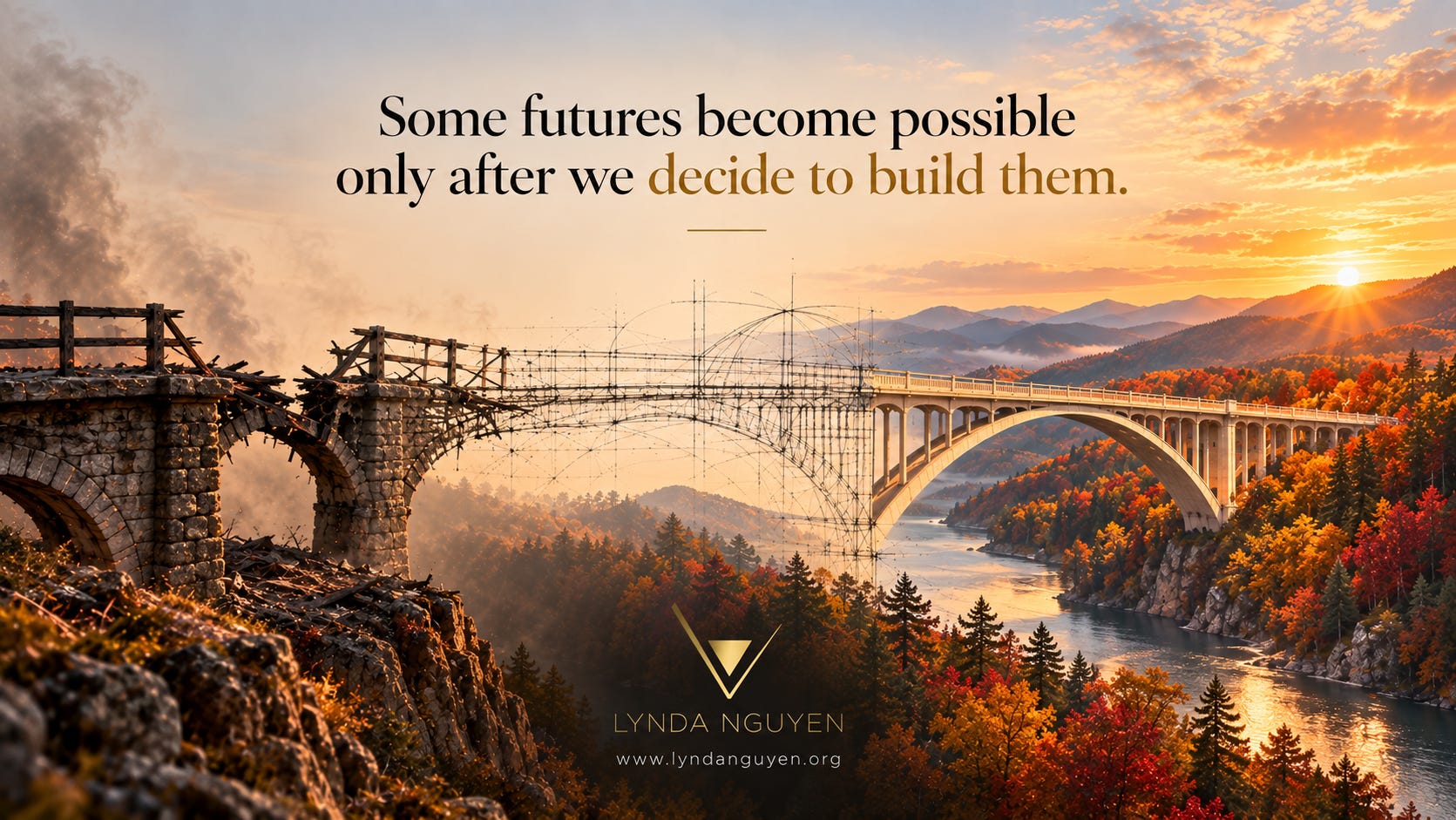
Sometimes the bridge that needs to burn is the one we keep using to retreat into indecision. The endless reconsideration. The requirement for certainty. The belief that all the conditions must exist before the commitment can. The assumption that today’s reality has earned the authority to define tomorrow’s possibilities.
My family crossed an ocean because history gave them little choice. I have choices they did not. That difference is not small. It may be the entire point.
They did not endure uncertainty so that uncertainty itself could become a family value.
Survival was not the inheritance. Possibility was.
I do not honor their courage by making my life unnecessarily difficult. I honor what they built by recognizing that I have options precisely because they created them. Honoring what they built does not require recreating the conditions under which they built it. Perhaps it means using the freedom their choices helped make possible.
To choose deliberately. To accept uncertainty without worshipping it. To look directly at reality without confusing it for destiny.
There is still faith in this. Not the faith that everything will work because we were brave enough to begin, but the faith required to move before every answer is available. We build what is ours to build. We prepare, calculate, ask, learn, adjust, and work. And then we leave some room for what cannot be reverse engineered.
Perhaps that is what surrender actually asks of us. Not to wait for life to reveal the entire path, and not to pretend we control where it leads. Only to become responsible for the next part that is ours.
Sometimes the decision has to come before all the evidence arrives.
Then we look honestly at the reality before us and what we have already set in motion. We trust what cannot yet be known, take responsibility for what can, and ask ourselves what the future we are building requires of us now:
What must become true?
Who am I becoming?
What am I doing to make it real?