
We spend a lot of time teaching leaders how to read a room.
Read the personalities. Read the politics. Notice who has influence and who has gone quiet. Pay attention to resistance. Watch the body language. Understand what is being said and, perhaps more importantly, what isn’t.
I have taught some version of this for years.
But there is a transaction that happens before any of it.
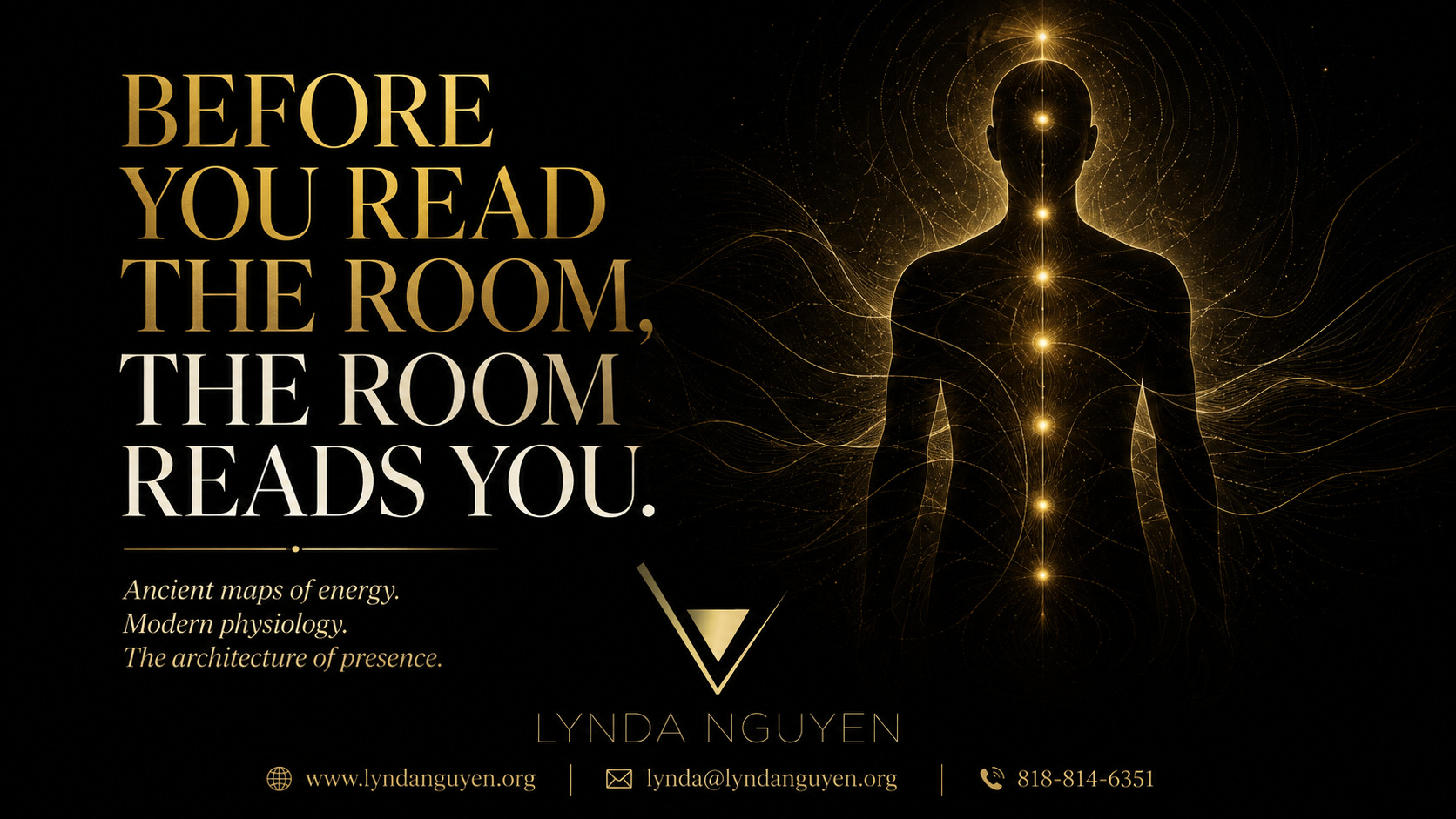
Before you read the room, the room reads you.
We know this intuitively. Someone walks into a meeting and the room shifts. Nothing has been said yet, but people straighten in their chairs. Or soften. Or become guarded. Someone else enters and somehow everyone settles.
We have dozens of ways of describing this.
Presence. Charisma. Gravitas. Vibe. Energy. Executive presence.
Sometimes we simply say, There’s something about her.
Human beings have been trying to understand that “something” for a very long time.
Long before I was coaching executives and TEDx speakers, facilitating leadership programs, or teaching teams how to navigate difficult conversations, I was studying another set of maps for understanding a human being.
During my intensive years training in Kundalini and Tantra Yoga in India, I learned to think about the human system through concepts like prana, chakras, and nadis: energy, centers, and the pathways through which that energy was understood to move.
This was not the brightly colored chakra chart that would eventually become ubiquitous in Western wellness culture. It was part of a much larger inquiry into consciousness, attention, embodiment, and the relationship between different aspects of ourselves.
One idea stayed with me in particular:
Where something becomes visible isn’t necessarily where it began.
More than a decade ago, I began incorporating some of this thinking into a program I called Activated Leadership, which I offered privately to dozens of executive clients.
The chakra system provided part of the architecture underneath the work.
But I learned fairly quickly that language matters.
Walk into certain executive rooms and begin talking about blocked chakras or nadis, and you may lose people before you’ve had an opportunity to show them why any of it matters.
So I changed the language.
I didn’t change the work. I learned to translate it. And as my own training expanded, I became more rigorous about distinguishing what I could measure, what I could observe, and what belonged to an ancient contemplative tradition.
The seven centers became seven remarkably practical leadership inquiries.
The root became safety and groundedness: what happens to our leadership when certainty disappears? The sacral became creativity and adaptability, our capacity to remain fluid rather than rigid under pressure. The solar plexus became agency and power: authority, confidence, boundaries, and our relationship with control.
The heart became connection and relational capacity. The throat became expression and congruence. The third eye became perception and discernment, including our ability to distinguish observation from the story we’re telling ourselves about it. And the crown became purpose and stewardship: what our leadership is ultimately in service of.
I wasn’t diagnosing executives’ chakras. I was using an ancient map to ask contemporary developmental questions.
What surprised me was how little resistance there was to the underlying inquiry once the vocabulary changed.
Over time, though, I wanted more maps.
I wanted to understand what we could observe, practice, and, where appropriate, measure.
HeartMath was also unusually close to home for me. One of my closest friends was part of the organization’s earliest C-suite leadership, so conversations about the heart, coherence, energy, and human potential weren’t concepts I encountered only through professional training. They had been part of the everyday language of my life for years.
When I became a HeartMath-certified practitioner and trainer myself more than a decade ago, I gained another framework through which to explore the relationship between physiological state, self-regulation, and what becomes available to us under pressure.
Heart-rate variability, or HRV, is the variation in timing between heartbeats. My work with HeartMath gave me a practical vocabulary for exploring HRV, physiological regulation, and what HeartMath describes as coherence: a more ordered pattern of heart-rhythm activity associated with synchronization among physiological systems. The electrical activity of the heart also produces a magnetic field that can be measured outside the body with sensitive instruments. I found that fascinating, but I became equally interested in not making it mean more than the measurement itself could establish.
What I could observe in my own work was more immediate: state changes how we show up. It changes breathing, pace, attention, facial expression, voice, our capacity to listen, and what we do next. Other people encounter all of that before we’ve explained ourselves.
Over the years I worked with trauma survivors in Los Angeles, veterans living with PTSD, and medical professionals who had spent careers learning to regulate everyone except themselves. Some had never been taught to use the breath deliberately as a tool for shifting state. They had never been taught that returning to coherence was a skill, or that the state they carried into the room became part of the heartbeat of the room, whether they were aware of it or not.
That work changed how I understood presence, not as a quality some people are born with, but as something that can be cultivated, practiced, and returned to even after the hardest moments.
HeartMath didn’t prove the ancient map. It offered a modern physiological framework for exploring some of the same questions humans have been asking for centuries.
That distinction matters to me.
Science isn’t something I want to sprinkle over an ancient tradition to make it sound respectable. Where research exists, I want to understand it. Where something can be measured, I want to measure it. Where something belongs to contemplative tradition, metaphor, or lived experience, I want to say that clearly too.
What fascinated me was the overlap in the questions.
What happens inside us under threat? What changes when attention changes? What happens when we become more regulated? How does internal state influence what becomes available to us next? And what do other people experience in our presence?
Across all of these frameworks, I kept returning to the same question: how does an internal state become an interpersonal experience?
My work coaching more than 70 TED and TEDx speakers gave me another laboratory for observing this.
Of course the words mattered. We worked hard on the words.
But anyone who has coached speakers long enough discovers that the words are never the entire transmission.
You can perfect the opening. Move the pause. Cut three sentences. Rehearse the gesture. Get the story exactly right.
And then a human being has to walk onto the stage and inhabit it.
Audiences perceive congruence.
They perceive whether someone is present or performing presence. They feel the difference between a memorized pause and an actual moment of contact. They notice tension, pace, attention, certainty, warmth, and whether the person speaking seems to believe the thing they are asking everyone else to believe.
Long before an audience consciously evaluates a speaker, it is already experiencing them.
Before you read the room, the room reads you.
Looking back, I realize how ordinary this language had become in my life. Another of my closest friends spent these same years immersed in chakras, energy, and plant-based healing through juices. These weren’t worlds I visited occasionally. They were conversations happening around dinner tables, on retreats, in trainings, and between friends while I was simultaneously translating many of the same questions into the language of leadership.
The more deeply I’ve worked across these disciplines, the less interested I’ve become in making their languages compete.
Different maps can reveal different things about the same complicated human being.
Sometimes energy is simply the word we reach for when we perceive the whole before we have consciously identified its parts.
Aura is another word humans have used for that perceived whole. Whatever its metaphysics, the word points toward an experience we know intimately: we encounter one another as more than a collection of individual behaviors. We encounter the whole person, often remarkably quickly.
She feels grounded. Something about him feels off. Her energy changed. He sucks all the oxygen out of the room. Everyone calmed down when she arrived. She lights up a room.
We often know the experience before we can name the mechanism.
That doesn’t mean every intuitive impression is accurate. Humans are also creatures of projection, bias, history, and pattern recognition. But dismissing the entire category because our perceptions can be imperfect misses something important: we are constantly affecting and responding to one another.
Leadership happens inside that exchange.
And this is where the ancient idea of pathways has continued to influence how I think about organizations.
I don’t believe corporations have chakras.
I do believe they have flow.
Information flows. Authority flows. Attention flows. Trust flows. Resources flow.
And when any of those repeatedly stop in the same place, an organization eventually develops symptoms.
The person who won’t speak up may appear to have a communication problem. They may need communication training. Or they may have accurately learned that speaking up in this particular system carries a cost.
The executive who micromanages may appear to need delegation skills. They may. Or underneath the behavior may be fear, identity, an inability to tolerate uncertainty, or an organizational structure that has made one person the bottleneck for every meaningful decision.
Where the symptom appears isn’t necessarily where the problem began.
Ancient systems taught me to pay attention to where energy stopped moving. Leadership taught me to ask where information, trust, authority, attention, or agency stopped moving.
That question has followed me into almost everything I do.
Over the years, the vocabulary of my work became more secular. I added behavioral frameworks. Physiology. Research on stress and regulation. Mediation and conflict practices. Somatic work. Decision-making. Organizational systems.
The language changed because the audience changed.
The work underneath it did not.
I was still interested in the whole human being.
Safety. Creativity. Power. Connection. Expression. Perception. Purpose.
And I was still interested in what happens when those dimensions work together rather than against one another.
I’ve come to think of alignment this way: not as some permanent state of perfect energetic balance, but as increasing congruence between what we believe, what we feel, what we say, what we choose, and how other people actually experience us.
After more than 15 years of doing this work, I’ve come to see the search for a single correct map of the human being as the wrong question.
The energetic traditions taught me to notice flow. Physiology taught me to notice state. Coaching taught me to notice behavior and presence. Organizational leadership taught me to notice systems.
Each catches something the others can miss.
And all of them keep returning me to the same place:
Leadership begins before the strategy, before the presentation, before the perfectly chosen words.
It begins with the human being who walks into the room.
Because before you have had the opportunity to read everyone else, they are already experiencing you.
The question worth asking may not only be whether you know how to command a room.
It is something considerably more revealing:
What becomes possible in other people when you arrive?