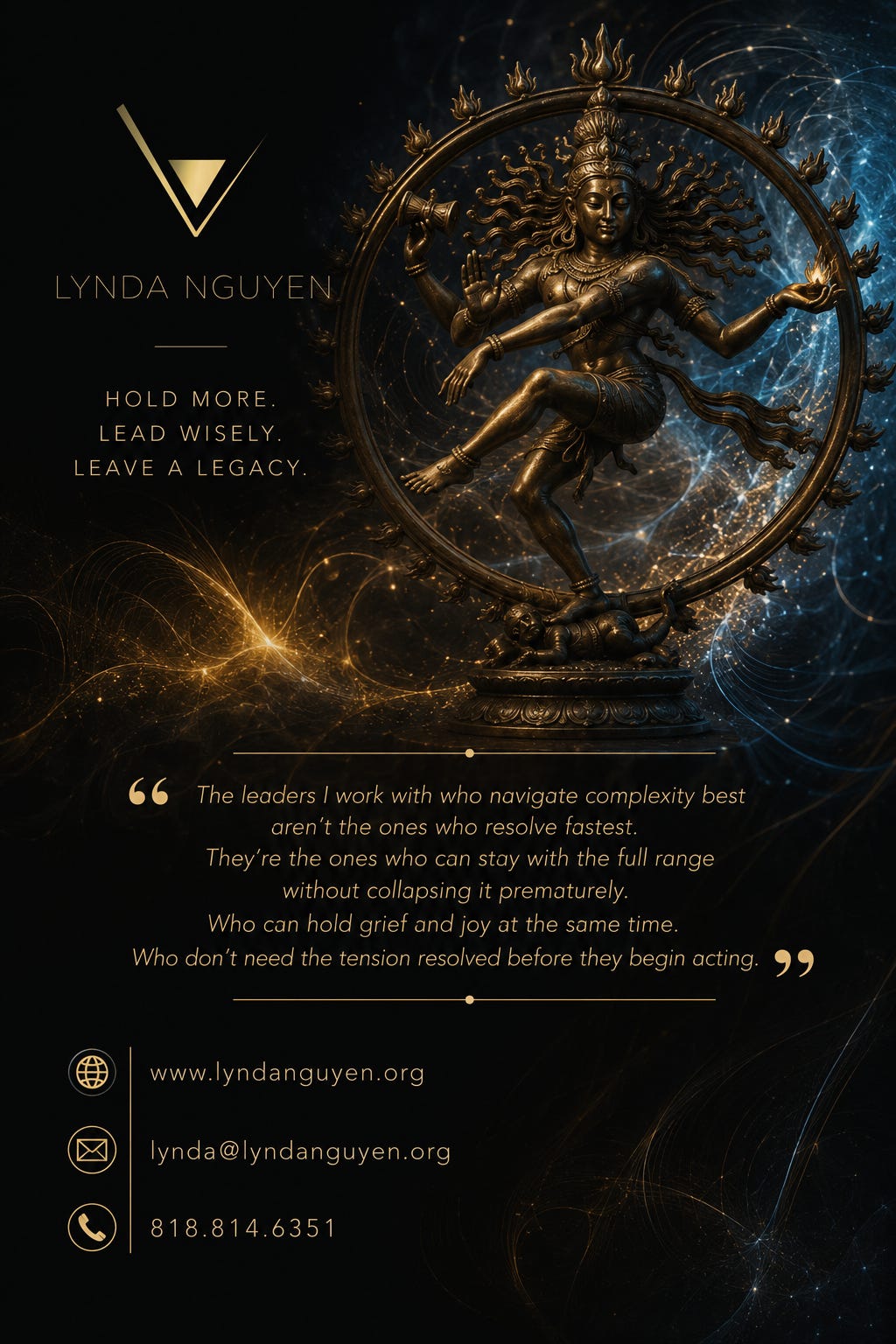

There is a 2-meter bronze statue of Lord Shiva outside the world’s largest particle physics laboratory.
India gifted it in 2004. CERN accepted it. They placed a plaque beside it with a quote from physicist Fritjof Capra explaining why a dancing god belongs outside a building full of accelerators and equations.
Nobody thought that was strange.
That’s the part I keep returning to.
I studied navarasa in India the year I held grief and joy at the same time.
Navarasa—nine rasas, nine fundamental states of human experience. Not nine emotions in sequence. Nine ways of being alive. Ancient Indian thinkers approached inner life with remarkable precision. They mapped consciousness with extraordinary care.
That year I realized it wasn’t a curriculum.
It was a diagnosis.
I had been trying to resolve the two states. File them separately. Finish one before allowing the other. That’s what we’re trained to do. Name it. Categorize it. Move on.
The rasas said no.
The full range is the point.
You don’t get to choose which ones show up. You only get to choose how much of yourself is available to meet them.
Nataraja isn’t depicting one emotion.
One hand creates. One destroys. One offers fearlessness. One points toward liberation. A ring of flames surrounds the dance. A small drum marks the first vibration—the sound before sound.
All of it.
Simultaneously.
Mid-dance.
Whether you see it as metaphor, intuition, or coincidence, it’s difficult not to pause at the symmetry. An ancient sculpture describing reality through dance now stands outside one of the world’s leading physics laboratories.
Modern physics has a concept called superposition.
A particle can exist in multiple possible states until it’s measured. Measurement changes what can be observed.
I don’t mean that human beings obey quantum mechanics.
I mean the metaphor is surprisingly useful.
We do this to ourselves constantly.
We collapse our own complexity.
Sitting in multiple states feels unbearable.
If I’m grieving, I should finish grieving before I laugh.
If I’m hopeful, I shouldn’t still be angry.
If I’m a leader, I should already know.
So we choose one story and call it identity.
Maybe that’s where we lose something.
Capra’s plaque at CERN says that modern physicists have chosen the dance of Shiva as their image for the dance of subatomic matter.
Not simply as decoration.
As an image that helps express something language struggles to hold.
The leaders I work with who navigate complexity best aren’t the ones who resolve fastest.
They’re the ones who can stay with the full range without collapsing it prematurely. Who can hold grief and joy at the same time. Who don’t need the tension resolved before they begin acting.
That’s not a spiritual practice.
It’s a leadership competency.
The work was never becoming less human.
It was becoming large enough to hold more of what being human already is.